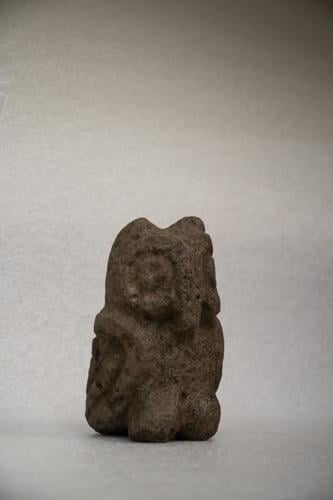
Lawrence “Larry” Hughes has gifted his collection of Gorge-area Native artifacts that numbers some 290 items to the Columbia Gorge Discovery Center and Museum. One piece is this small zoomorphic stone owl figure, which is in excellent condition.
Some of the items come with little provenance attached, and Susan Buce needs to research them. Larry Hughes did “a fantastic job of documenting where, when and from who” he acquired items, Buce said. “It’s been a very educational process for everyone who works in collections.”
Lawrence “Larry” Hughes has gifted his collection of Gorge-area Native artifacts that numbers some 290 items to the Columbia Gorge Discovery Center and Museum. One piece is this small zoomorphic stone owl figure, which is in excellent condition.
THE DALLES — Sixty years ago, a Native American maul sparked Lawrence “Larry” Hughes’ lifelong passion for archaeology, and started a collection of Gorge-area Native artifacts that numbers some 290 items. Now, he’s passing the collection on to caretakers at Columbia Gorge Discovery Center and Museum.
Museum Registrar Susan Buce received the donation in June and began cataloging items soon after.
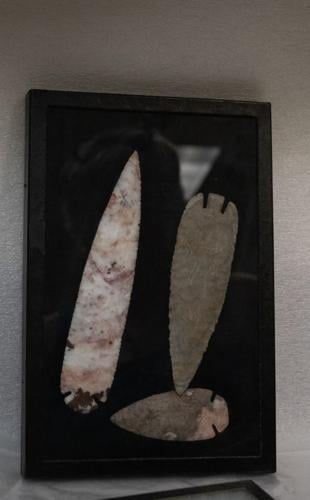
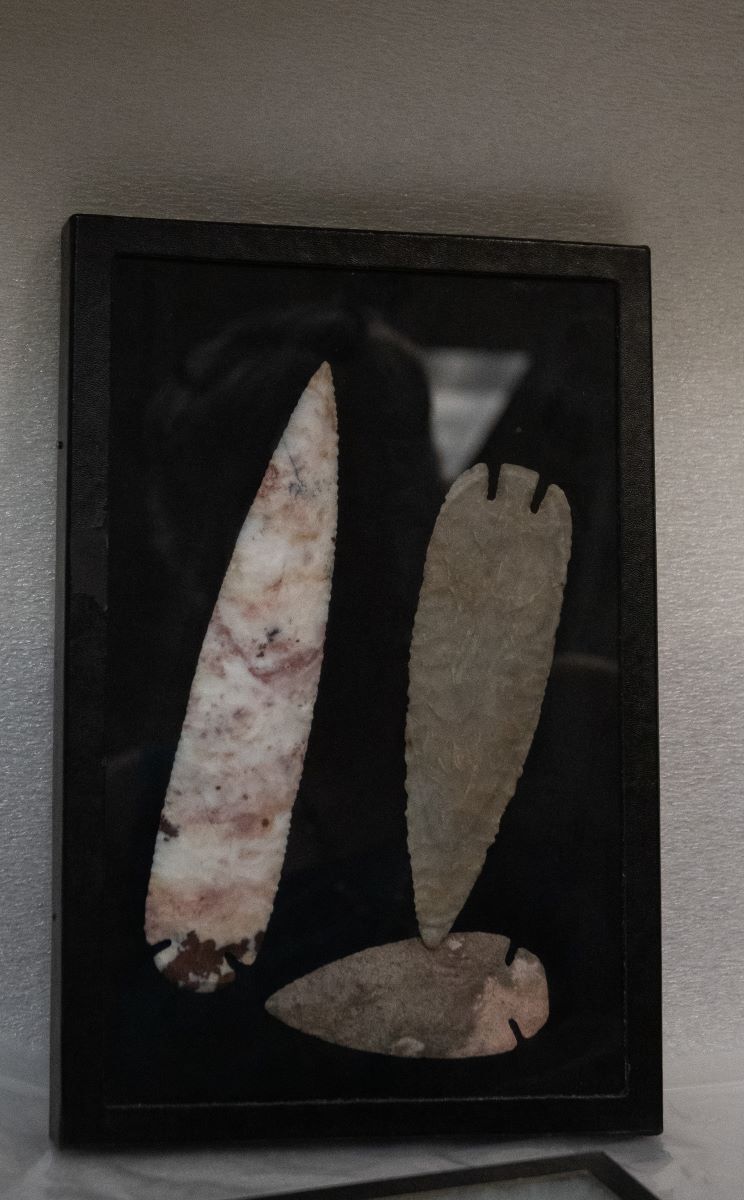
This collection is mostly stone tools such as scrapers, net weights, mauls, pestles and mortars. It also includes frames of arrowheads, including some projectile points that may have been used for spear-fishing or darts for bird-hunting. Other objects include stone tools, stone pipes and reprints of local Western art.
A large percentage of the stone tools come from the Columbia Gorge region belonging to the River People. Ancestors of people from both sides of the Columbia, from Warm Springs, Nez Perce, Umatilla and Yakima reservations, may have created the items, Buce said.
“My love for archaeology started when I was about 10 years old,” Hughes remembered. “I went to the library. And I started reading. The more I read, the more interested I got.”
Later, he operated Hughes Feed and Grain in The Dalles, which once stood where Optimist Printers is now.
“My first piece was about 60 years ago,” said Hughes. “My son came home from school. Some kid’s thrown a rock at him. And he picked the rock up and brought it home, and it was a maul.”
Hughes talked to the rock-throwing boy’s father, a tug-boat operator, about the situation. The incident happened during the construction of The Dalles Dam, and the boy’s dad had “a whole yard full” of Native American items. He gave the maul to Hughes, and a passion was sparked.
“The stone tools were really the ones that interested me,” Hughes added. “Each piece had something to tell you.” Emory Strong’s books on regional archaeology also fueled Hughes’s interest. Hughes said Strong’s belief that “the amateur archaeologists and the regular archaeologists could get along just fine” inspired him.
After building and caretaking the collection for decades, Hughes has now passed it to the museum. An array of artifacts are laid out carefully on Buce’s counters, waiting to be cataloged — a process she expects to take weeks. “It can take up to a half hour for each and every item,” Buce noted. “But this is my production line.”
Collector Larry Hughes acquired a number of projectile points.
Flora Gibson photo
“It’s amazing how much goes on behind the scenes,” said Adriana Thompson, who is working with Buce to catalog the collection. For each item, they document any provenance or history, and provide a collection accession number. They assess the item’s condition, measure it and photograph it.
A small zoomorphic stone owl figure, a carving from the Gorge region, stands out to Buce.
Buce assesses the condition of each item. The owl, for instance, is in excellent condition, with no fractures, and “spectacular” carving, Buce said. The owl, like every item, received a collection accession number.
The collection contains a few non-local items, but most were acquired from the Gorge region.
This collection was made before the advent of new laws in the 1970s, which are designed to prevent the disturbance and looting of sensitive cultural sites, a major problem in the Gorge. Collecting such items has been illegal since 1970s. Violators are subject to penalties which include property forfeiture, fines up to $100,000 and up to five years imprisonment.
The local items will reside in the museum’s over-flowing storage and displays. “We are going to display some of them in our Community Chest exhibition, then replenish some of the exhibits in our Native Living exhibition. ... When you have things that are standout examples of what you’re doing, then you want to refresh your displays,” Buce explained.
Some of the items come with little provenance attached, and Buce needs to research them. Hughes did “a fantastic job of documenting where, when and from who” he acquired items, Buce said. However, those collectors he acquired from often did not. “It’s been a very educational process for everyone who works in collections.”
But Hughes didn’t always know where other collectors first picked up the items they passed on to him. “It’s very challenging when you don’t have that breadcrumb trail of history,” Buce said. As an example, she pointed out a stone matate, which could possibly have been used to grind corn. This could be from outside our region, but she’ll need to do more research on similar tools.
The lack of provenance reflects the fact that there were fewer rules about collecting at the time, resulting in items being taken, without permission, compensation or good record keeping.
Hughes’ items mainly came from other collectors. “Around that time [the construction of the dams] there was a dozen collectors with real fine collections in that area,” he said. “It just seemed to grow after I got started.”
Some people gave him their objects outright, others sold to him. “A lot of people wanted to know that the objects would be displayed,” he said. “Or they had been in closets and on the shelf at home and nobody ever saw them.”
Some of the items come with little provenance attached, and Susan Buce needs to research them. Larry Hughes did “a fantastic job of documenting where, when and from who” he acquired items, Buce said. “It’s been a very educational process for everyone who works in collections.”
Flora Gibson photo
One group of non-local items came from Colonel Elder, the resident engineer for The Dalles and John Day dams. Elder, like many, passed the items on to Hughes after acquiring them himself. “I never really got the thrill of finding an object, but I got satisfaction of protecting and storing them. But there came a time when I no longer could protect them,” Hughes explained. “Time to pass it on to the next generation.”
Hughes knew the Discovery Center well. “When they first organized, I was a volunteer and built birdhouses for them,” he said. He later donated 125 pieces to the museum. “So I felt that they would keep the collection in this area, where it came from.”
Buce said the museum hopes to work with Native American partners to determine how the museum can better interpret their history, including this collection. One project is to update the museum’s signage, and ensure the new Native American items are exhibited with respect for their cultural significance and educational value.
“We’ve got goals in our strategic plan that we have not yet met ... to do a better job of displaying signs that interpret what visitors are seeing,” Buce said. “But those are ongoing goals. And I’ve come to the conclusion I’m not going to live long enough, it might take 100 years to do a proper job of this. But we want to do the best job we can to tell the story of everybody who has had a hand in the history of shaping this region.”
The cultural and educational value of the new collection is paramount, Buce noted.
Hughes said he thought of himself as a caretaker of the collection. “I enjoyed it. I collected it. I showed it. I displayed it. And I protected it,” he said.
Hughes, who remembers the Columbia River before the dam, said that this idea was very present for him in childhood. “Before the dams backed the water up and inundated this country, we would go out and we could spear fish below where the Indians were dip-netting,” he recalled.
“This is not the story of white people who came into this area,” Buce stated. “This is the story of how a culture existed here for tens of thousands of years. And the impact that the immigrant community had, as they came through and settled into the area. There’s a bigger story than just the little bit that we’re taught in school.”



Commented