
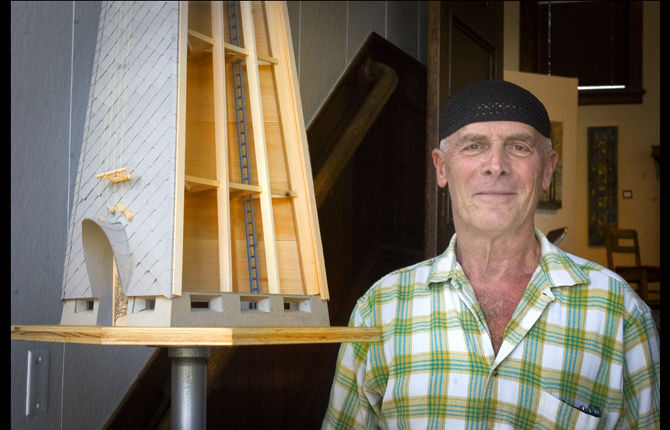
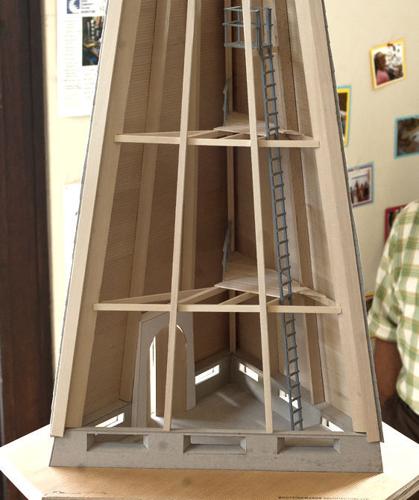
Someday, Randy Hager hopes to build a fantastical structure: a 47-foot tall, three-sided, walk-in musical instrument whose four strings are “played” by the breeze.
The nearly five-story triangular building would have a 500-square foot base where the public could go inside and feel the healing vibrations emitted not only by the strings strumming outside, but by the chiming of three crystal bowls hanging from the violet stained-glass ceiling.
Called “The Bell Tower Project,” Hager had a model of his vision made by a Portland architect. It has been on display at The Dalles Art Center, ‘Art on Oak’ in Hood River and was recently shown to the White Salmon City Council, mayor and city engineer.
The base of the building has three 24-foot sides, tapering to 12-foot sides at the top. Light will come in through golden stained glass windows around the bottom, etched glass doors, and the stained glass ceiling.
A retired builder, Hager moved to The Dalles in 1999 from the Sandy River area. A Renaissance Man of sorts, he sculpts, writes poetry, and was a professional proofreader.
What he isn’t, is a musician, but that hasn’t stopped him from pursuing the dream of a walk-in musical instrument, a notion that started niggling in his mind some 30 years ago.
At that time, he’d built himself a round house, which, he said, had “very specific and unusual sound characteristics inside of it due to the fact that I built it according to certain number factors. And I just saw that it was possible to imagine a building that sounded, by its own accord, inside at all times.”
“Instrument strings on the exterior caressed by the wind orchestrate harmonic resonance within, similar to the sound of the East-Indian stringed instrument tamboura, where listeners are benefitted in the deep quiet of the tower’s interior,” a brochure on the Bell Tower states.
And his bell tower won’t produce just random sounds, but specific notes. “There’s four musical notes that neurologists now know are the consistent sounds of the human brain’s neurological and synapse function that the nervous system uses to keep itself in harmonic balance.”
As to what those four notes are, Hager is keeping those to himself.
He said the tones emitted by the building will be “an orchestration of sound that’s of service to us.”
For Hager, the project represents decades of imagining, pondering and tinkering with ways to make it a reality. “Sometime around 1980 I started working on this whole sound philosophy,” he said. “The language of the brain, all nerves and synapses, is all musical notes.”
For 46 years, Hager has followed the Maharishi Mahesh Yogi, who became famous as the Beatles’ guru.
The Maharishi’s teachings are “basically an observation of the human nervous system based on the laws of physics,” he said. “It just has to do with the factors of the brain that are known to attune to sound.”
The 30-foot long strings on the Bell Tower can be strummed with just a gentle breeze going one and a half miles per hour, Hager said.
They “are specific strings that vibrate easily and generously,” he said. They make what he calls a “drone sound,” or a background sound. The strings will run from above the door of the building to the top of the building.
Right now, he’s working on mechanical factors that will transmit the sound from the strings, across the bridge, and into the bell tower.
The tower will feature timber sourced from Glenwood Valley Timber, owned by Blair Simpson, and the exterior will be covered in 15,000 pounds of stainless steel, which is nonmagnetic.
“I don’t want magnetic fields set up that disturb anything or cause other sounds to happen,” Hager said. “In a way it’s kind of guesswork. I have to take the information I know inside and apply it the best I possibly can to keep magnetic factors from showing up in the building, causing corrosion.”
The three crystal bowls in the crown of the building will each have a different thickness to create a different tone. A caretaker will be the only one able to play them, by pulling a chord hooked to a felt-tipped hammer.
The crystal bowls have “lasting harmonic qualities, resonance qualities,” he said.
He also wants to have a caretaker’s house, plus public restrooms, next to the bell tower.
He is looking for three to five acres to house the bell tower and said, “There’s been interest in several sites in the state and that’s why I’m making this request right now, to make site and funding appear,” he said.
A Portland architect firm, Scott Edwards Architecture, has created the model and drawings, and Hager has lined up builder Mike Butterfield of Mosier to be the general builder.
“He said, ‘I’d go anywhere on the planet to build that.’”


Commented