
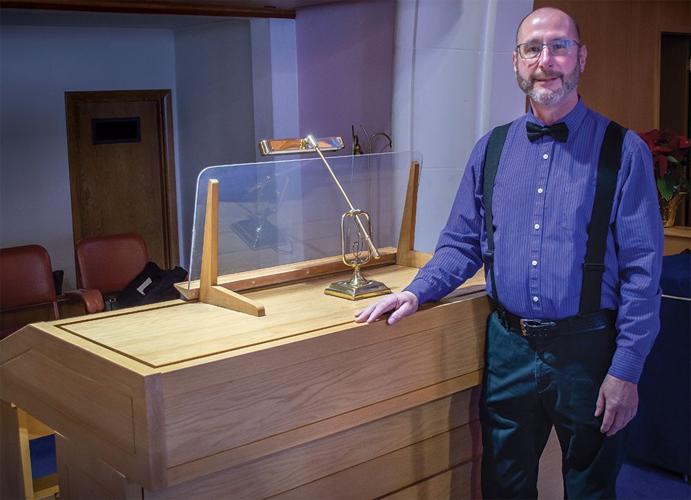
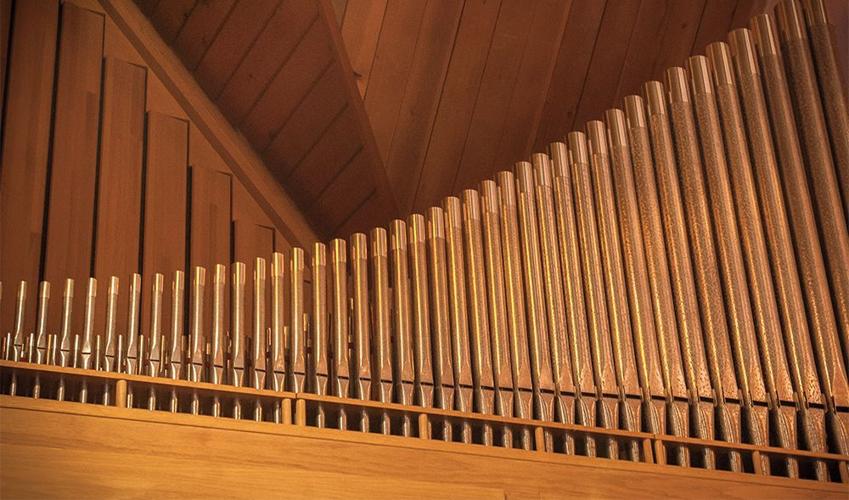
A 61-year-old man operating the instrumental behemoth that is a pipe organ: Two hands and two feet eloquently dance across the two keyboards and the two-and-a-half octave pedal board to sync 18 straight ranks (sets of pipes) in an endless array of rhythms and songs. His music is one moment a structured, pacing tune, the next a chorus of liberation and creativity.
Garry Estep is his name, and he has transformed the role of organist at Zion Lutheran Church, using music to accentuate the experience of the congregation every week.
“Music taps directly into the emotional center of the brain,” said Estep. “You can make people feel what you want them to.”
His road to Zion was filled with wildly different experiences and hardships, all of which culminated in his arrival in The Dalles.
Born and raised in Cincinnati, Ohio, Estep was one of seven kids. With a crowded household to tend to, his parents couldn’t afford piano lessons, but they did gift him a chord organ at the age of 11. From there, his aptitude for the piano, and music in general, began to display itself.
“I borrowed a hymnal from a local church our family went to and started reading the notes and associating them with the numbers on the keyboard,” said Estep. “I essentially taught myself to read music.”
Estep transitioned to the piano, a much different instrument despite their perceived similarities, at age 15. His musical talents and passion discovered, he began his pursuit of a musical career by attending Ohio State University’s School of Music from 1975-1979.
Following his graduation, Estep gained experience performing pipe organ for weddings, composing music for theatre productions and touring around the nation and into Canada with musical group “Celebration.”
Eventually winding up in Nashville, Tennessee, Estep worked for Vanderbilt University’s Blair School of Music, the Nashville Ballet, and the Nashville Opera.
Then, in 1990, he stepped away from professional music for medical reasons. “I actually began getting arthritis in my hands and wrists around age thirty-three,” he explained.
A new path came from Estep’s professional retirement from music, as he received a Bachelor of Science degree, summa cum laude, from Middle Tennessee State University after majoring in Computer Science and Physics from 1991 through 1995. He continued on the education path, immediately beginning work on a master’s in physics with an emphasis in space plasma physics from the University of Alabama Huntsville in 1998. He received a NASA fellowship from the Marshall Space Flight Center as well, and though his career as a musician was over, Estep was far from done playing; in fact, he preferred the change.
“That made all the difference in the world for me, to transition from playing music professionally to playing because I wanted to,” said Estep.
Happy with music as his hobby, Estep delved into the world of engineering, beginning with Boeing as a systems engineer, where he found himself working in Alabama, Colorado, California and Virginia. During that time he endured an 8 month fight against Hodgkin’s Lymphoma, a form of blood cancer, which he overcame through chemotherapy and radiation treatment.
In 2011, he took a job with Insitu, Inc., as a senior systems engineer. Once here, as he had before, Estep looked for opportunities to share his music with the community.
In 2017, he began performing at St. Paul’s Episcopal Church as a part-time pipe organist. From there, his notoriety spread to Pastor Tyler Beane at Zion Lutheran Church.
“Pastor Tyler needed a substitute organist, so he asked me, and I substituted for a couple of days,” said Estep. “After a few sessions, the regular pianist hinted at me that I should apply for the position. I met with the pastor and the board, and lo and behold, now I’m the organist.”
The vacancy for organist at Zion came with the passing of the beloved Phyllis Ann Ronfeld, who had grown up attending the church and who held the position of organist for 70 years. Estep acknowledged the legacy Ronfeld left behind and what it was like coming in after she passed away.
“I was a little apprehensive to begin with,” said Estep. “You have a congregation that for 70 years they loved her music, loved her playing and loved her as a person. People grew up with her there; people died with her there; it was kind of intimidating to take over at first.”
Though nervous about how he would fit in, Estep was not swayed from performing in the styles he’d learned all his life. Trained in a bevy of musical genres, he was prepared to offer Zion the entirety of his musical repertoire, even if it meant creating the tune as he went.
“What I love about playing here is the creativity,” said Estep. “With the music here you have a prelude, a postlude, sometimes an offertory—I make the music up for those. I rarely have music in front of me because it’s easier for me to just noodle around.”
Estep’s “noodling around” certainly seems to have made an impact on the congregation. Since beginning just a few short months ago, Estep has been approached by dozens of people complimenting his upbeat, jovial sound and commenting on the additional joy they’ve received while at service. Hearing those kind words means the world to him.
“That’s what it’s all about,” said Estep. “I feel grateful when they say that. The fact that they’re expressing that to me means a lot. I tell people all the time, I’m so grateful that they allow me to come and play for them.”
When he’s not working at Insitu or grooving with Zion congregates, Estep focuses on his other passion—theatre. Having performed on stage at various points throughout his life, Estep has familiarity with theatre production; it was this experience and the desire to perform that motivated him to establish a non-profit known as Serious Theatre.
“I wanted to do Pulitzer Prize-winning plays, so I formed my own non-profit organization last year,” said Estep. “It’s been great so far, and I’m proud to say we have a $500 scholarship we’re awarding to a graduating senior this year.
It’s safe to say that Estep will be sticking around for a while, involving himself in the arts by pursuing his passions and sharing them with any and all. His love for performing aside, Estep views his artistic talents and the service they provide, the happiness they instill, as his way of helping the community.
“Doing this for the church, doing Serious Theatre, for me it’s a way to give back to the community.”


Commented