
THE DALLES — In the weeks since the Rowena Fire raced across the bluffs west of The Dalles, destroying 61 homes and 91 outbuildings, the community has faced a question: where will people live, safely, while they rebuild?
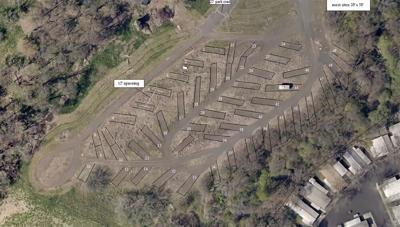
County planners have now put forward an option. An application filed under the Columbia River Gorge National Scenic Area rules proposes converting two county-owned parcels on the northwest edge of The Dalles into a temporary neighborhood, specifically for individuals displaced by the fire.
This grid of up to 49 parking sites is sized to accept RVs, manufactured homes or tiny homes, anchored by an existing farmhouse that could also be used for shelter. An overflow parking area is also included in the proposal.
“The planning division has been actively working to expedite recovery since pretty much a day after the fire,” said Planning Director Daniel Dougherty at the Aug. 20 meeting of the Wasco County Board of Commissioners.
The plan, described as an emergency measure rather than a long-term redevelopment strategy, is built around a reality laid bare in the fire’s aftermath.
“The full scope and breadth of that damage and destruction is not yet known, but we do know there is significant damage to essential infrastructure. It’s left numerous households without safe, stable, permanent housing,” said Dougherty.
Housing sites won’t be permanent
The application asks for permission to use two tax lots, one 155 acres and the second about 4.4 acres, as grounds for an Emergency Temporary Housing Community.
Each parking site can accommodate up to 15-feet by 55-feet (825 square feet) structures and allow the county to inspect, repair, replace, maintain and operate existing utilities on the property.
Dougherty noted that the planning guidelines for this site are drawn from the county’s codes for RV parks, but that does not mean the site will ever be used for recreation in the future.
“I want to stress that it’s not an RV park,” he said.
For infrastructure, the planning division sought approval to run above ground utilities, including mobile generators and generator lighting units, black and grey water tanks, [and] potable water tanks.
Additionally, Dougherty pointed to existing utilities from a previous RV park on the site, though the county is currently uncertain about their condition. Using these lines would be preferable to the noisy and expensive above-ground stopgap utilities.
National Scenic Area rules come into play
Under the National Scenic Area ordinance, the proposal falls within “post-emergency/disaster construction” clauses, meaning these protected natural areas are still allowed to serve in the community’s wildfire recovery.
Still, resource protection guidelines add additional steps to the site’s construction.
Located near the fish-bearing Chenoweth Creek, the proposal requires buffers and consultation under scenic-area rules. County staff wrote that they will notify the Oregon Department of State Lands and the Oregon Department of Fish and Wildlife, and implement all reasonable mitigation measures those agencies require.
The county also noted that it is siting the temporary community out of public view.
“The proposed Emergency Housing Area will be clustered in the southwest corner portion of the property, and not visible from applicable KVAs,” the application says, referencing “key viewing areas,” or vantage points central to scenic-area compliance.
A community in limbo
The county’s application specifically identifies lack of housing in the wake of the fire as a public safety risk.
While full demographic statistics have not been fully collected, the application identifies vulnerable populations impacted by the Rowena Fire, including “elderly, non-English speaking populations, and low or fixed income households.”
Extreme heat compounds the risk, as do the effects of sudden displacement: “The loss of permanent housing has increased the number of houseless people … [and] lack of safe, permanent housing can cause extreme stress and can exacerbate existing mental and physical health conditions or trigger new ones.”
The application stakes that claim directly: “The Emergency Housing Area will provide a location for the placement of housing and other accessory structures that are necessary for ensuring continued public safety from homelessness for IDPs (internally displaced persons). It will also ensure that Wasco County mitigates further harm and/or loss of life and property for persons impacted by this disaster.”
In Dougherty’s telling, the five-year recovery window is not overly long. The fire damaged wells, tanks and septic fields, slowing down the return process, even for those who intend to rebuild on their lots.
In his and Community Development Director Kelly Howsley-Glover’s research, Dougherty solemly noted that only 25% of homes destroyed by wildfire were rebuilt within five years.
“Long-term recovery may take half a decade,” Dougherty said.
For more information about Rowena Fire recovery, visit Wasco County’s website, www.co.wasco.or.us/departments/emergency_management/rowena_fire_long_term_recovery_group/index.php.


Commented