
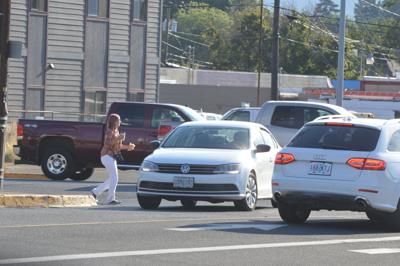
Heights urban renewal comes back on the city’s front burner this month with a public meeting that could largely determine the course of long-discussed improvements to the commercial district south of downtown.
The Heights Urban Renewal Advisory Committee will meet Aug. 22 hear a city staff proposal to accept a $494,000 contact with Seattle-based engineering firm MIG to conduct engineering and design and come up with a concept plan for improvements to the Heights streetscape, with the actual work likely to be done in 2021-22. Funds will come out of tax contributions by businesses in the Heights Urban Renewal District.
The meeting happens via Zoom at 5:30 p.m.; see the city website, cityofhoodriver.gov for details on how to remotely attend the meeting.
In 2017, the Urban Renewal Agency hosted a series of community events to prioritize Heights Urban Renewal Plan projects. These meetings included open-ended options for the public to propose new ideas. Studying traffic flow modifications on State Highway 281 (the 12th-13th couplet) was a common request.
Dovetailing on the Agency hosted events were grassroots events, including a “Walkshop” facilitated by Blue Zones, LLC and streetscape demonstration projects as part of an Open Streets event. These community events heavily emphasized modifying traffic flows on Highway 281.
While popular in these community driven forums, the adopted 2011 Heights Plan does not include modifications to traffic patterns as a funded project, according to Will Norris, city finance director.
In 2019, the city had entered a contract with the firm Greenworks to proceed with Heights planning, but Norris said the contract was dissolved by mutual agreement.
MIG received a similar rating as Greenworks and was invited to submit the proposal now pending.
The proposed contract sets out a year-long process to work with the Urban Renewal Agency (URA) to establish a comprehensive plan for improving 12th and 13th Streets and the intersections and streets that tie the couplet together at the north and south ends of the Heights District (May and 13th streets and May and 12th streets, and Belmont/Union Street).
This project will address proposed improvements documented in the 2011 Heights District Urban Renewal Plan as well as recent URA and community conversations related to traffic safety, community identity, and other city and stakeholder goals.
The proposed MIG contract includes $415,373 in professional fees and another $12,000 in payments to subcontractors including Klein and Associates of Hood River.
The design process for this project will occur in three distinct phases. At the completion of Phases 1 and 2 the consultant will prepare an executive summary memorandum that summarizes outcomes and key findings from tasks completed in that phase. This memorandum will be used as an “approval” package to be accepted and approved by the URA prior to moving to the next phase of the project.
Phase 1 — Establish project vision and foundation: cataloging existing conditions and develop a base map of the project area to support work to be completed in Phases 2 and 3.
Phase 2 — Concept development: Develop preliminary concepts and an approach to evaluate concepts based on the community’s vision. The outcome of Phase 2 will be the recommendation of the preferred concept based on a quantitative and qualitative evaluation of the preliminary concepts.
Phase 3 — Develop Preferred Concept and Action Plan: This phase includes tracking changes or additions to show how the Transportation System Plan needs to be changed to accommodate or include the Heights "preferred concept," according to Norris.
The consultant would be responsible for arranging and conducting the extensive public outreach required by the city. The consultant, working with the city, will develop a “doorhanger” flyer that will be distributed to area businesses and residences adjacent to the project area, and with assistance from Next Door, will visit businesses and residents along the corridor to discuss the meeting, confirm contact information, and provide flyers. Consultant assumes door knocking will occur on one day and take place one-two weeks prior to the public meeting. Flyers will be translated into Spanish.
MIG will present a kickoff workshop and coordinate with the URA (Joint Advisory Committee) and project team during active periods of the project to track project progress, scope and schedule. An initial project schedule will be developed prior to the kickoff workshop.
The consultant will coordinate with the City, URAB and URAC to identify up to eight individual or small group meetings to be interviewed by the Consultant. The goal of these meetings is to engage people who could have a significant influence on the project. The stakeholder meetings may include representatives from City Council and Planning Commission, local neighborhood and community groups, the Chamber of Commerce, Rotary, development experts, landowners and business owners, and other stakeholders. In-person Spanish translation services will be provided. The dates for the public engagement steps have not been scheduled.The intent of the interviews is to gain information on the state of the corridor, considerations moving forward, including discussion of public engagement results to date that are relevant to the discussion. Up to two meetings will be translated into Spanish by Next Door.
The approximate two-hour public workshop will introduce the project, verify visioning from kickoff workshop and provide interactive exercises for meeting participants to identify opportunities and constraints along the corridor.
Klein & Associates will perform a survey of the project area. The survey will include horizontal layout from back of sidewalk to back of sidewalk and include sidewalks, curbs, curb laydowns for driveway and ramps, and the painted centerline of streets. In addition to hardscape the survey will locate landscape boulevards and visible utilitiesincluding power poles, power lines, water valve and fire hydrants, storm drain inlets, catch basins, trees, and manholes.
The traffic analysis will evaluate the impacts to auto, freight, transit, bicycle, and pedestrian modes of travel associated with the alternatives.
Traffic study outcomes will respond to the evaluation criteria and include assessments of mainline and side street auto delay, accessibility and safety for large vehicles, need for turn lanes and intersection capacity improvements, potential diversion of traffic to surrounding city streets, qualitative analysis of pedestrian and bicycle facilities quality of pedestrian crossing improvements, relative improvements to safety, and compatibility with transit.


Commented
Sorry, there are no recent results for popular commented articles.