
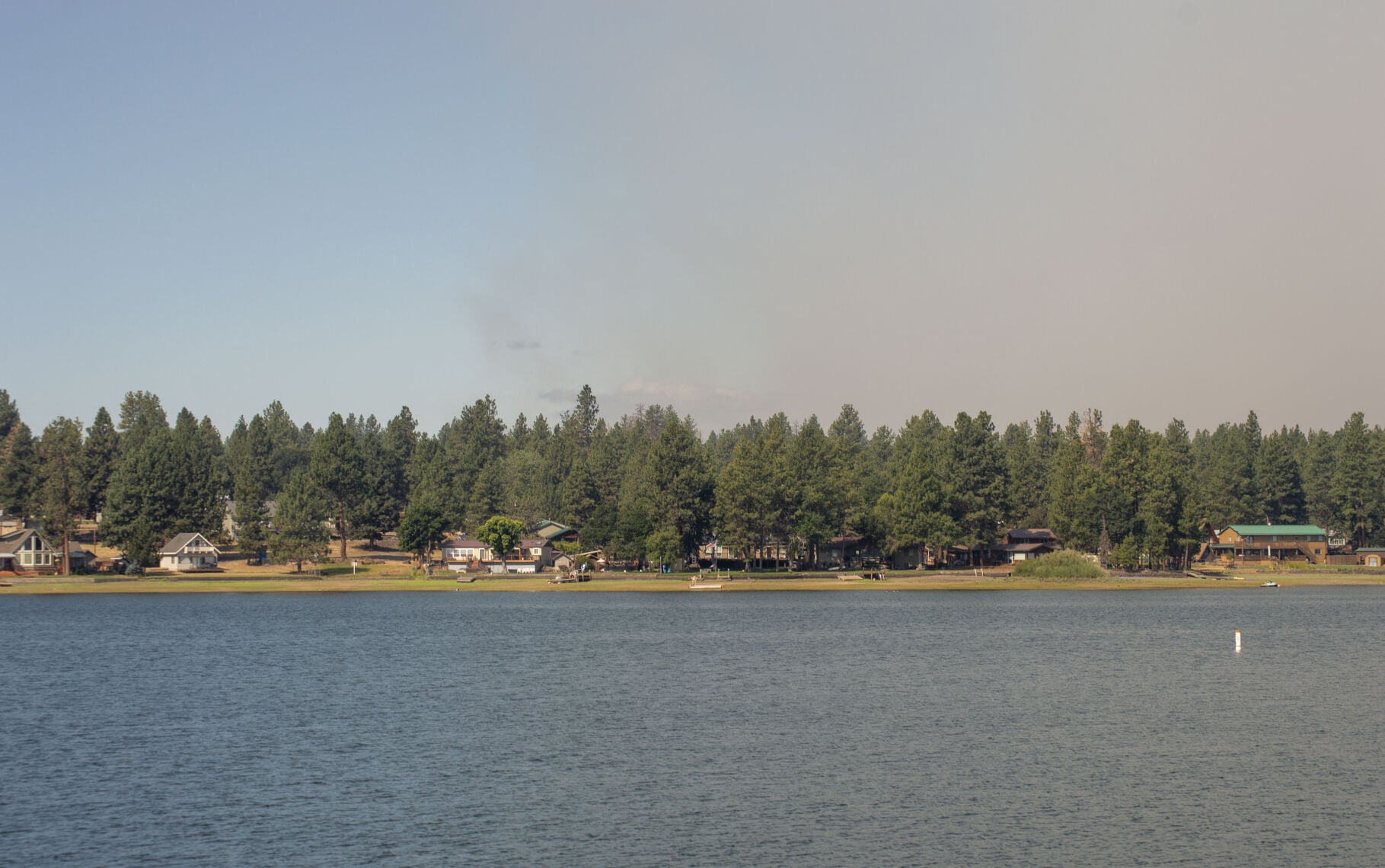
As I write this, the Grasshopper Fire is burning intensely through the place I call home. It has burned several hundred acres of my family’s land and, while we are fortunate that our homes are still standing, some of our neighbors cannot say the same. At least six homes and 15 other structures had been destroyed, with damage assessments continuing. And it isn’t over yet.
It has threatened the Highland Ditch and several thousand acres of irrigated farmland that depend on it. It has threatened communities including Pine Hollow, Sportsman Park, Friend, and Dufur, among others. It has forced the Wasco County Fair elsewhere, ended Mt. Hood Meadows’ summer season early, and placed Camp Baldwin and the surrounding area under evacuation precautions. Countless farmers, ranchers, community members, volunteer firefighters, and others continue to work through this crisis alongside the state, federal, local, and international resources assigned to the fire.
What is happening here needs to be talked about, and it cannot continue to be reduced to the familiar argument over logging, environmentalists, or a single lawsuit. There is a deeper problem, an underlying current that is overlooked because it spreads responsibility across administrations, institutions, and a span of seven years. This land, this forest, had a plan in place to reduce the risk of wildfire, and the processes responsible for seeing this plan through could not move at the speed required to address the very risk the project was designed, in part, to reduce.
Recognition vs. reality: a seven-year gap
The Grasshopper Restoration Project began back in 2019. The Forest Service identified several purposes for the project, including enhancing and restoring forest diversity, reducing risks associated with high-intensity wildfire, improving wildlife and aquatic habitat, and providing timber and other forest products. It was not developed without the participation and input of the public; it moved through the Forest Service’s formal scoping, comment, and objection processes.
The project authorized roughly 5,300 acres of commercial and non-commercial thinning, along with prescribed fire and other fuels treatments within the project area. The broader Mt. Hood landscape was subsequently designated as one of the Forest Service’s national Wildfire Crisis Strategy priority landscapes in 2023. The Wasco County Forest Collaborative had worked with the Forest Service for years to develop a pipeline of restoration projects on the Barlow Ranger District, including Grasshopper. Local stakeholders and federal land managers had recognized the problem and then spent years deciding what should be done about it. What they did not have was a system capable of starting, let alone finishing, the full project before the risk materialized.
The timeline of this project is important to consider in its entirety as it progresses through a series of phases. The first phase, Scoping, began on July 15, 2019, followed by the formal comment period that began on Feb. 18, 2022. Seven months later, on Sept. 2, 2022, the object period began. The Forest Service finalized and signed the decision on Jan. 11, 2023. In June 2023, Oregon Wild filed suit and initiated the litigation that spanned 19 months and settled in January 2025. The Grasshopper Fire started on July 23, 2026, approximately 18 months post-settlement.
It took nearly three and a half years for the project to move from scoping to final decision, and this was prior to the litigation. Unfortunately, this timeline is not unusual. Research examining Forest Service fuel-treatment projects found that, from the initiation of environmental review, mechanical treatments took an average of 3.6 years to begin on the ground, while prescribed burns averaged 4.7 years. That this timeline is considered normal should concern us far more than any single delay.
Pointing fingers, assigning blame: who is responsible?
There has been significant attention placed on the lawsuit filed by Oregon Wild, and that lawsuit accounts for approximately 19 months of the seven-year history of this project. Oregon Wild challenged commercial logging provisions affecting mature and older forest. The organization alleged that the Forest Service had failed to adequately account for impacts on mature forest, northern spotted owl habitat, carbon storage, carbon emissions, and other climate-related concerns.
The settlement resulted in tangible changes. The Forest Service withdrew treatment Units 161 and 204, reduced treatment intensity in other units, established diameter limits for trees removed under the project, and adopted additional protections for cedar, Pacific yew, and oak. The federal government also agreed to pay $55,000 in attorneys’ fees and costs under the Equal Access to Justice Act. Oregon Wild has since emphasized that it did not seek to stop all fuel reduction within the project, and it reports that 98.4% of contracted non-commercial mechanical work was completed.
Despite Oregon Wild’s arguments and its role in the project’s litigation history, the central problem remains unresolved. The litigation lasted approximately 19 months and does not explain the three and a half years preceding the final decision, nor does it explain why, according to Oregon Wild’s own account, the commercial timber component still had not been offered for bid more than 18 months after the settlement. Oregon Wild states that the Forest Service had yet to take that first step as of August 2026. By the time the Grasshopper Fire ignited, the legal dispute had been resolved, and the settlement expressly allowed the Forest Service to continue with all other planned activities authorized under the Grasshopper Project. Yet another year and a half passed.
There were other extenuating circumstances that affected this project. The COVID-19 pandemic consumed much of the time between scoping and decision, while Oregon and the Mount Hood region experienced an extraordinary 2020 wildfire season during the same period. More recently, the Forest Service experienced a dramatic reduction in its workforce. A 2026 Government Accountability Office review determined that the agency’s workforce decreased by approximately 20% in 2025. Forest Service officials told GAO that staffing challenges were already limiting their ability to plan, prepare, and implement timber sales and that the 2025 reductions further strained that capacity. Officials in six Forest Service regions specifically told GAO they needed more staff to plan and prepare timber sales.
We cannot gloss over the fact that an agency tasked with managing and mitigating wildfire risk across federal landscapes cannot do so effectively while losing a fifth of its workforce, just as a project cannot be implemented while it remains caught in environmental review or litigation.
There is no single factor that explains the seven years; an accumulation of factors does. Every participant in this project’s history can identify a period in which someone else was responsible for its forward movement or delay. When examined individually, many of the explanations currently circulating are reasonable. Taken together, they describe a system that allowed seven years to pass between the beginning of planning for a wildfire-risk-reduction project and the fire that overtook the landscape before the full project was implemented. This is an institutional failure in which responsibility is distributed across multiple institutions, decisions, and years.
Environmental consequences cannot stop at the lawsuit
The environmental consequences associated with that seven-year period deserve the same level of scrutiny. Federal environmental law has developed different systems and processes for evaluating what an agency proposes to do. Agencies, such as the Forest Service, are required to measure acres and tree diameters, evaluate wildlife habitat and the projected carbon effects of the project. They are also required to prepare environmental analyses that discuss these considerations, solicit public comment, respond to objections, and defend their decisions in court if and when necessary. These protections exist for good reason, particularly on public land.
The system, however, has no comparably effective mechanism for assigning a cost to elapsed time. Another year spent on environmental analysis can appear administratively neutral even as the underlying project is intended to address wildfire risk. Delay remains an abstraction until the risk itself materializes. Once that happens, the costs move quickly from hypothetical to actual. We are now faced with suppression expenditures, evacuations, damaged habitat, threatened water infrastructure, agricultural impacts, private property losses, post-fire recovery costs, and more.
Oregon Wild’s objections rested in part on questions about carbon storage, mature forests, and northern spotted owl habitat. Those questions still mattered on July 23 when the Grasshopper Fire started, and in fact they became more urgent. When this is over, we need to know how much of the contested habitat burned and at what severity. We need to know what happened to live-tree carbon within those stands, how much future sequestration capacity was lost through mortality, and how previously treated areas performed compared with untreated areas. These questions should be answered empirically, not rhetorically. Fire severity varies, and the Forest Service’s own post-fire assessment program measures changes in live basal area, canopy cover, and burn severity after major wildfires precisely because the effects within a fire perimeter are not uniform.
It would be scientifically indefensible to treat every acre within the fire perimeter as destroyed. It would be equally indefensible to account meticulously for the carbon consequences of removing trees while treating the carbon consequences of severe wildfire as external to the broader environmental analysis. Forest Service research has found that high-severity wildfire can compromise forest carbon stocks and generate substantial carbon emissions. Research comparing fuels-treated and untreated forests that later experienced high-severity wildfire found that treatment carries an initial carbon cost but can reduce subsequent wildfire emissions. Additional research shows that thinning combined with prescribed fire can reduce subsequent wildfire severity, with a 2024 meta-analysis finding that thinning followed by prescribed fire was the only treatment studied that maintained a statistically significant reduction in wildfire severity after ten years.
Northern spotted owl habitat presents the same problem. If protecting habitat was a legitimate reason to modify the Grasshopper Project, then the condition of that habitat after the fire belongs in the same environmental accountability. Environmental review cannot evaluate only the risks created by action. In an area prone to wildfire, the risks that accumulate during years of delay also deserve consideration. This is where the institutional problem becomes difficult to ignore.
Urgency, but only after the forest is already on fire
The federal response that comes after a wildfire starts is another area where this imbalance becomes visible. The Forest Service is developing a nationwide post-fire environmental assessment specifically intended to make subsequent site-specific post-fire decisions more efficient. The proposed actions include hazardous fuels reduction, hazard-tree removal, timber salvage, reforestation, and restoration of water and soil systems. The agency itself has said there is a need to address burned areas “in an expedited manner” and for a “more rapid, efficient, and effective response” by local managers.
Burned forests create several different hazards and impact roads, infrastructures, watersheds, wildlife habitat, and surrounding communities. Because of the nature of impact and its immediacy, a rapid post-disaster response is critical. The Forest Service’s proposal specifically identifies hazards to infrastructure, deteriorating fire-damaged trees, watershed effects, and the declining economic value of salvageable timber as reasons for timely action. Recovery efforts should not take seven years to implement.
The problem lies in how differently government values time before versus after a catastrophe. After a forest burns, delay itself becomes recognizable as a threat to public safety and economic recovery. Yet before the fire, years can accumulate within a standard administrative process even when the purpose of the project explicitly includes reducing the risk of high-intensity wildfire. We have built mechanisms that support faster response once the damage is visible while continuing to tolerate prevention timelines that span multiple years and multiple fire seasons. This distinction may make procedural sense within individual agencies, but when viewed from the landscape those systems are supposed to manage and protect, it becomes much more difficult to defend.
The costs of this kind of disaster do not end at the edge of the forest. The Grasshopper Fire has threatened the Highland Ditch. Oregon Water Resources Department records show that the system supplies irrigation water to roughly 3,600 acres and more than 40 users in the Wamic and Pine Hollow area, whose agricultural production depends on water diverted from Badger Creek. Wasco County canceled its fair as fire activity increased and evacuation zones expanded. Families and community members have evacuated or prepared to evacuate. Livestock have been moved, highways have been closed, and about 1,500 firefighters and support personnel from the United States and abroad are now assigned to the incident.
FEMA approved a Fire Management Assistance Grant for the Grasshopper Fire, making federal funding available for up to 75% of eligible firefighting costs. Elsewhere in Oregon this season, FEMA denied FMAG requests for the East Evans Creek Fire and Rowe Creek Fire Complex, prompting Sens. Ron Wyden and Jeff Merkley to demand an explanation of the agency’s criteria. Public money and resources now flow directly into suppression and will ultimately support recovery from a fire burning across a landscape where public institutions spent years planning work intended, in part, to reduce high-intensity wildfire risk.
Making time part of the policy
There is no credible policy response to the Grasshopper Fire that consists simply of eliminating environmental review or blaming environmental organizations. There is also no credible response that treats a seven-year timeline between the beginning of planning and the arrival of wildfire as acceptable on land already identified as high risk and high priority. Oregon cannot rewrite NEPA, restructure the EAJA, or independently restore federal Forest Service staffing. The state can, however, insist on making the cost of delay visible.
For every priority forest-restoration landscape in Oregon, the state should track and publicly report how long it takes to move from agreement to action. That means measuring the time between collaborative agreement, a federal decision, and actual project implementation on the ground, as well as reporting how many acres of land were actually treated. Once a fire starts, every acre burned is measured. The state should be just as willing to measure how long known wildfire risks remain untreated.
Oregon also needs increased capacity to implement and complete restoration work across state, federal, and private land. Right now, a significant amount of that work depends on a Forest Service that recently lost approximately one-fifth of its workforce, while agency officials report insufficient staffing to plan and prepare timber sales. Oregon’s congressional delegation should push for stable Forest Service funding and staffing focused specifically on ensuring approved projects are completed. What is approved on paper means little if the work never reaches the forest.
Policymakers at the federal level also need to address the question raised by the significant difference in pre-fire and post-fire response timelines. If accelerated procedures are justified because burned forests pose immediate risks to communities, infrastructure, watersheds, and more, then there needs to be a serious discussion about when an imminent and well-documented wildfire threat warrants comparable urgency before resources are lost instead of after.
None of this requires abandoning environmental protection. It requires accountability for the environmental consequences of time. Carbon lost to severe wildfire belongs in the analysis, as does habitat altered by fire. The accumulating exposure of communities, agricultural systems, and public infrastructure within and around these forests also belongs in the analysis. A process designed to assess environmental consequences cannot treat the passage of seven years, seven fire seasons, as though nothing is happening simply because the consequences remain theoretical. Risk itself changes over time, and the cost of waiting needs to become part of how we evaluate these projects.
My family will measure the Grasshopper Fire differently, and so will our neighbors and community. We will measure it in land burned, land lost, and in how close the flames came to our homes. We will measure it in a landscape that will be altered, and we will measure it in the aftermath once the crews leave. This experience does not tell me which treatment would have stopped this fire, and it would be irresponsible to claim that it does. But it does tell me that seven years is a concrete data point, not an abstraction.
The people involved in the Grasshopper Project recognized a problem, argued over the details, revised the plan, and ultimately reached an agreement about how this forest should be managed. Every institution and agency involved can explain what happened during its portion of the years that followed, and many of those explanations are valid. Collectively, they are not good enough. Collectively, this is a systems failure.
Grasshopper was part of a landscape identified as a wildfire priority years ago. People came to the table, and they developed a plan that survived public comment, environmental review, objections, litigation, and settlement. Yet the processes responsible for turning that plan into completed work moved significantly slower than the risk on the ground.
Seven years after the process began, the fire got there first.
•••
Jeanna Deswert is a midwife with a Master’s degree in political science, who has dedicated the majority of her career serving on the frontlines of humanitarian crises around the world. She grew up in Friend, Oregon, where her family still lives, and is the place she calls home. The land has been in her family for generations and includes property directly affected by the Grasshopper Fire.


Commented