
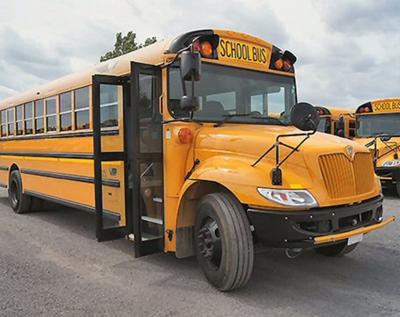
The White Salmon Valley School District applied for a Clean Diesels rebate program Thursday, Oct. 29, through the U.S. Environmental Protection Agency to potentially replace three buses in the district’s bus fleet. The grant is lottery-based and provides a $25,000 rebate for each newly purchased bus.
District School Board members discussed the decision to apply for the grant during their meeting on Oct. 22. An action item will be brought to the table if the district is awarded the grant by the EPA.
Transportation supervisor Susan Tibke and the lead mechanic Carl Rude presented information to the board requesting its input on the application for the rebate to purchase three new buses. The last purchase of new buses was in 2013.
“Buses are on a depreciation scale, so we receive money from the state to reimburse us for the purchase of buses,” explained Tibke, “that money goes into the Transportation Vehicle Fund (the TVF) and can only be used for the purchase of yellow school buses.”
The district already receives yearly reimbursements from the state to compensate for the depreciating value of a previously purchased bus, this reimbursement lasts for 13 years for standard sized yellow school buses and eight years for short buses.
“It’s a reimbursement, is what it is, when you purchase a large bus that goes on a depreciation scale of 13 years,” said Tibke. “So every year they put out with a state bid quote and they take one thirteenth of that and pay that to you, which goes into a fund that can only be used for school buses. Then the next year is another state bid quote, and they give you a thirteenth of that.”
“At the same time there is a clean diesels rebate program available from the EPA,” Tibke explained. “So for every bus that we decommission and purchase a new cleaner bus with, we get $25,000 back from the EPA.”
Currently the Transportation Vehicle Fund holds a little over $375,000. A new bus would cost about $134,000 without the rebate. With the awarded rebate included, a new bus would cost a little more than $109,000.
If the district is awarded the rebate the cost of three new buses would be $75,000 less than the ticket price of $402,317.07, or about $327,300. New buses must be route buses meant for transporting students to and from school.
“We’d really like to [purchase three] because then that takes three buses out of our fleet that are not gaining any money from the state at all,” Tibke explained, “then putting three more buses that are better emissions, safer all around, have the cameras, and we’re getting money from the state.”
Without the rebate, spending $402,317.07 instead of $327,300 for said buses, the TVF would still have about $57,600 remaining after the purchase. There’s also the 2016 Depreciation that would be added to the fund for the buses purchased within the last 13 years, totaling $84,873.89, which the district will receive in Sept. of 2016.
“So we have seven buses that are 1998s and older,” explained Rude when presenting possible candidates to the School Board. “Our oldest bus is actually a 1994 bus, which we use for co-op. That one’s back 112,000 miles, which is low miles for the age of the bus.”
“Then we have several of them that are around 130,000 miles a couple around 170,000 and two of them that are pushing 200,000 miles,” said Rude. “What we would like to do is take three of the buses, which have the miles and the age, and get rid of them.”
“One of them I think is going to need a new turbo before long, which is probably going to push us about $2,000 on a bus that probably wouldn’t have much longer anyway. So that would be an ideal bus to get rid of,” explained Rude.
“In order for the district to get the rebate the buses have to be decommissioned to the point where they can no longer be used,” said Rude. “The frame has to be cut in half in two places, and a hole has to be cut into the block of the engine. The goal of this rebate program is to get older higher emission diesel buses off the road and replaced with newer lower emission buses.”
“Typically if buses are traded in by the district we can see a return of about $1,500, which is about what would be expected if the buses were sold at a surplus sale,” noted Rude. The buses also have to go through some kind of salvage yard after being decommissioned to meet rebate requirements added Rude.
“We have what I believe are a couple of good candidates, if we can make $25,000 off of them instead of $1,500 off of them I think that it’s a great idea,” said Rude to the board during last Thursday’s meeting.
The reimbursement was due Friday, Oct. 30. The school district will be informed within six weeks if it’s been awarded the grant. The buses cannot be purchased until the grant has been awarded. The district then has nine months to purchase and receive the buses in order to collect the reimbursement from the EPA.


Commented