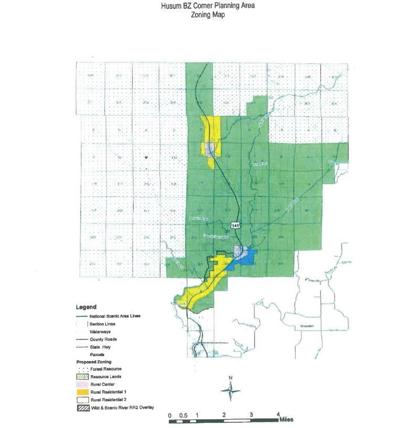
The Klickitat County Board of Commissioners heard a lot of testimony about what to do with the 2012 Husum-BZ Corner Sub-Area Plan and Zoning Update during its hour-and-a-half public hearing last Thursday at the Pioneer Center that was attended by nearly 90 people.
Chairman Rex Johnston (R-White Salmon) stated at the outset the hearing was called at the request of a group of lower White Salmon River valley landowners. Johnston and fellow Commissioners David Sauter (R-Lyle) and Jim Sizemore (R-Centerville) listened to calls from those residents for the repeal of what has become a controversial settlement agreement the county entered into with the Yakama Nation in 2011 to resolve an environmental challenge to the county’s then-proposed 2012 land use update.
They also heard from the Friends of the White Salmon River, which is suing the county to overturn the 2012 update. The Friends and others spoke in favor of retaining the unprecedented settlement agreement and revising the 2012 update through a more inclusive and transparent public planning process.
“We are in favor of plan revision, we’re on the record for that, but only if we are moving toward something better,” said Pat Arnold, a Trout Lake resident and president of the Friends , a local environmental organization formed decades ago to look out for the White Salmon River basin.
Todd Collins, a member of the Husum-BZ Corner Community Council, told the County Board the council had passed a resolution that encourages the county to repeal the 2012 plan “because of ongoing concerns with the update.”
“People here have different motivations [for their calls for repeal],” Collins said. “Some want to get out of the settlement agreement, some want to get out of the plan and start over.” The community council, he indicated, supports the latter approach.
Johnston said after the hearing what he found most curious about the testimony was the role reversal between former supporters and current opponents of the 2012 update.
“I thought it was interesting that people who were for the plan are now against it because of the settlement agreement, and people who were against it are now for it because of the settlement agreement,” the District 1 Commissioner said.
David Powell, an employee of the Yakama Nation, read a statement from the Tribal Council that warned the county not to repeal the settlement agreement without consulting with council leaders first. (Powell declined to provide a copy of the statement for the record, per order from the Tribal Council, he said.)
“The negotiated settlement agreement offers superior protection” to cultural sites in the lower valley, Powell said, than that provided under the State Environ-mental Policy Act, which counties must adhere to when processing land use applications of any kind, anywhere in the county.
Opponents of the agreement between the county and the Yakamas said the county, by incorporating the agreement in the county code, changed the intent of the 2012 update without discussing its implications with the community first.
By adding cultural resource protection language to the county code that applies only in the Husum/BZ sub-area, proponents of repeal or revision of the sub-area plan said the county has added a new layer of regulation on top of what state law already provides.
Moreover, they expressed concern that the requirement for cultural resource surveys and possible mitigation measures to protect cultural resources will bind new residential development within the planning area.
“I’m not fighting this battle for myself,” former county commissioner Don Struck told the County Board. “I’m trying to help people understand the unintended consequences [of the settlement agreement].”
He said the settlement agreement the county and the Yakamas entered into is “a noble gesture,” but one that “binds the county” to do something it had not been required to do under former plans for the sub-area.
Struck told The Enterprise last Thursday afternoon the settlement agreement “would not have happened if I had been commissioner.”
Planning Director Curt Dreyer addressed the reasons why the settlement agreement came about in a staff memorandum to the County Board. In the memo, Dreyer noted, “Encouragement of future development within the revised zoning raised concerns with the Yakama Nation that archaeological resources would become increasingly prone to disturbance and/or damage. The County acknowledged that archaeological resources exist throughout the planning area and entered into the agreement with the Yakama Nation to require an archaeological survey for development that is within 500 feet of a known resource site. Most properties are not subject to the requirement, and do not require a survey, unless inadvertently encountered during construction.”
Dreyer wrote that 15 landowners with undeveloped land within 500 feet of 22 documented cultural resource sites could be subject to a required survey when proposing development “unless they are able to revise/alter their proposed building footprints to avoid the site.”
Dreyer told The Enterprise last Friday, “I have explained, many times, to all involved that only three surveys have been triggered as a result of the settlement agreement, and that the Planning Department had refined the way the agreement is administered so that it is less onerous, but...”
The County Board closed the hearing right around 8 p.m. but left the record open to receive written comments until 5 p.m. on Friday, May 1. Commissioners will take up the matter again on Tuesday, May 26, at which time they may render a decision.



Commented