
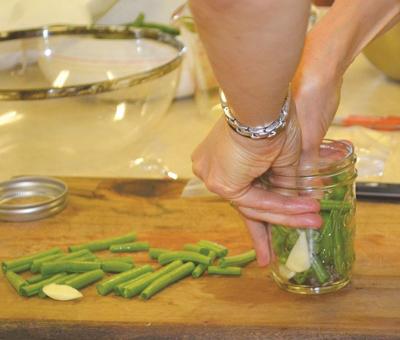
Fermentation may seem like a scary task to take on, since botulism is a potential risk, but that didn’t deter members of the Stevenson and Carson communities who gathered last week to learn a thing or two about fermenting vegetables.
The Stevenson Grange #121 and WSU Extension Service partnered together Tuesday, July 28, to host local farmer Alice Meyers at the Skamania County Fairgrounds for a workshop that demonstrated how to ferment vegetables and enjoy one’s harvest even after the season has passed.
“We have been truly blessed in this community, that there are so many wonderful people with so many talents, and any time I ask someone to do something, they do something,” said Mary Repar, Grange Master for the Stevenson Grange #121, when opening the class.
Meyers, who led the workshop, is a self-taught fermenter who’s been fermenting for about three years. For Tuesday’s talk and demonstration, Meyers provided all the materials including organic fresh produce grown and harvested from her garden.
Fermentation is a food preserving process that is the conversion of carbohydrates to alcohols, and carbon dioxide or organic acids, using bacteria under anaerobic conditions. During the class salt was used to aid in the progression.
The class begin with Meyers informing everyone to wash their hands, in order to expel any ‘bad’ bacteria that could contaminate the fermentation process.
Before preparing the materials for fermentation Meyers introduced a few books written by her favorite author who introduced her to the method of preservation, Sandor Ellix Katz, author of “The Art of Fermentation” and “Wild Fermentation.”
Meyers continued by reading a passage from a Katz book, which dispelled any misgivings anyone would have about the safety of fermenting food.
“I bring that up because I honestly believe after trying this for the last two to three years, I’ve never had a problem with any food,” explained Meyers.
“…For the most part this is an extremely safe way to preserve food, it is very good for you because of the probiotics it has in it. It preserves the nutrients, [and makes] the vitamins and minerals more available to you,” said Meyers.
Depending on the amount of salt used, Meyers said the fermentation processes can span from a few days to two weeks.
During the introduction Meyers suggested checking the fermenting produce by tasting it periodically to determine what stage is preferable, since the probiotics build on a bell curve the results of one week of fermenting will taste different than two weeks.
To get a taste of what was going to be made during the workshop Meyers set out an array of previously fermented vegetables including, last year’s sauerkraut, fermented char stems, and a beet and cabbage mixture.
Once everyone had sampled the examples of the finished product Meyers laid out beets, carrots, cabbage, green beans, garlic, dill, dried rosemary, and thyme for fermenting before discussing salts.
Meyers recommended using Himalayan Pink salt, or Real Salt (which can be purchased at Rosauers in Hood River) for fermentation. She urged fermenters to avoid using iodized salt, since the iodine will kill bacteria and prevent the fermenting process.
“Different salts have different grinds, and therefore different weights,” Meyers warned, “just be aware that if you use a thick grind salt, like this, one time and a finer ground salt [another, then] you’ll probably be getting more salt with the finer ground. So it’s best to just stick with one grind.”
Kosher salt is acceptable for fermenting, pickling salt is also usable.
Meyers did explain an alternative to salt when fermenting, instead whey can be used, but she couldn’t say whether or not it has a different taste since she hadn’t tried that method yet.
“I really don’t consider myself an expert, I’m just an enthusiast,” said Meyers.
The containers used for the workshop were small glass jars that could be used for canning, except a different lid was used to seal the contents that would allow for some of air to release during fermentation.
For the class a standard of two teaspoons of salt per pound of produce was used, the more salt used the slower the fermentation process, less salt means quicker fermentation.
Meyers suggested that fermentation projects be kept in cool dry places, more heat exposure means fermentation will occur faster, the less exposure to heat the slower a product will ferment, which makes the fridge an ideal place for storing fermenting produce.
Chlorinated water is also something to avoid when fermenting, Meyers said, participants suggested leaving water out for several hours for the chlorine to dissipate before using it. A filter is also an acceptable way to remove chlorine.
The two methods of using salt which Meyers shared with the class were either to use a brine solution, or dry salt your ingredients. Dry salting involves coating vegetables with salt and not adding liquid, while the brine method involves using a salty water solution to cover produce.
Meyers then set out all the needed materials with the help of Repar, and the half dozen participants began to weigh produce and measure salt for their fermentation concoctions. Jars were filled with dry salted vegetables, or brine before being sealed and labeled.
By the end of the class participants took home a jar, or two, of potential fermented produce, and the knowledge to recreate their experience.
The next sponsored Grange event will take place Sept. 26, at the Stevenson Library, and be an informational class on vermiculture, or composting with worms.


Commented