
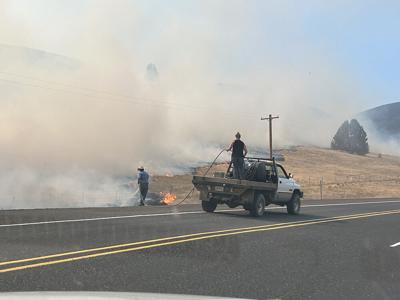
WASCO AND SHERMAN CO. — With the rapid growth of the Larch Creek fire actively burning in Wasco County, all residents of Wasco and Sherman counties are encouraged prepare for wildfire smoke and poor air quality.
Smoke from wildfires is a mix of gases and tiny particles from burning trees and other plant material.
Smoke can hurt your eyes, irritate your respiratory system, and worsen chronic heart and lung diseases.
Poor air quality conditions are a health threat and all residents should limit their exposure to smoke as much as possible. Those with respiratory or heart disease, the elderly and children are advised to stay indoors when the air quality is poor. Those who are medically dependent on electricity should have a backup plan for power failure. Air quality can change quickly. Visit the Oregon Smoke Blog and the Department of Environmental Quality (DEQ) Air Quality Index for the latest information. DEQ air quality monitoring data is updated hourly and is color-coded for ease of reading.
To avoid breathing problems or other symptoms from smoke:
1. Be aware of smoke concentrations in your area by checking the links below (or using the visibility index).
2. If possible, avoid working, exercising or recreating outdoors when air quality is poor.
3. Drink lots of water. Staying hydrated can keep your airways moist, which will help reduce symptoms of respiratory irritation like scratchy throat, runny nose and coughing.
Try to avoid driving in smoky areas. If unavoidable, keep your windows rolled up and vents closed. If you need air conditioning, make sure you set your system on “re-circulate” to avoid bringing smoke into your car.
5. Avoid smoke by staying indoors, closing all windows and doors and using a filter in your heating/cooling system that removes very fine particles. Portable air cleaners with high-efficiency particulate absorbing (HEPA) filters can also help keep indoor air cleaner in smaller spaces.
6. People with concerns about health issues, including those with asthma or other respiratory problems, should follow their breathing management plans; keep medications on hand, and contact healthcare providers if necessary.
7. If you must go outdoors, Oregon Health Authority advises that National Institute for Occupational Safety and Health (NIOSH)-approved N95 masks may offer some protection. Paper “comfort” or “dust” masks commonly found at hardware stores are designed to trap large particles like sawdust and will not protect your lungs from smoke. Specialized masks can help prevent smoke exposure are called particulate respirators (such as N95s). Users should select a respirator that fits well, to ensure a protective seal around the face. To get the most protection, learn how to put one on, properly position it on your face, and how to remove it. These are not currently made in children’s sizes. People with pre-existing health conditions should speak with their healthcare provider before using a respirator. The wearer may find breathing more difficult, particularly those with heart and lung conditions. Oregon OSHA offers how-to videos in Spanish (www.youtube.com/watch?v=iNQCVKRK970 ). and English (www.youtube.com/watch?v=ucmx_hj1SW8) about mask fitting.
If you need a cleaner-air day shelter during wildfire smoke events, please visit Mid-Columbia Community Action Council’s (MCCAC) website for the most recent information, www.mccac.com, including time, location, etc. .
Also consider public spaces, during their regular hours, which may have cleaner air, such as the movie theater, stores, the library or Mid-Columbia Senior Center.
For more information:
Wildfire Smoke FAQ for frequently asked questions about wildfire smoke and public health: sharedsystems.dhsoha.state.or.us/DHSForms/Served/le8626.pdf.
Oregon Smoke Blog for the latest on fires and air quality across the state: www.oregonsmoke.org
DEQ’s Air Quality Index for current air quality conditions: www.oregon.gov/deq/wildfires/Pages/Using-Visibility-to-Estimate-Health-Effects.aspx.
DEQ’s 5-3-1 Visibility Index for estimating smoke levels via visual observation: www.oregon.gov/deq/wildfires/Pages/Using-Visibility-to-Estimate-Health-Effects.aspx
CDC for Wildfire Smoke: www.cdc.gov/wildfires/risk-factors/index.html.
OHA for Wildfires & Smoke: www.oregon.gov/oha/ph/Preparedness/Prepare/Pages/PrepareForWildfire.aspx.
Oregon OSHA for respirator use in the workplace: osha.oregon.gov/Pages/topics/respiratory-protection.aspx
Or contact North Central Public Health District at 541-506-2600 or online at www.ncphd.org or facebook.com/NorthCentralPublicHealth.
•••
Una versión en español de esta historia está en línea en www.columbiagorgenews.com/enespanol.


Commented