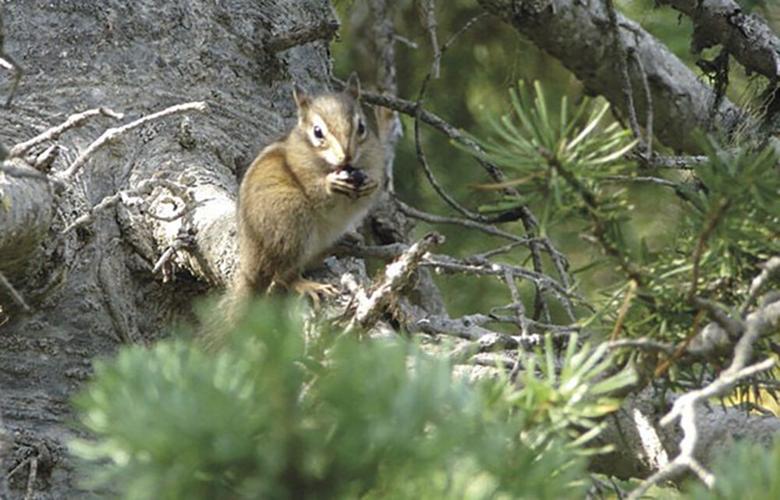
A chipmunk finds purple treasure, a huckleberry, to feast on. The U.S. Forest Service announced in March that it would not be issuing permits to commercial pickers this year.
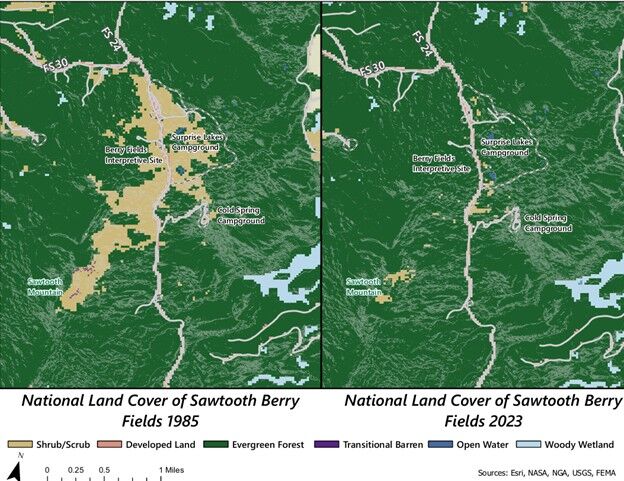
A map of the Sawtooth Berry Fields, located in the Gifford Pinchot National Forest. Ecological data demonstrates the dramatic decline in shrubland, or berry fields, from 1985 to 2023 as a result of conifer encroachment.
A chipmunk finds purple treasure, a huckleberry, to feast on. The U.S. Forest Service announced in March that it would not be issuing permits to commercial pickers this year.
GIFFORD PINCHOT — In late March, the United States Forest Service (USFS) announced that it would not issue permits to commercially harvest huckleberries in the Gifford Pinchot National Forest this upcoming season.
The Ḱamíłpa Band of the Yakama Nation has urged USFS to reign in huckleberry picking since the 1930s, viewing the commercial program as a violation of tribal rights to fish, hunt and gather in their “usual and accustomed places,” as enshrined by the Treaty of 1855. Gifford Pinchot is the only national forest that allows large-scale harvest of huckleberries, but the pause isn’t permanent.
“The Ḱamíłpa Band has always been advocates for huckleberries,” said Elaine Harvey, a Ḱamíłpa gatherer and watershed department manager for the Columbia Inter-Tribal Fish Commission. “It’s a food we use for subsistence in our homes, with our families, and it’s a medicine to us. We also use it in all our ceremonies” — everything from weddings and funerals to traditional feasts.
“Huckleberries are a vital cultural and ecological resource, and we must ensure their sustainability for generations to come,” Johanna Kovarik, Gifford Pinchot’s forest supervisor, said in a written statement. “This change allows us to work more closely with tribal governments, and local stakeholders and law enforcement to improve management while reducing conflicts.”
USFS did not respond to Columbia Gorge News for additional comments.
Thriving at high elevations in a variety of forest ecosystems, 12 different species of huckleberry grow within the Gifford Pinchot, and they’ve long evaded domestic cultivation. The hardy bushes require mountain snow and shorter summers to produce fruit, historically sprouting from acidic soil nourished by fire. According to USFS, commercial pickers harvest anywhere between 50,000-70,000 gallons of huckleberries in the Gifford Pinchot annually, but last year, Harvey got just eight gallons in total — enough for the ceremonies, but not for her own subsistence.
As Harvey explained, USFS suppressed low-severity, cultural burning cultural burning ever since the agency was established in 1905, a practice that replenishes soil nutrients, kills invasive fruit flies like the spotted wing drosophila and opens pathways for sunlight to touch forest floors. Without fire on the landscape, conifers encroached berry fields and huckleberry habitat has declined as a result.
“Now you go up there, and you can’t even see the mountains,” she said. “Access to our food has been limited, and now it’s getting to a point where we’re put on the back burner ... Huckleberries are just as important as salmon to us.”
Over-harvesting is another issue. While Harvey and other tribal members pick huckleberries one at a time, taking care to respect the bush and the plants around it, she described how commercial pickers use rakes to strip bushes clean, regardless of whether the berries are actually ripe, at all hours during the late summer, early fall harvest season.
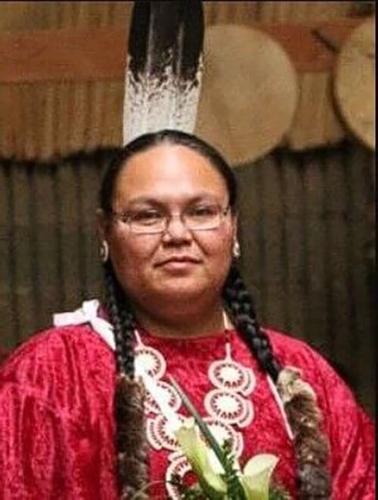
Elaine Harvey, CRITFC Watershed Department Manager
“I always get sad every year,” she said. “What about the bears? What about the birds? They live here and they need huckleberries for their food too.” Harvey and the Yakama Nation believe that every part of the environment is connected: If one being suffers, others do as well.
One gallon of huckleberries can sell for up to $200. Pickers receive a fraction of that profit and often sell the berries to natural food companies like Northwest Wild Foods, which is based in Burlington, Washington, and made $750,000 from huckleberries alone in 2006. As detailed by High Country News, these companies then sell to private customers, wineries or other companies that churn out huckleberry products, such as Tillamook Creamery.
Locally, vendors pop up in Trout Lake when picking season arrives and several smaller businesses sell huckleberry commodities, including Dickey’s Farm Store in Bingen. Dickey’s usually sources its fresh huckleberries from Gifford Pinchot, which fetch anywhere from $75-$100 per gallon, and sells other products like huckleberry syrup, jam, cider and mead produced elsewhere.
“It’s kind of a concern because it does bring people and business into our store,” said Laurie Walker, one of the family’s fifth generation who helps manage the store and farm. “But I also understand, too, that some of the practices haven’t been real good here lately.”
A map of the Sawtooth Berry Fields, located in the Gifford Pinchot National Forest. Ecological data demonstrates the dramatic decline in shrubland, or berry fields, from 1985 to 2023 as a result of conifer encroachment.
Zoë Kleiner graphic
And, of course, Bingen hosts its popular Huckleberry Festival in Daubenspeck Park every fall. Denise Stewart, who chairs the committee responsible for planning the event, reported she’s been on the phone with her berry buyer trying to figure out other places to get fresh huckleberries, such as Idaho.
“I don’t think anything’s going to be different, but I always look for the glass half full,” said Stewart. “The festival will be there, and we’re going to have a great time.”
“It’s understood that huckleberries are a valued resource for both Indians and non-Indians; however, it is important everyone is mindful and respectful of these fields to be able to return next season,” said Yakama Nation Tribal Council Chairman Gerald Lewis in a press release.
Beyond habitat loss, invasive species, drought and sustainability concerns, USFS also cited “escalating conflicts among harvesters” as a reason for halting the commercial program. Harvey recalled how commercial pickers have threatened tribal members with dogs or a machete in the past, which she said were clearly attempts to “push us out” and “make us uncomfortable.”
Commercial pickers, who can pay $60 for a two-week permit with a 40-gallon limit, or $105 to harvest up to 70 gallons throughout the season, frequently cross into treaty-reserved areas and tail Indigenous pickers, according to Harvey. High County News reported that USFS typically employs one to four temporary officers to patrol the berry fields, but the agency seldom fined commercial pickers for exceeding their quota or working in illegal spaces.
Last September, USFS announced it wouldn’t hire any seasonal workers in 2025 due to funding shortages, but Gifford Pinchot employees have been rehired after being fired in February amidst President Donald Trump’s federal workforce cuts, according to The Columbian. Harvey and other Yakama Nation leaders have personally shared these experiences during annual meetings with USFS officials spanning at least a decade, often talking with different people each year since the agency’s turnover rate is so high, leading to little change.
In 2023, however, Harvey was appointed to a committee tasked with overhauling the Northwest Forest Plan, a federal land management strategy for the Gifford Pinchot and 16 other national forests in the region. With a higher-ranking audience, Harvey used the opportunity to elevate the negative impacts of huckleberry commercialization as much as possible.
“I felt like a broken record,” she said. “The 1855 treaty of the Yakama Nation with the U.S. government is supposed to be the supreme law of the land.”
Harvey hopes the commercial ban becomes permanent, but people can still sign up for free personal use permits, allowing a harvest of up to three gallons per year. USFS will make a final decision on the pause after consulting with tribes, stakeholders and reviewing ongoing assessments.
Harvey also noted the Yakama Nation Tribal Police Department is coordinating with law enforcement agencies in Klickitat, Skamania and Lewis counties to enforce this year’s policy, along with USFS.
“It’s not just the Native people stewarding the land anymore,” Harvey said. “We’re all stewards and everyone needs to respect and protect the rivers, the forest because it’s all going to impact the future.”





Commented