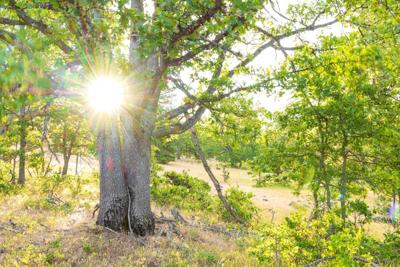
KLICKITAT CO. — Perched above the Klickitat River, a 2,666-acre parcel known as Klickitat Oaks is now accessible to the public after being acquired by the nonprofit Columbia Land Trust. The name is a callback to the Oregon white oaks that dominate the landscape, though the land is also home to an abundance of wildlife, including 15 species on Washington’s Priority Habitats and Species list.
In its 2022 grant funding year, the area ranked highest for conservation projects in Washington state. However, Conservation Director Nate Ulrich emphasized the land’s importance for its historical uses and cultural significance.
“Our value is to make these accessible to the public, to manage them in a way that benefits neighbors, [and] to maintain hunting traditional uses,” he said. “It’s part of the landscape scale grazing lease, so we’re able to ensure that grazing can continue.”
The Yakama Nation allocated a portion of its funding from the America the Beautiful grant toward the project, as the land lies within its ancestral territory. Their Natural Resources staff gave expertise on stewardship of the land, including how to maintain biodiversity in the state.
Another goal, Ulrich said, is to ensure a continuous landscape for migratory species such as the elk and deer by connecting the open spaces without fences.
“If we can do our part here at home, we’re helping hold up that whole chain,” Ulrich said, pointing to the importance of even the smallest parts, like acorns and caterpillars. “If one location fails to provide the habitat that those species need along the way, then the whole thing starts to be weakened.”
Jeff Kelly, natural area manager, added that the site lies along the Pacific Flyway, a migratory bird corridor from Patagonia to Alaska. He highlighted how important the Oregon white oaks are for animal habitats.
“They develop these cavities, openings within the tree, that birds, squirrels and other wildlife inhabit,” Kelly said. “And not just that, you have insects and invertebrates that are living in those trees that birds feed on. So they’re nesting, feeding and migrating through the corridor of oaks.”
Kelly also stated that the Oregon white oaks are part of a healthy fire-resilient ecosystem.
The trees, which can grow to be 500 years old, are less susceptible to crown fires and can resprout if burned. In landscapes where fire has been suppressed, faster‑growing conifers such as Douglas-fir and ponderosa pine can move in, eventually out-competing Oregon white oaks.
Going forward, Kelly said the land trust plans to maintain the landscape through fuel-reduction projects such as reintroducing prescribed burns and continuing grazing.
The conservation efforts of Klickitat Oaks stemmed from a larger land transaction that took place in 2021.
That year, SDS Lumber and Timber Companies, along with more than 96,000 acres of land, were sold to three buyers — Twin Creeks Timber, LLC, Wilkins, Kaiser & Olsen, Inc., and The Conservation Fund. The land and mills were divided up, and The Conservation Fund acquired 35,000 acres of the land.
“What was beautiful about that is each entity got to focus on its specialty,” Ulrich said. “That is a real win-win because what we’re focusing on tends to be lands that have oaks, which aren’t very valuable for managing timber.”
Working as an intermediary buyer, The Conservation Fund facilitated the sale of Klickitat Oaks to Columbia Land Trust for permanent conservation, completing Phase I this January.
Phase II and III are future sites that are “part of that same vision,” Ulrich said, and will connect existing public lands further south and north, in between lands managed by the Washington Department of Fish and Wildlife and the Washington Department of Natural Resources.
“Here in Klickitat County, we’ve been pretty lucky because most local ownership lands have, on the whole, been open to public access in most places,” Ulrich said. He pointed to a recent article in The Wahkiakum County Eagle that described how investment companies purchased traditional hunting grounds and later closed public access to them, sometimes blocking routes to nearby lands that remained open.
“We’re lucky that that hasn’t been kind of a thing that timber companies have done here,” Ulrich added. “But as we come in and serve these places, we’re able to guarantee that that won’t happen in the future.”



Commented