
The City of The Dalles voted to award a $206,980 contract to Davey Tree Expert Company for what they refer to as “the downtown tree project” at the regular city council meeting on Sept. 25. In this project, the city will remove 62 dead or dying trees from The Dalles downtown area and planting another 68 to replace them.
Community Development Director Joshua Chandler said the health of trees downtown has become a matter of concern for the community over the past few years. With the help of The Dalles Beautification and Tree Committee, the maintenance and upkeep of downtown trees has become a key project for the coming years, he said.
“Maintaining street trees in our community has a multitude of benefits that extend past just aesthetics and appearance,” Chandler said. “They play a crucial role in improving the environment, supporting economic and social well-being, and contribute to a vibrant and livable city.”
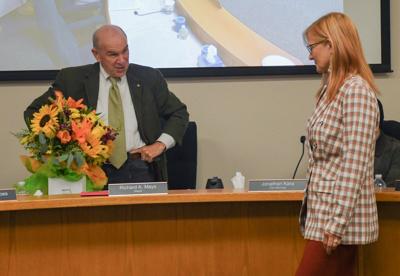
In other business, the city celebrated City Clerk Izetta Grossman’s retirement. According to Mayor Rich Mays, Grossman worked for the city for 17 years, eight as city clerk and nine as assistant to the city manager.
The mayor gifted Grossman with a bouquet and each of the city councilors spoke about Grossman, praising her kindness, organization and extensive knowledge about the city and its administrative affairs.
“When in doubt, ask Izetta,” Councilor Tim McGlothlin said.
Following councilor statements, Grossman gave a few words about her perspective on city council and the work they do, both as the clerk and a citizen of The Dalles.
“We don’t always agree with our councilors,” she said. “We don’t always think that they’ve thought about it or that they know what they’re doing, but these people care more about your city than you’ll ever know. You don’t become a councilor or a mayor or a city manager or a city attorney or anyone who works for the city without wanting what’s best for this organization. Do we make mistakes? Sure. Do we step on toes sometimes? Oh boy. But always with the best interests of the whole at heart. Always. This is a good group of people. I’m leaving a city I love as a municipal employee, but not as a citizen. I encourage you all to always make sure your voices are heard because they can’t do anything if they don’t know about it.”
Going forward, Amie Ell will take over as city clerk. She can be reached at amell@ci.the-dalles.or.us.
The city also voted to approve a construction contract for the reconstruction of the south apron, the addition of five new taxi lanes and a new fuel apron at the Columbia Gorge Regional Airport. The cost of the south apron reconstruction and new taxi lanes will be $2,962,501, and the cost of the new fuel apron will be $401,502.
According to Aviation Manager Jeff Renard, this cost fits within what was budgeted for these projects in the 2023-2024 budget, with most of the money coming from federal and state grants, specifically the airport improvement plan and the federal infrastructure bill. Only 2% of the money will come from the city, with an additional 2% from Klickitat County.
Police Chief Tom Worthy also presented an update to the city’s officer use of deadly physical force plan, as required by Senate Bill 111, which was passed in 2007. As the bill is highly prescriptive, Worthy said, there were not many changes made, mostly ensuring that the plan, which was originally from 2007, was up-to-date and had the signatures of those currently employed and in office, rather than those who were in 2007.
Finally, there was a presentation on the proposed housing needs analysis and buildable land inventory, which aimed to assess the need for housing in The Dalles currently, and estimate what that may look like over the next 20 years.
Using the numbers from the 2020 census, the American Community Survey and Portland State University’s population center and population forecast, the agencies the city was working with — Johnson Economics and MIG, Inc. — found that, currently, 62% of the housing in The Dalles is owner-occupied and 38% is renter-occupied. Of the owner-occupied housing, 86% is single-family detached homes, 1% is single-family attached homes and 13% is manufactured homes. For renter-occupied housing, 39% is single-family detached homes, 8% is single-family attached homes, 5% is duplexes, 11% is tri- or quad-plexes, 32% is multi-family residences with five or more units and 4% is manufactured homes.
In regards to population, there was found to be a 11% increase between 2010 and 2030, with the population changing from 15,800 to 17,550. It was estimated that there would be an additional 6% increase between 2023 and 2043, with a 2043 population estimated at 18,600.
In regards to forecasted housing need, it was estimated there would need to be 400 more households and 500 more housing units in the next 20 years. This is compared to the additional 450 households and 400 housing units between 2010 and 2023. They estimated needing 259 more single-family homes, 43 townhomes, 48 buildings with two to four units, 107 buildings with five or more units and 48 more manufactured homes.
City Councilor Dan Richardson expressed concern about the projections, believing they were modest compared to the growth that has already been seen in the last 13 years.
The buildable land inventory was also discussed. In it, they found there was surplus land within the urban growth boundary to support estimated community growth by 2043, which councilors expressed doubt about, seeing as residential areas being used for farming practices were included in the assessment as developable.
MIG and Johnson Economics agreed that was a common concern among communities and though they are required to use the PSU numbers, they would be willing to look at what the numbers would look like with a higher estimated growth rate and could give those numbers when they returned to the council at a later date.


Commented