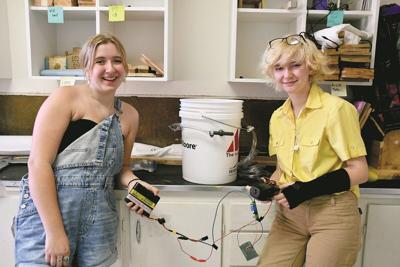
Lilli McCauley, left, and August Peterson show off their prototype of “Swoosh,” a water filtration system designed for ease of use by agricultural workers.
Lilli McCauley, left, and August Peterson show off their prototype of “Swoosh,” a water filtration system designed for ease of use by agricultural workers.
WHITE SALMON — Four Columbia High School sophomores spent months designing, building, and programming a handwashing station to allow a more sanitary environment for farm workers as a part of this year’s Project Invent competition. The team will be competing for $500 in investment funds later this month at Project Invent’s Demo Day in San Francisco.
At Demo Day, the group will be pitching their product to leaders and innovators in business. It’s a culmination of their hard work that began in September of last year, when they first began searching for a product idea that could solve a real world problem and invoke social good.
The group, including members Lila Witherrite, Lilli McCauley, August Peterson, and Maddie Ayer, is working under the mentorship of Gorge Makerspace’s founder Jack Perrin, who has hosted local Project Invent teams for several years.
Project Invent, according to its website, works to empower students with 21st century skills to succeed individually and impact globally, through invention. The project takes students through the development process, challenging them to solve real world problems.
It’s the group’s second time participating in the competition. Last year they made it to finals, which was held virtually, and this week they will be boarding a plane to take their project to an in-person conference, where they will get up on stage and demonstrate their product to attendees.
The group first worked with locals to determine the problem they wished to solve. Their goal with the project was to design a product that can help the highest amount of people possible.
In the previous project, they created a communication device, in the form of a stuffed animal, to allow long distance communication between a nine-year-old with cerebral palsy and their mother.
This year the group wanted to create a product that would solve a problem for the largest number of people possible.
Upon learning about the complications surrounding access to clean running water for agricultural workers, the group decided they wanted to create a system that would solve these complications. For farmworkers who are paid by the amount of produce they harvest, many do not wish to halt their work to spend time locating and using handwashing stations, and sometimes such stations are not readily accessible.
Many market solutions out there require running water, so they designed a product that recycles water, draining it through a filtration system and running the water back through the system, negating the need for access to running water.
“We want to show that people are listening and wiling to address their needs,” Peterson said. “Even if we’re not solving problems, just listening can help.”
The design process had dramatic results for the team.
“Last year I was so sure I didn’t want to do any computer stuff,” said McCauley. But after learning a bit of coding, she was able to tackle obstacles, which gave her a lot of confidence going into this year’s project.
Perrin said the group works well independently. He gave them “gentle nudges” through the year, allowing the group to problem solve together. At one point, Perrin introduced them to a local with ample knowledge on filtration systems. Because of that connection, they learned knowledge that they applied to their own filtration system.
Besides market research, they also research pesticide sanitation, and through testing, came up with a design of six jets to spray water, allowing cleanup of any leftover pesticides that may linger on hands.
The group calls the product “Swoosh.” As they explained, the idea came to them after one of the group members said they wanted “something to put your hands in to go ‘swoosh.’”
Regardless of the outcome this week at Demo Day, the group wants to take their product out to local agricultural producers. The group sees the product as a solution to a real-world problem that can be solved physically, but they learned that problems on the farm can be overlooked because of a stigma that is present.
Oftentimes farmworkers choose not to complain or raise attention to a problem. Mental health isn’t talked about as much in the community, they said, adding that while they can’t fix systemic issues such as that, they can work to eliminate problems with invention.
“There’s lot of agriculture in the Gorge,” they said. “We want to make sure they have a voice.”



Commented