
Moratorium targets central county where developers eye 160-MW facility
Update, Jan. 24, 2022: Columbia Gorge News received comment from Stacy Gramazio, Director of External Affairs & Community Engagement Strategy at Cypress Creek Renewables, who said: "While we are disappointed that Klickitat County is considering a solar moratorium despite the significant economic uplift that Carriger Solar is expected to provide, Cypress Creek will continue to engage with the community as we weigh all options for Carriger Solar.
Carriger Solar is a proposed 160 MW solar facility that will generate approximately $19-30 million in tax revenue for Klickitat County. This will directly and indirectly impact the Goldendale School District, county roads, the fire department, and other taxing districts. Additionally, there will be hundreds of full-time jobs created during the project's construction phase and several long-term, high-paying jobs for the county after that. We look forward to continued partnerships within the Klickitat County community. Additional project information is available at www.carrigersolar.com."
Klickitat County Commissioners Dan Christopher and Lori Zoller voted to enact a six-month moratorium on solar development proposals over one acre in size and located in the Goldendale and Centerville valleys at the Jan. 10 meeting of the board of county commissioners.
The moratorium marks the second such move to halt solar development applications since 2021. County township and ranges 3-14, 3-15, 3-16, 4-14, 4-15, 4-16, 4-17, 5-15, 5-16, and 5-17 are affected by the moratorium.
The area cited in the moratorium includes land that was identified for potential development through the proposed Carriger Solar Project, as well as surrounding areas, identified as the Goldendale and Centerville Valleys.
The Carriger Solar Project, proposed by Cypress Creek Renewables, was presented to the community in a series of town hall meetings last year and discussions between county officials and representatives from the North Carolina-based renewable energy development firm. Cypress Creek has not yet submitted a formal application to the county for relevant permits.
The areas included in the moratorium are located both within and outside the county’s Energy Overlay Zone (EOZ) — a special designated planning overlay designed to accelerate industrial renewable energy projects in areas where environmental and feasibility studies have already been completed. Columbia Gorge News requested a response by Christopher, the originator of the moratorium proposal, to explain the reasoning behind the inclusion of certain tracts of land in Klickitat County.
Some explanation is included with the moratorium document: “Most residents of Goldendale and Centerville never thought large scale solar farm development would be a possibility in the Goldendale and Centerville valleys … It is the Board of County Commissioner’s opinion that the citizens’ voices have not had a chance to be heard with regards to long range strategic planning in the Goldendale and Centerville valleys in regard to large scale solar farm development or locations …
“The purpose of the moratorium is to protect the customs, culture, natural resources and resource lands of the residents of the Goldendale and Centerville valleys, and to ensure that the county’s planning and future development is consistent with the local community’s long range vision for the area.”
Commissioner Jacob Anderson was the sole “nay” vote on the proposal.
He was also the sole commissioner unaware of Christopher’s proposal by Christopher’s own admission: At the Jan. 3 meeting where it was first presented, he said, “Commissioner Zoller did help me prepare this a week ago before she even started in office, so it was all done above board, and within the law.”
At that meeting Christopher said neither the county comprehensive plan nor the EOZ’s founding document addressed large scale solar development.
Anderson requested a delay in a vote to seek the county prosecutor’s legal opinion on the proposal. He said it was necessary to delay a vote on the basis that the moratorium was not “arbitrary and capricious with regards to what townships there are.”
Christopher responded that he had not sought legal counsel on the proposal, adding that urgency in voting upon the moratorium was necessary given that a solar company could apply for a development permit “tomorrow.”
“I don’t want to pull the motion and wait for legal counsel to give me an opinion because the wait time could put thousands of residents in jeopardy,” Christopher said.
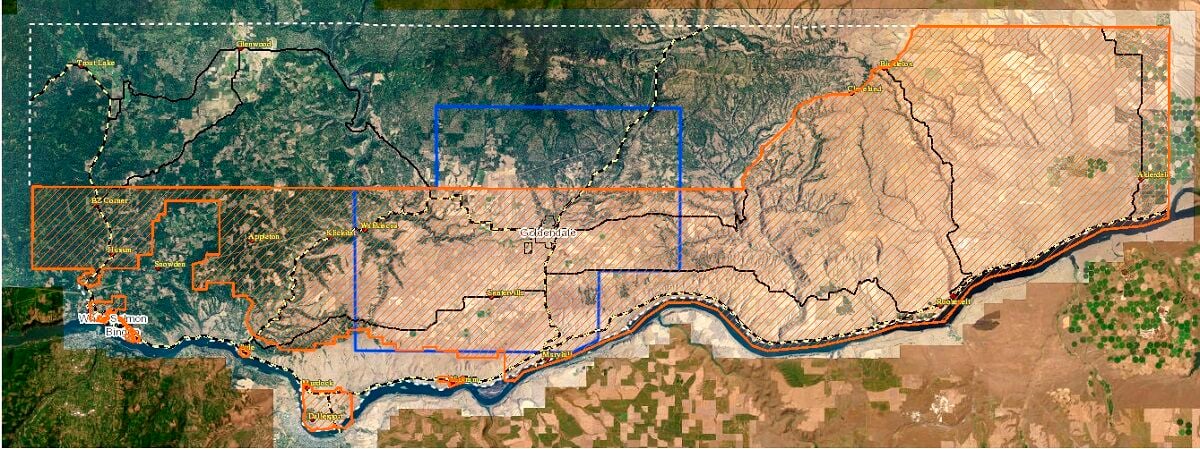
The approximate area included in the solar moratorium is outlined in blue. The county Energy Overlay Zone is outlined in orange.
Despite Christopher’s adamancy for urgency on the issue, the board continued the vote to Jan. 10, one week later, since the proposal had not been included in the Jan. 3 agenda.
By last week’s meeting Christopher had not obtained a written legal opinion by the prosecutor, which was one grievance held by Anderson against the proposal.
Anderson, Christopher, and Zoller all in essence agreed that local control over planning decisions was the goal of the board; however, Anderson argued that the moratorium would instead force a solar development firm to bypass local planning processes and send development permit applications to the state Energy Facility Site Evaluation Council (EFSEC) for review.
Since last year, commissioners Anderson and Christopher both expressed their grievance over a perceived overreach by EFSEC to approve project applications, which requires a signature by the governor and a vote of approval by the five-member council.
Anderson used a Dec. 5 letter by EFSEC justifying its authority to approve solar farm applications despite a local moratorium enacted in Yakima County as rationale towards his vote against the moratorium. He also pointed to a 2018 decision by EFSEC to bypass a moratorium, enacted by the Kittitas County Board of Commissioners, that disallowed solar development applications. In approving the Columbia Solar Project, located near Ellensburg, EFSEC argued that the moratorium only applied to the regulations concerning “the processing of applications and does not regulate how land is used.”
“It is my opinion that this moratorium will not put a hold on solar development but instead will force a developer to (go) through EFSEC Expedited Processing which will not allow for the same local input or decision making authority,” Anderson said.
Christopher said that for the past two years he has been “stalling” to “make Cypress Creek feel comfortable so that they wouldn’t turn in a permit,” arguing that immediate action be taken to not allow developers more time to submit a development application through the county planning department.
Anderson said via email that Cypress Creek received a Purchase and Power Agreement near the end of 2022 and intend to proceed with the permitting process this year, he said, which was revealed during a meeting with representatives of the development firm last Friday.
Anderson also expressed concern that Christopher and Zoller agreed to vote for the moratorium before Zoller’s swearing-in, which occurred at the beginning of the year, saying it could constitute a violation of the Open Public Meetings Act.
“All three commissioners are doing what they feel is going to be best to protect and promote the interests of Klickitat County residents. I commend my seatmates for their bold action and respect the decision of the board.
“It is my desire to ensure the actions the board takes have the desired outcomes and that we always understand ahead of time the unintended consequences of our actions,” Anderson said in an email.
Zoller clarified on her “yea” vote that “this isn’t new thinking for me,” saying she has been attending meetings and spoke to many people during her campaign.
“It was the number one issue,” she said. “My fear is as we move forward and do something, those projects will get challenged anyhow for that. There’s legal standing to do that … This is a public participation issue for me.”
Zoller provided additional comment via email: “My goal for the solar moratorium would be to give Klickitat County the time to review all policies and ordinances currently enacted. We need to provide an open and inclusive public process and develop policies and ordinances that protect the values and desires of the people of Klickitat County and ensure protection of our valuable resource lands. And if done correctly, would in fact, ensure the success of any industrial solar projects undertaken in the future.”
The 2-1 vote taken on Jan. 10 approved the six-month moratorium and directed the planning director to “assist the planning commission to hear from the public through public hearings and to make recommendations that may establish siting and location regulations.”
This current moratorium is different from the one enacted by the Board of Commissioners in 2021, by the fact that it covers different areas, although some overlap is present. The 2021 moratorium included the area outside of the EOZ, while this moratorium includes a wide swath of central Klickitat County, some of which overlaps the EOZ and some of which is excluded from it (see graphic, page 1). The 2021 moratorium also received a signature for technical compliance by the county prosecutor whereas the most recent moratorium did not.
Commissioners voted to rescind the first moratorium in June of 2021 with a recommendation that they would perform a “cumulative impact analysis” on solar developments and provide a list of mitigatory impacts to be included within a set of findings in future Board of Adjustment decisions pertaining to a solar development application.
A public hearing is required within 60 days to produce findings of fact.
Columbia Gorge News reached out to Cypress Creek Renewables for comment but had not received a response by deadline.


Commented