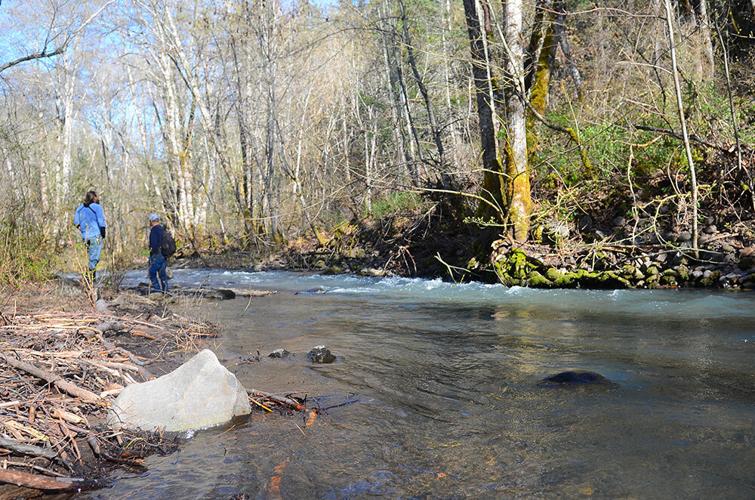
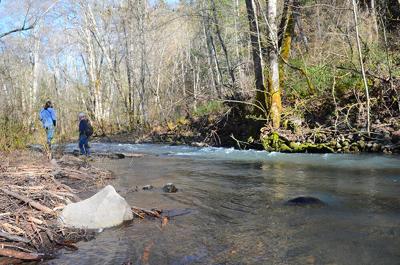
Adam Lieberg, Columbia Land Trust, and David Lindley, Yakama Nation Fisheries, scan Rattlesnake Creek to see how recent high-water events shifted the log jams.
Adam Lieberg, Columbia Land Trust, and David Lindley, Yakama Nation Fisheries, scan Rattlesnake Creek to see how recent high-water events shifted the log jams.
HUSUM — Rattlesnake Creek, the largest tributary to the White Salmon River, is the focus of a habitat restoration effort spearheaded by Columbia Land Trust. In partnership with the Yakama Nation Fisheries, they’ve placed a series of log jams across a mile-long stretch to improve not only the health of the watershed but the surrounding ecosystem.
“I’m always looking at ways we can meet multiple objectives ...[Rattlesnake Creek] hit all the marks for high-priority conservation,” said Adam Lieberg, natural area manager for Columbia Land Trust. He stated the area is an important habitat for aquatic and terrestrial species, and is home to a unique Oregon White Oak system.
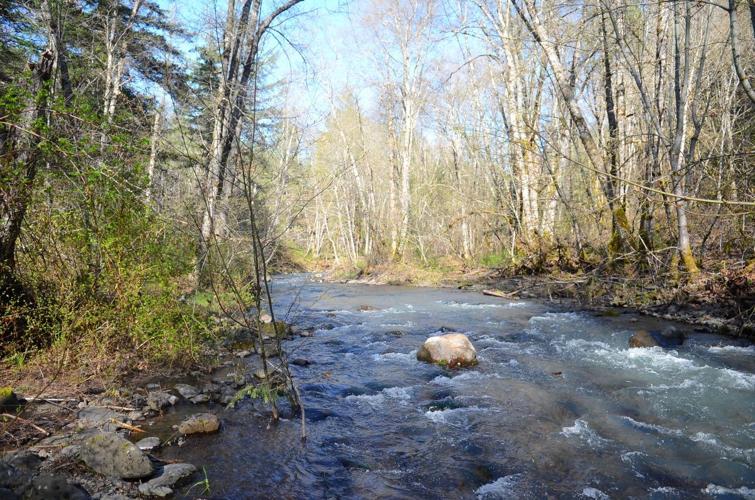
Rattlesnake Creek, a tributary to the White Salmon River, is marked as a high-priority location for salmon and steelhead recovery.
Emma Renly photo
In 2023, Columbia Land Trust acquired the remote 917-acre unit along Rattlesnake Creek and began the early planning stages of assessment, design, funding and permitting for log jams. Using the Beaver Restoration Assessment Tool (BRAT), the team identified the section as a “low-hanging fruit” for restoration work.
“The BRAT modeling actually shows individual areas that are more suitable to wood; they’re generally slower, flatter sections of the creek,” said David Lindley, southern territories habitat coordinator for Yakama Nation Fisheries. “Then, we designed places where we would build the log structures.”
In 2024, the first phase of floodplain enhancement began at Rattlesnake Creek with support from a climate resilience grant from the Bureau of Indian Affairs. Crews cut, dragged and carried wood by hand, using pulley systems and a tractor to move larger trees into place for the log jams.
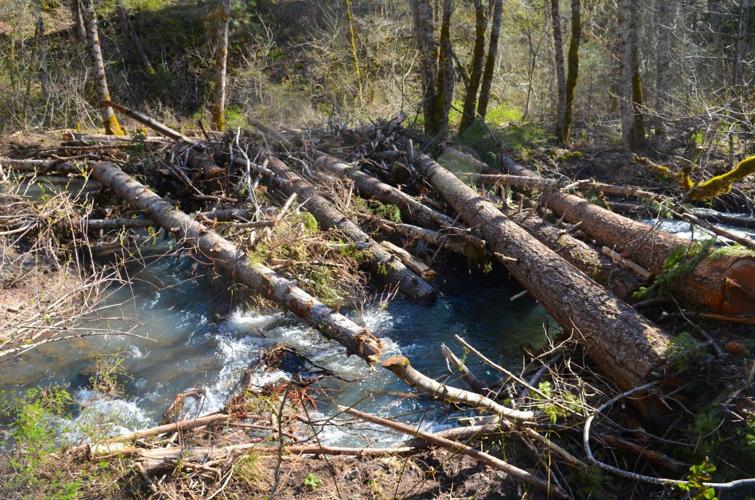
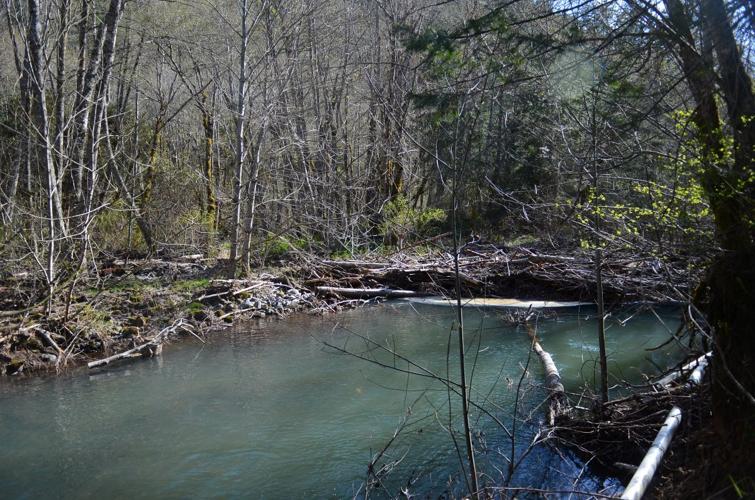
A downstream log jam acts like a catcher’s mitt, trapping loose wood before it reaches the main river.
Emma Renly photo
In total, 60 structures were set in the creek to help restore areas where there were once historical log jams. Most of the material used came from on-site trees.
“Broadly, there’s a history of commercial logging that removed a lot of trees that would have naturally fallen in, as well as logging specifically in the riparian corridor,” Lindley said. “There’s also a history throughout the White Salmon River of harvesting wood and log jams …The wood that would have naturally recruited was removed.”
Both Lindley and Lieberg also emphasized the importance of log jams for wildlife. Around Rattlesnake Creek, this includes the northern spotted owl, western gray squirrel and black bear.
“With the hot and dry climate that we get in the summertime in the East Cascades, keeping water on the landscape, spreading it out, keeping things green and lush, has multiple benefits for all kinds of species,” Lindley said, pointing to how split channels and slow pools of water increases habitat diversity and lowers the water’s temperature.
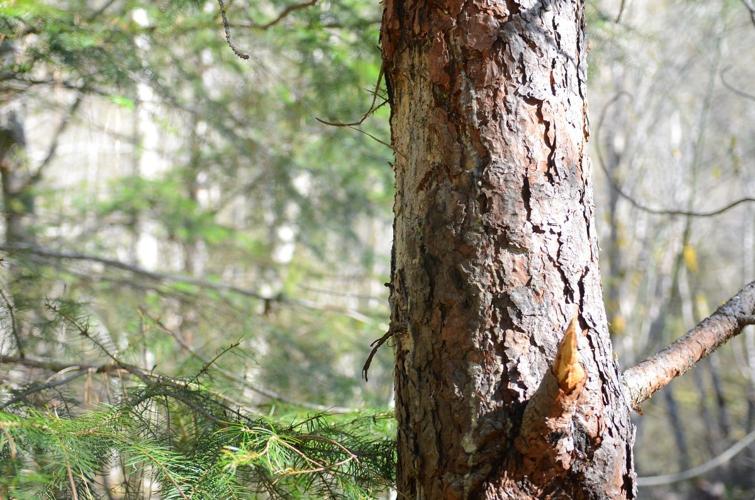
Parallel to the river corridor is a habitat rich with wildlife, as evidenced by the many trees marked by bears.
Emma Renly photo
Below the creek waters, Lindley said the restoration work was important for salmon and steelhead, which rely on small spawning-size gravel to build redds, or egg nests. These fish had been blocked from accessing upper stretches of the White Salmon River for nearly a century until the Condit Dam was breached in 2011.
“We did a habitat survey before the project and a lot of the small spawning-size gravel wasn’t present because there wasn’t that structure holding it back,” he said. “The log jams are really important to accumulate that spawning-size substrate.”
“You can really see that in Rattlesnake Creek, but that’s kind of true too with a lot of our tributaries around here,” Added Lieberg.
Lindley emphasized that the project’s focus went beyond the channel and looked at the entire landscape from ridge top to ridge top. “We would love to see neighbors upstream and downstream and see if they’re interested in expanding the project beyond our reach … Fish and wildlife don’t operate by property lines.”
Since the wood structures aren’t permanently anchored, the team expects to keep monitoring the creek and adding material as needed in 2025.
“We’ve had a couple of high flow events throughout the winter and early spring, and that’s definitely moved stuff around,” Lieberg said. “These things are going to move naturally.”
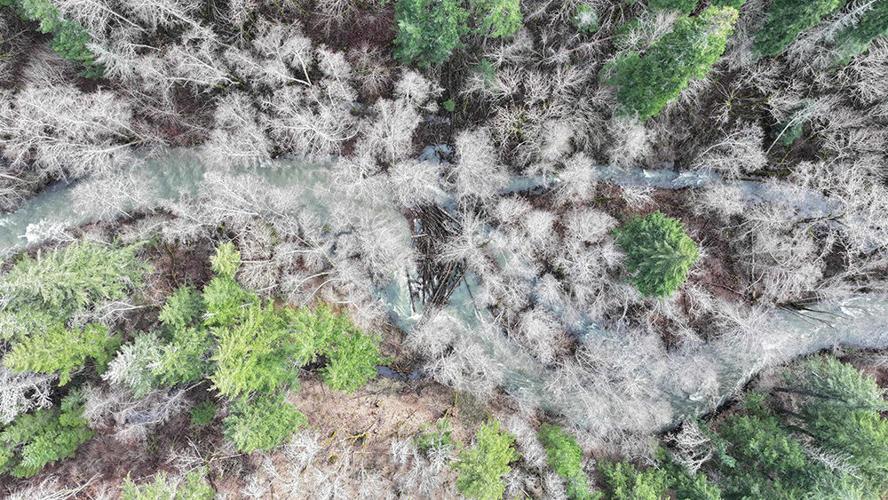
Aerial view of one of the log jams in Rattlesnake Creek.
David Lindley photo
The BRAT model was also used to assess other mid-Columbia watersheds, including the Wind River, Klickitat River and Rock Creek.
While adding wood can benefit nearly all streams of mainstem rivers, Lindley said the team is careful not to propose projects in heavily used recreation areas like the Klickitat or White Salmon rivers. “It’s a rarity to find a place like this,” he said, referring to Rattlesnake Creek. “We’re really intentional about where it’s appropriate to do this type of work.”
One of the pools of slow-moving water formed by the log jams.
Emma Renly photo
Understanding that the creek leads directly to the highly recreated White Salmon River, the design included an oversized “catcher’s mitt” log structure downstream of all the other jams to collect wood. For river users interested in exploring Rattlesnake Creek itself, signs have been installed upstream to warn of the log jams.
“We knew wood would move, and we designed for that,” Lieberg said. “It’s all about finding the right places where that natural movement is safe, for the river and for people.”



Commented