
Pacific Power has been working with Hood River representatives to mitigate concerns surrounding the utility company’s new Wildfire Mitigation Plan, but the conversation has been wrought with frustration on both sides.
The plan involves a variety of measures intended to reduce wildfire risks, including: Increasing the minimum vegetation clearance area around its power lines, additional air and ground line inspections, updating systems with protection and control devices such as wood pole alternatives and covered conductors, training and equipping field crews to monitor for wildfire risks, installing weather monitoring points and sharing data with local weather and fire teams, and mapping its service area to highlight areas of elevated wildfire risk.
(The plan is accessible online at www.pacificpower.net/outages-safety/wildfire-safety.html.)
“I think what is different (this year) is, when we look at the types of what we see is happening, in California in particular, with how fast these things can move, we have to up our game,” said Scott Bolton, senior vice president for external affairs for Pacific Power.
A number of wildfires in California were recently linked to downed power lines, and residents of Paradise, Calif., recently won a lawsuit against Pacific Gas and Electric (PG&E) for negligence following the devastating Butte County Camp Fire in 2018.
“Let’s avoid those situations; let’s protect the public, knowing that we have those measures,” Bolton said.
One aspect of the plan that has local emergency management worried is a measure Pacific Power is calling the Public Safety Power Shutoff (PSPS): Proactively shutting off power in high-risk fire areas during extreme-risk weather conditions.
“This is an emerging best practice for all emergency operators,” said Bolton. “It’s not unusual that if we believe there is an overriding public safety situation to turn off the power.”
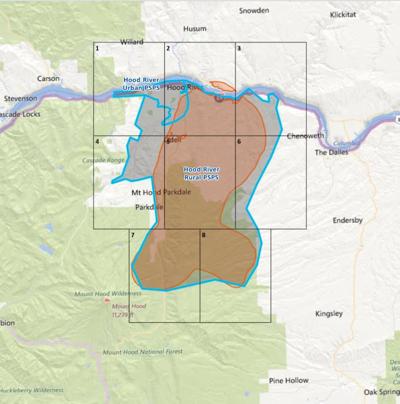
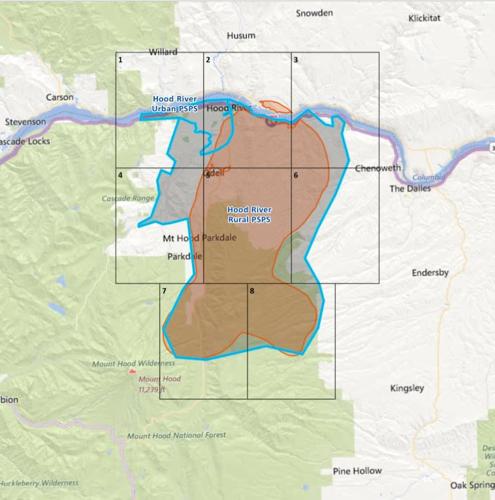
The measure has been implemented statewide and Pacific Power identified an area encompassing Odell, Pine Grove, a chunk of the Mt. Hood National Forest, parts of Parkdale and parts of Hood River as a “fire high-consequence area” and mapped out a “potential Public Safety Power Shutoff area” around it (see image).
“These (areas) are where we have assets,” Bolton said. “Really, when you look at the math, it’s the usual suspects.”
Part of Pacific Power’s Wildfire Mitigation Plan is improving weather monitoring, Bolton added, and he said he expects these areas to shrink going forward.
“I think we would be the first to admit that the plan as it looks today will only be improved and refined,” he said.
Local emergency management coordinators and local representatives, including the Hood River County Commission, Port of Hood River and Hood River City Council, have expressed concerns about Pacific Power’s implementation of its Wildfire Mitigation Plan, particularly citing lack of communication on the PSPS measure and its quick implementation at a poor time — right at the beginning of fire season.
“The response that we’ve had in Hood River has been very interactive and very helpful,” Bolton said when asked by a reporter how Pacific Power has been working with the Hood River community to mitigate concerns regarding the plan.
“This issue came up fast in late May and could have high impact on our community,” Hood River County Emergency Management Coordinator Barb Ayers said in an earlier interview. “It is too close to fire season now, to respond so quickly to such a significant change, with our small county staffs.”
While Bolton said that Pacific Power is working with local groups and has held public informational meetings, County Commissioner Les Perkins said that Pacific Power canceled the one public meeting it had scheduled in June.
“We’re trying to be constructive with Pacific Power,” said Perkins, adding that there is “still not a lot of clarity” surrounding the utility company’s Wildfire Mitigation Plan, and “questions we’ve asked have not been answered.”
“There’s something different happening in Hood River (than in other communities) and from our prospective, we’ve been providing more info,” Bolton said.
When asked by a reporter why Pacific Power decided that the plan, including the PSPS measure, needed to be rolled out in such a short time-frame, Bolton said, “It’s fire season. We didn’t want to go through another fire season being unprepared ourselves.”
For Bolton, “the silver lining to this entire discussion” has been learning “as a company and provider to the community, how can we better improve emergency response.”
The PSPS is intended as a last-resort, Bolton said, and will go into effect on a case-by-case basis depending on certain hazardous weather conditions, including low humidity and high winds. Based on Pacific Power’s weather modeling, Bolton said that Hood River would not have experienced a PSPS in the past eight years.
Despite the apparent rarity of a PSPS occurring, Bolton said it is important to have the measure in place “because of the frequency and intensity of fires we experience throughout the west,” specifically referencing the situation in California.
While Hood River emergency management had previously expressed concern that Pacific Power’s weather modeling wasn’t accurate, Perkins said that Pacific Power “did finally share their data with us and it was much better than we were taking them for.”
But despite the apparent rarity of a PSPS and assurances that a PSPS would only last a few hours, Perkins is concerned about the community impact of a PSPS.
“If we hit that point, you can’t say it (a power shutoff) isn’t going to last for days,” he said, adding that information regarding the process of coming back online after a shutoff has been ambiguous at best.
“It’s not in our interest to shut off power if we don’t have to,” Bolton said. “We want to keep power reliable and we want to keep people safe … if we are doing those two things, then we are doing our job.”
Regarding Hood River emergency management’s concerns surrounding the PSPS, Bolton said, “This has been a bit vexing because other parts of the state have actually embraced this approach,” particularly referencing a “partnership” with Douglas County.
“It’s hard to say” why Pacific Power hasn’t achieved that kind of positive relationship with Hood River, Bolton said, adding that the primary concern he has heard from Hood River is that a PSPS would negatively impact tourism and commerce in the community.
“We don’t believe that is the case at all,” Bolton said. “It’s not the kind of thing that is going to cripple business in Hood River … people have extrapolated to that extreme very quickly.”
If a PSPS does go into effect, Bolton said that its impact likely wouldn’t exceed what the community already deals with in unplanned outages.
Perkins disagrees.
“I don’t think anybody understands the impact of an outage,” he said, adding that Hood River County is trying to find funding to do an economic analysis of a significant power outage.
One of the possible reasons why Hood River has had difficulty dealing with Pacific Power, Perkins said, is Pacific Power’s status as a big company dealing with a small community.
“What’s an emergency to us doesn’t rise to the same level as them,” he said.
One good thing to come from this frustrating situation, Perkins said, is that it draws public attention to Hood River’s infrastructure.
“It’s important for small communities to think about the infrastructure that serves them,” he said, emphasizing the importance of taking responsibility for that infrastructure. “We’re in a really good position to move the ball in some of these (infrastructure) issues,” he said.


Commented