
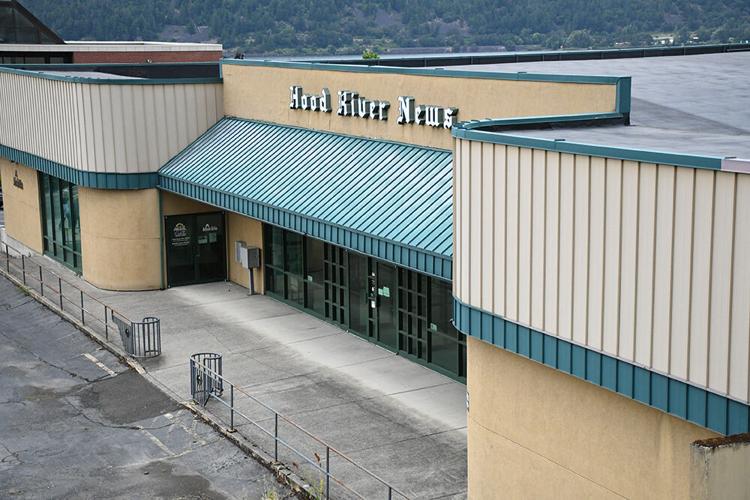


HOOD RIVER — Last January, after multiple hearings and months of public pushback, Hood River’s Planning Commission denied Line 29 Architecture’s application for a 135-room Marriott hotel on the former Hood River News lot, citing compatibility and traffic concerns.
On June 25, eager to ignite constructive dialogue surrounding a refined, condensed iteration of the hotel, the State Street Development Group (SDG) invited neighbors to Riverside Church for a listening session and design workshop.
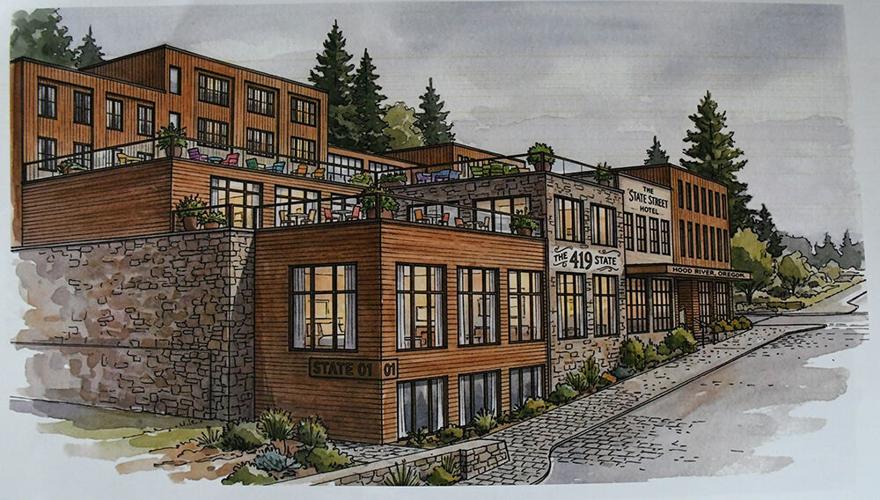
Developers Gabe Duus and Robert Gilham presented new concept renderings that incorporate design tweaks mindful of Sherman Street property owners, Hood River’s architectural identity, and summer parking scarcity, while Mark Vanderzanden, founder of Surround Architecture, facilitated the conversation.
Vanderzanden has overseen around 75 projects in town since 1991, so he’s familiar with its historical character and development regulations; SDG brought him on as both a design advisor and a trusted liaison between developers and residents.
Still a hotel?
Although a previous application was denied and other options have been thoroughly vetted, SDG is firm in its belief that a branded hotel is the best fit for the location, ensuring zoning compliance and financial viability.
The site is zoned commercial and specifically anticipates a hotel due to its high-value location and considerable size, according to Duus. Though the Marriott brand’s involvement has produced reservations for skeptics in previous deliberations, the developers are adamant that its big name is critical to generate enough revenue in a town with a four-month peak season, and it doesn’t negate the building from matching downtown’s historic vibe.
SDG has a housing (large condo) alternative, but the building would be taller, unaffordable, and require less parking under current state housing rules — incongruent with community needs. They argue that a centrally located hotel is the more controlled, smaller-footprint option that still supports downtown business via guest spending.
Workshop attendees suggested several alternatives — modernized civic complexes, grocery stores, farmers’ markets, community spaces, etc. — which SDG and Vanderzanden characterized as welcome ideas that don’t pencil without major public subsidy.
Project scope
One of the chief public complaints about January’s denied application was the building’s massive, view-obstructing size. Thus, one of SDG and Vanderzanden’s primary design goals this time around was to reduce guest rooms and guest areas by 10%, from 135 rooms to roughly 122.
Instead of one long, monolithic building, they’ve transitioned to a cluster of smaller, connected buildings stepped down the lot, with varied heights along Sherman that comply with Hood River’s 45-foot height limit.
SDG’s new concept sketches move away from a starkly modern, cookie-cutter Marriott prototype, implementing brick, stone, and historically referential details that echo surrounding older buildings.
The hotel is intended to be locally-themed and will possess a unique name and identity tied to the history and culture of Hood River.
“The Marriott name is helpful as a platform for getting reservations,” Vanderzanden said. “I don’t think that has to drive what this building is all about, or what this place is all about.”
Parking and traffic
Since parking pressure is already severe downtown, neighbors fear overflow into nearby residential streets and increased congestion on Sherman, State, and nearby intersections.
Vanderzanden emphasized that a downtown hotel encourages guests to park once and walk to restaurants and shops for the remainder of their stay — a better option than a peripheral hotel from a city-wide traffic standpoint, he said.
The developers recommended a broader, operations-oriented parking plan comprising of a hotel-run shuttle to popular recreational and commercial areas, valet, and a bike/e-bike program for guests.
SDG previously proposed a multi-story parking structure on the site of the current lot, which would require the city to sign a long-term lease or buy a block of stalls so the project can be financed. The city has not provided a substantive response, despite letters from the developers and their attorney, he said. Present neighbors said they’d be willing to advocate to the city for this partnership.
Ongoing concerns
Despite the updates, many neighbors still felt a large hotel is the wrong use for the site, fearing increased tourism and loss of local character.
One resident, lawyer Marc Geller, briefly sparred with SDG about the project’s height, which he said would block his view on Sherman and — using his personal interpretation — does not comply with the city’s 45-foot height limit, measuring from the bottom of the site’s gradient to the building’s apex.
Vanderzanden agreed that the city’s height limit is inconsistent and unclear in the way that it’s explained, particularly in how it’s measured on slopes, encouraging people to visit the planning office for a clear explanation of how height is interpreted.
In many cases, in fact, SDG and Vanderzanden told attendees that their complaints are better off directed toward the city, reflecting broader community-level policy issues that one private landowner and development group cannot fix.
Next steps
SDG will continue integrating community feedback to polish its design and work with the city on a possible public-private parking structure. The intention is to seek some level of consensus within 4-8 weeks at subsequent listening sessions.
The meeting closed with a shared appreciation for the dialogue, acknowledgment of differences of opinion, and mutual frustration with some aspects of the city process.
“We’ve spent a lot of money to get to this point,” Duus said. “We can’t keep doing that for the next three years just to try to come up with a consensus. We want to find a consensus, we want to get a group together that says we understand this is a commercial property … and they’re trying to find something that fits, that meets the compatibility argument … I would like to build this hotel … I’d like to build [one] that fits in, that people will enjoy.”
•••
Our journalism needs your support. Subscribe and read more at columbiagorgenews.com.


Commented