
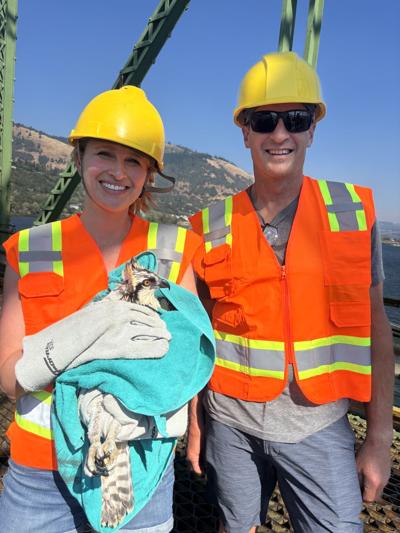
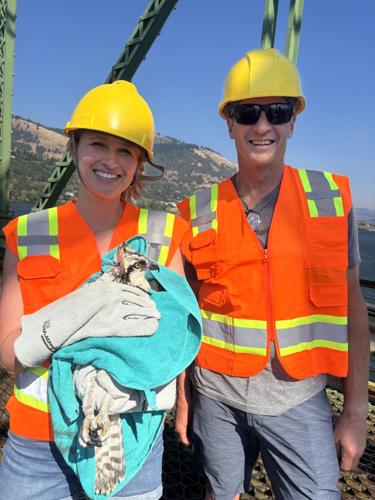
HOOD RIVER — The Hood River-White Salmon Bridge closed on short notice on Aug. 7 for a very good reason.
Just ask the osprey.
The story began Wednesday, Aug. 5, as Angela Alberg crossed the bridge on her way to work.
“I saw people ahead of me swerving to get out of the way,” she later posted to Facebook. There on the bridge deck under the lift span was an immature osprey. “I immediately stopped when I came to it. Traffic stopped both ways as I hopped out of my car, high heels and all. I grabbed my beach towel and slowly approached the bird. She clearly couldn’t fly, and was so scared.”
Alberg drove her new passenger to the lawn at the Oregon Department of Motor Vehicles office in the port waterfront. She then reached out for help, soon contacting Mountain Top Wildlife, a non-profit organization based north of White Salmon. Mountain Top “provides free medical care for wild animals found sick, injured or orphaned,” according to its website. “Patients are treated with the explicit goal to be released back into the wild.”
“It’s pretty amazing that she was bold enough to stop, get out, put her beach towel over it and get it off the bridge,” said Dr. Dave Stauffacher, a Hood River veterinarian. Stauffacher volunteers at Mountain Top Wildlife alongside its founder, Ash Harris, who carries state and federal licenses to rehabilitate injured wildlife. “She waited with it, and I think missed some work.”
“I was available to get over there within an hour or so and collect the bird,” he added.
Stauffacher brought it to Mountain Top’s intensive care facility. “We were able to take X-rays, do general blood work and lead testing,” he explained. There were no fractures or serious injuries. “The bird had its full flight feathers, so was probably about two months old.”
Lead poisoning had sickened the bird. Stauffacher applied chelation therapy – medications that bind to lead in the bloodstream, allowing the bird to flush its system. It would likely recover, but only if it could return to its nest.
“Osprey are not good patients,” Stauffacher explained. Unlike many other raptors, “They don’t eat well in captivity. They still rely on mom and dad to eat.”
The young bird would only survive a few days. It needed to go back to its nest as quickly as possible. It was now Friday afternoon, and the bird had fallen on Wednesday. It was time for a command decision. Enter port commissioner Tor Bieker, who had just attended a port meeting earlier Friday afternoon. He and Stauffacher are friends, and he had already learned of the osprey’s initial rescue. Stauffacher now advised him of the urgency.
Bieker conferred with Kevin Greenwood, the port’s executive director, and the port’s facilities director, Amanda Rose, as well as the Oregon and Washington transportation departments, on an ambitious plan: close the bridge that same afternoon and get the bird back home. Both transportation departments posted closure advisories on their highway signage, while Patty Rosas of the port staff engaged social media.
“I said we need to do this, like today,” Bieker recalled. “Let’s give notice. Let’s do it.”
But the nest was a good 30 feet above the bridge deck, high atop the central lift span. How to return it safely?
By now it was late Friday afternoon, and port staff was wrapping up their day. Nonetheless, Jay Cruz of the port’s facilities staff stepped forward. An expert “manlift” operator, Cruz would take the young osprey aloft in the lift’s bucket.
One more problem arose. There were not one but two osprey nests. Which was the right one?
Oregon’s Department of Transportation (ODOT) entered the scene again.
As Bieker explains, it turns out ODOT recently inspected the lift span. “They provided us with photos of them working on top, and so they were able to verify that the nest right in the middle of the lift span had two osprey.”
With logistics arranged and the correct nest identified, Bieker called Dr. Stauffacher and asked him to bring the bird. It was now 4 p.m. Friday. Stauffacher and Harris delivered. Harris accompanied Cruz in the lift bucket, which Cruz operated while Harris held the osprey. Both were secured by safety gear. They reached the top girders, but were still short of the nest. A stiff breeze didn’t help.
Cruz transferred Harris’s safety line directly to one of the girders, allowing her to climb out of the lift basket high above the deck.
“The wind was just blasting,” Bieker said. “It was a steady wind of close to 30 mph. Our hard hats were trying to blow off. She gets him into the nest, and the bird starts calling to its parents. We saw an osprey rising from the river with a fish in its claws. The osprey flies over. We don’t think it was a parent, since it flew off to the shore. So at this point we’re waiting for an update. We know the other juvenile in the nest has already taken off and is able to fly. This one’s very close.”
“Getting him back in the vicinity of other adults is critical,” Stauffacher explained. “We return them where we got them. Many species are territorial. If you don’t get them close to where they started, they might end up in competition with others of the same species. The shoreline may not have been close enough to the nest.”
As she placed the bird in its nest, Harris discovered a lead fishing weight, providing a likely source of the bird’s lead contamination.
“Lead is a real threat to a lot of birds,” Stauffacher noted. “It’s a huge cause of death among a lot of raptors – lead bullets, or in this case probably lead associated with fishing gear. People can make a conscious choice to look for non-lead weights, non-lead bullets, but you have to take the effort to go find them. That would make a difference for hunters, fishermen and wildlife.”
Mountain Top Wildlife is a relative fledgling itself, created about two years ago as a Washington partner to Rowena Wildlife Clinic, which formed in 2002.
Stauffacher emphasized that the Rowena Clinic’s support has been essential in helping establish Mountain Top Wildlife. Stauffacher has been a vet for 32 years but only recently became involved in wildlife rescue, training first at the Rowena facility.
Ash Harris received her Washington rehabilitation license in 2023 and her federal license in 2024.
“It’s such a privilege to work with wildlife,” Harris wrote in a text exchange two days after returning the osprey to its nest. “This was the best possible outcome—a really special moment! The Port staff and Gorge community were so supportive.”
Bieker cited a “really outstanding job by our whole staff coming together and getting this done.”
“Our vision statement says we stand for outstanding environmental stewardship,” Bieker added, while recognizing the delay motorists experienced during the brief closure. “Here we had a bird in danger of dying from human activity. Hopefully it’ll live a long, happy life eating salmon on the Columbia. It was great. I’m really impressed how everybody came together.”
The day after the rescue, Stauffacher saw a juvenile osprey with an adult on the bridge’s north tower. “I’m encouraged and hopeful that’s our osprey up there,” he said.
“It’s hard to know for sure.”


Commented