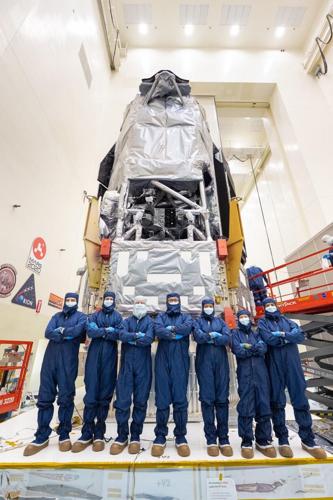
During a key integration milestone for NASA's Nancy Grace Roman Space Telescope, technicians and engineers from the agency's Jet Propulsion Lab in Southern California gather inside the Payload Hazardous Servicing Facility at NASA's Kennedy Space Center in Florida on July 8. (NASA/Jolearra Tshiteya via SWNS)
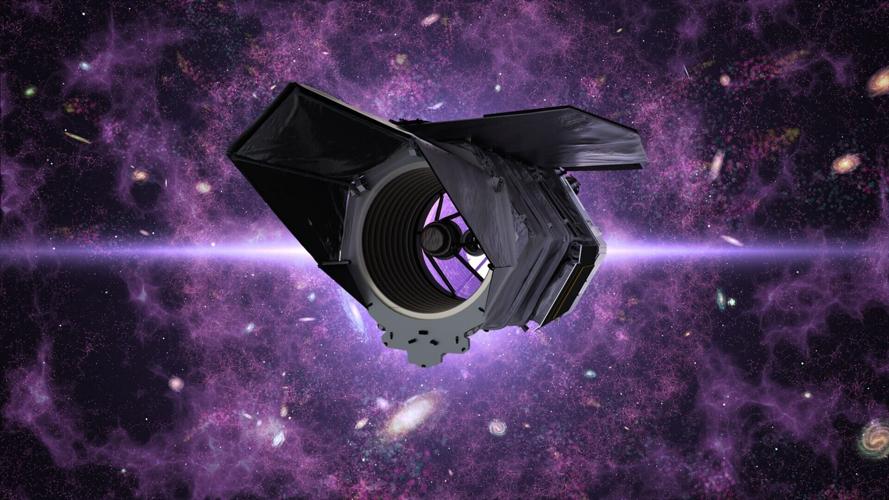
An artist impression of NASA's Nancy Grace Roman Space Telescope. (SWNS)
By Dean Murray
A space telescope set to measure light from a billion galaxies is a step closer to launch next month.
Technicians completed fuelling NASA’s Nancy Grace Roman Space Telescope, which will search for Earth-like planets and explore the mystery of dark energy and why it’s causing the universe to expand faster over time.
The team carefully loaded 290 gallons of hydrazine fuel into the observatory at the Payload Hazardous Servicing Facility at NASA’s Kennedy Space Center in Florida.
While highly effective, hydrazine is extremely toxic, caustic and a known carcinogen, so NASA technicians handling it require specialised protective gear and strict safety protocols.
Named after NASA’s first chief astronomer, the "mother of the Hubble Space Telescope," the Nancy Grace Roman Space Telescope will have a field of view at least 100 times larger than Hubble’s, potentially measuring light from a billion galaxies in its lifetime.
During a key integration milestone for NASA's Nancy Grace Roman Space Telescope, technicians and engineers from the agency's Jet Propulsion Lab in Southern California gather inside the Payload Hazardous Servicing Facility at NASA's Kennedy Space Center in Florida on July 8. (NASA/Jolearra Tshiteya via SWNS)
By Talker
Launching nine months ahead of schedule, NASA and SpaceX are targeting liftoff for no earlier than Aug. 30, aboard a SpaceX Falcon Heavy from Kennedy Space Center.
After launch and separation from the rocket, Roman will use the onboard propellant to perform maneuvers as it travels to Sun-Earth Lagrange point 2, or L2, located about one million miles from Earth.
NASA said: "Researchers are eager to study thousands of exoplanets Roman will discover, to learn how closely they resemble Earth.
"They also will use Roman to study the mystery of dark energy and why it’s causing the universe to expand faster over time."



Commented