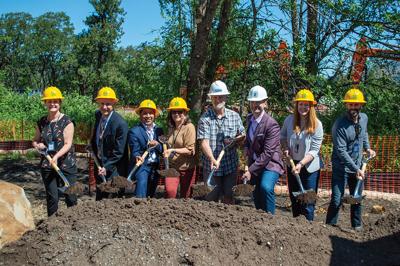
Project partners ceremoniously break the ground at Mariposa Village, Hood River’s largest affordable housing development in over a decade, on May 30. Pictured from left to right are Jessica Woodruff, chief development officer of Community Development Partners (CDP); Phil Brady, board chair of Mid-Columbia Housing Authority (MCHA); Roberto Franco, affordable rental housing development deputy director of Oregon Housing & Community Services; Janet Hamada, executive director of The Next Door Inc.; Paul Blackburn, mayor of Hood River; Bryan Guiney, Oregon field office director for the U.S. Department of Housing and Urban Development; Karen Long, executive director of MCHA and Columbia Cascade Housing Association; and Eric Paine, CEO of CDP. Nathan Wilson photo
Project partners ceremoniously break the ground at Mariposa Village, Hood River’s largest affordable housing development in over a decade, on May 30. Pictured from left to right are Jessica Woodruff, chief development officer of Community Development Partners (CDP); Phil Brady, board chair of Mid-Columbia Housing Authority (MCHA); Roberto Franco, affordable rental housing development deputy director of Oregon Housing & Community Services; Janet Hamada, executive director of The Next Door Inc.; Paul Blackburn, mayor of Hood River; Bryan Guiney, Oregon field office director for the U.S. Department of Housing and Urban Development; Karen Long, executive director of MCHA and Columbia Cascade Housing Association; and Eric Paine, CEO of CDP. Nathan Wilson photo
HOOD RIVER — Construction of Hood River’s largest affordable housing project in over a decade has begun. Set to partially open in summer 2026, Mariposa Village off Rand Road will boast 130 units for working class people and families at a time when funding for federal rental assistance is uncertain.
On May 30, Community Development Partners (CDP) and the Columbia Cascade Housing Corporation (CCHC), Mid-Columbia Housing Authority’s (MCHA’s) development arm, held an official groundbreaking event alongside several partners. With a community garden, park, trail connections and six multi-story buildings, folks earning up to 60% of the area median income ($64,140 for a four-person household) can soon fill the apartments and townhouses of Mariposa Village, intended to shelter both young and old.
“Especially in communities like Hood River, which are very popular to live in and where we all want to come and enjoy and take a vacation, there’s a dynamic that’s really emerged,” said Jessica Woodruff, CDP’s chief development officer. “Families that have been here for generations start to get priced out.”
“People whose work is the foundation of the community — who do the maintenance work of all the infrastructure, who prepare and serve the foods, who clean and staff the buildings — they don’t command the incomes that enable them to compete with higher incomes and tourists for housing,” said Phil Brady, board chair of MCHA. “These 130 units of Mariposa Village are all ways to say, ‘We see you, you belong here, and we believe that you deserve healthy, respectable housing.’”
Servicing that vision, MCHA will provide rental assistance to 39 units through federal housing vouchers for people in greater need. In a central shared building, the housing authority will also offer “Community for All Ages” programming designed to foster connections between children, adults and seniors.
In January 2020, the City of Hood River purchased about 7 acres west of downtown and donated it to the eventual co-developers. Funding for Mariposa Village came from a variety of sources, such as direct appropriations from Congress and the Oregon Legislature along with other state programs and a grant from the U.S. Department of Housing and Urban Development (HUD).
“Affordable housing is never simple. It’s a complex puzzle of policy, financing, design, land use and understanding of community needs. It requires navigating layers of regulation of competing interests,” said Karen Long, executive director of MCHA and CCHC. “But Mariposa village is proof that we can solve that puzzle.”
Getting people into those homes, however, and helping others keep up with existing bills might become more difficult.
While HUD is funded through this fiscal year, the Trump administration requested a $26 billion cut to the agencies’ rental assistance programs in fiscal year 2026, calling the system “dysfunctional.” This includes Section 8, a housing voucher program implemented in the 1970s where tenants with private landlords typically pay 30% of their income toward rent and the government picks up the rest.
MCHA administers federal rental assistance in Hood River, Wasco, Sherman, Skamania and Klickitat counties, and Section 8 is its largest program. Almost all of the housing authority’s funding comes through HUD. Each month, MCHA distributes about $750,000 in rental assistance to 900 households across all its programs. MCHA also employs 24 people, and most of their salaries depend on continued federal funding.
The “big, beautiful” budget bill recently passed by the House of Representatives did not contain specific appropriations for HUD.
“Locally, regionally and nationally we are in a housing crisis. Rents are skyrocketing, new housing development is slow and wages stay stagnant. Cuts to federal rental assistance will exacerbate an already tough situation. Our waiting list for housing assistance is approximately 18 months,” Long wrote over email. “Every day, our waiting list grows longer, and we have people walk into our doors who cannot afford their rent or have nowhere to go.”
Long added that disabled people, the elderly and working families with children each make up one third of the total population MCHA serves.
Over 10 million Americans and about 121,000 Oregonians depend on some form of federal rental assistance. The median rent in Oregon rose 32% between 2001 and 2023, and wages have not kept up, according to the Center on Budget and Policy Priorities.
In the budget request, Director of the Office of Management and Budget Russell Vought called for sending the remaining rental aid directly to states, allowing them “to design their own rental assistance programs based on their unique needs and preferences.”
“Local housing authorities already have the ability to design and create policies based on localized knowledge of programs,” wrote Long. “Moving to a state-based system would remove the local connections we have to the people we serve, the trusted relationships we have built with local landlords, and the local knowledge of what works for our rural community.”
An announcement will be made when a waitlist is available for Mariposa Village. If you have questions or would like to receive updates, email HRaffordablehousing@communitydevpartners.com with your name and preferred contact information (phone, email, etc.).



Commented
Sorry, there are no recent results for popular commented articles.