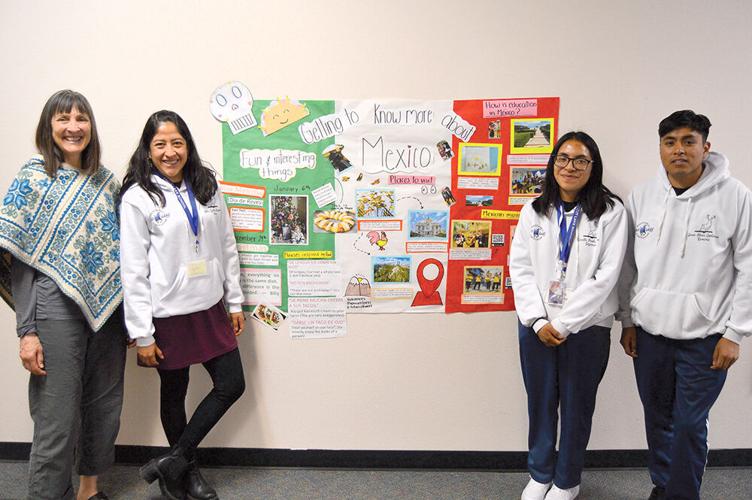
Trout Lake School hosted two student teachers and one instructor from Escuela Normal San Felipe del Progreso, Mexico, in April. From left to right are Virtual Instructor Catherine Brown, Instructor Cynthia Ramírez Pérez, and Student Teachers Lissette Paola Flores Segundo and Josué Alexis Ramirez in front of an informational poster they created to teach students a little about Mexico.Trisha Walker photo
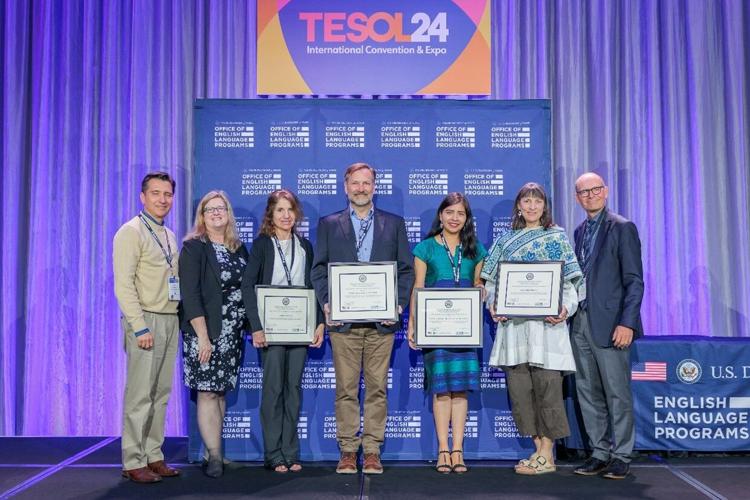
United States Department of State presented a Virtual English Language Educator Partnership Award March 22 in recognition of Trout Lake School District’s contribution in strengthening the relationship between the U.S. and Mexico. Left to right, Jose Manuel Villafuerte, Regional English Language Office in Mexico City - RELO); Susan Bell, director of English Language Programs for the U.S. Department of State; Linnea Jaeger, virtual educator, U.S. Department of State; Matt Ihle, Trout Lake School principal; Gina Monroy, English teacher trainer and representative of Escuela Normal de San Felipe del Progreso, Mexico; Catherine Brown, virtual educator, U.S. Department of State; and David Fay, regional English language officer, U.S. Department of State.
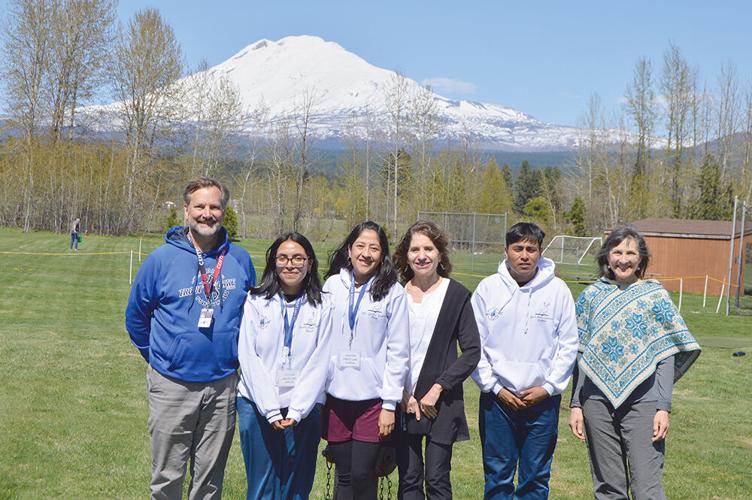
Trout Lake School hosted two student teachers and one instructor from Escuela Normal San Felipe del Progreso, Mexico, in April. Pictured, left to right, are Trout Lake Principal Matt Ihle, Student Teacher Lissette Paola Flores Segundo, Instructor Cynthia Ramírez Pérez, Virtual Instructor Linnea Jaeger, Student Teacher Josué Alexis Ramirez and Virtual Instructor Catherine Brown on the school field. For more photos, visit columbiagorgenews.com.Trisha Walker photo
Trout Lake School hosted two student teachers and one instructor from Escuela Normal San Felipe del Progreso, Mexico, in April. From left to right are Virtual Instructor Catherine Brown, Instructor Cynthia Ramírez Pérez, and Student Teachers Lissette Paola Flores Segundo and Josué Alexis Ramirez in front of an informational poster they created to teach students a little about Mexico.Trisha Walker photo
TROUT LAKE — Trout Lake School made history in April, simply by hosting two student teachers and one instructor from Mexico.
Teacher Cynthia Ramírez Pérez, PhD., and student teachers Lissette Paola Flores Segundo and Josué Alexis Ramirez, from Escuela Normal San Felipe del Progreso, a teacher training institute located about two hours from Mexico City, spent April 14-28 at the school for a bi-national educator exchange.
The exchange was part of a virtual education program in Mexico — and this was the first time a virtual educator had requested an in-person exchange. The program was so notable that a pre-visit ceremony was held at Escuela Normal San Felipe del Progreso, attended by the sub-superintendent for Mexico state’s department of education, the general director for all teacher education schools within the state of Mexico, and two representatives from the U.S. Department of State.
“Bilateral relationships and cooperative projects like this are key to cultivating goodwill and positive relationships between our nations,” said Catherine Brown, a virtual English language educator who additionally teaches English for Speakers of Other languages at Columbia Gorge Community College.
Ramírez Pérez, the department head for the school’s English language development program, wrote a grant two years ago through the United States Department of State for a virtual educator; she was then paired with Brown.
Brown works for the U.S. Department of State as a virtual (meaning online) educator, as does Linnea Jaeger, Husum. After Brown wrote a grant that sponsored Ramírez Pérez at her home as they attended the international Teacher Training Institute for English (TESOL) conference in Portland last year, Brown realized she had a bigger dream — to bring student teachers from the San Felipe del Progreso training institute to the U.S. to experience an American school and community.
“I thought, ‘Trout Lake would be such a wonderful community,’ it’s so open-minded; people know each other,” said Brown. “And [the school is] K-12, so the students could experience many different ages of classrooms.”
Brown approached Trout Lake Principal Matt Ihle about hosting the exchange, who agreed. Seventeen students applied to come, with eight interviewed by Brown, Ramírez Pérez, Ihle and two representatives from the U.S. Embassy in Mexico. Ultimately, Flores Segundo and Ramirez were chosen.
“We had a difficult time narrowing it down,” Ihle said. “There’s a lot of talent, a lot of intellect and a lot of potential in this neighbor that happens to be our biggest trading partner.
Trout Lake School hosted two student teachers and one instructor from Escuela Normal San Felipe del Progreso, Mexico, in April. Pictured, left to right, are Trout Lake Principal Matt Ihle, Student Teacher Lissette Paola Flores Segundo, Instructor Cynthia Ramírez Pérez, Virtual Instructor Linnea Jaeger, Student Teacher Josué Alexis Ramirez and Virtual Instructor Catherine Brown on the school field. For more photos, visit columbiagorgenews.com.Trisha Walker photo
“The State Department is really excited about this program,” he said. “They’re in the business of doing diplomacy and building understanding. And this is that concept, fleshed out in a way that is making an impact on young teachers, but also on the school — learning about what life is like in Central Mexico … I wanted to share an experiential picture of what life is like — for teachers, specifically, learning how to become teachers — so that our kids could see that little snapshot of another culture, another bit of the world.”
Because the exchange was coordinated by both the U.S. and Mexico state departments, airfare, visas and even pocket money were provided “because they know and understand that it’s because we’re going to come and learn about your culture, from your teaching practices and your students, from your world, and take it back to our schools,” Ramírez Pérez said. “Our students in basic education will be seeing the world through [the student teachers’] eyes because of what they have seen … Our students, our little ones, our Mexican students in basic education are going to say, ‘Ah, maybe one day it’s going to be me who is going to the States.’”
The first week of the exchange had Flores Segundo and Ramirez observing Trout Lake students, with the second focusing on presentations — from food to the fact the color TV was invented in Mexico. Ramírez Pérez said the students were also being exposed to resources and materials not common in Mexico.
Host families provided a place to stay as well as support, Flores Segundo said. “Every day is a new opportunity to improve and learn about the community … we feel so grateful for you to give us this opportunity to learn about your country, your culture, your students’ certification. We feel so happy and grateful all the time here in Trout Lake.”
As the team met up in Ihle’s house for departing thoughts, Flores Segundo noted that “my [host] mother told me I was welcome back anytime. I have felt so welcome here … We really don’t want to leave.”
She also said that coming to Trout Lake had given her “new knowledge as to how to improve our teaching practices at school to give better opportunities to our students. We have a new vision about education, about learning and teaching practices … We are better teachers, and of course we can share this experience with our classmates and our students.”
Ramirez agreed, saying the Trout Lake community had been welcoming and friendly, and that he was looking forward to sharing his experience with his fellow student teachers back home. “I really believe that education can change the world,” he said. “So we as teachers have this opportunity to make a difference in the students’ lives, so they can change their lives and the difficulties they face in the future.”
Ihle said that, with so much negative news of the border, the exchange is a way to showcase the positive relationship between the U.S. and Mexico — America’s largest economic trading partner. “I do believe it’s an opportunity to show we’re neighbors,” he said.
“We come here to show that we are Mexicans — we are more than what you can see in the news,” Ramírez Pérez said.
The Trout Lake exchange will be evaluated to see if the goals of the program were achieved and what needs to be adjusted to make it better for both the school and the student teachers.
Ramírez Pérez hopes that more communities will apply for and participate in such exchanges. “I hope this will be picked up by other communities,” she said. “That would be a dream.”
United States Department of State presented a Virtual English Language Educator Partnership Award March 22 in recognition of Trout Lake School District’s contribution in strengthening the relationship between the U.S. and Mexico. Left to right, Jose Manuel Villafuerte, Regional English Language Office in Mexico City - RELO); Susan Bell, director of English Language Programs for the U.S. Department of State; Linnea Jaeger, virtual educator, U.S. Department of State; Matt Ihle, Trout Lake School principal; Gina Monroy, English teacher trainer and representative of Escuela Normal de San Felipe del Progreso, Mexico; Catherine Brown, virtual educator, U.S. Department of State; and David Fay, regional English language officer, U.S. Department of State.
Contributed photo
Award received
The United States Department of State presented Brown, Jaeger and Ihle with a Virtual English Language Educator Partnership Award at the annual U.S. Department of State Awards Ceremony held March 22 in Tampa, Fla.
The award recognizes Trout Lake School District’s outstanding contribution to the program’s success with appreciation for strengthening the relationship between the United States and Mexico through the Virtual English Language Educator Program, said a press release.
“Trout Lake School is excited to share the great experiences of our rural school with early career teachers from Central Mexico who are learning to teach at the same time they are learning English,” Ihle said. “We have so much to share with them while they share their culture and language with us.”
The Virtual English Language Educator Program was launched in 2022 and is a U.S. Department of State public diplomacy initiative that fosters intercultural exchange, according to a department press release. “Through projects developed by U.S. Embassies in more than 80 countries, Virtual Educators work directly with local teachers, students, and educational professionals to improve the quality of English language instruction offered at prestigious universities and other academic institutions,” said the release.



Commented