Some clouds this morning will give way to generally sunny skies for the afternoon. Areas of smoke and haze are possible, reducing visibility at times. High near 90F. Winds WNW at 10 to 15 mph..
Tonight
Mainly clear skies. Areas of smoke and haze are possible, reducing visibility at times. Low 56F. Winds W at 5 to 10 mph.
Carter and Company “muncher” machine, resembling a giant metal horse head, pulverizes 12-foot pieces of bridge deck that crews cut up with saws and torches.
Carter and Company “muncher” machine, resembling a giant metal horse head, pulverizes 12-foot pieces of bridge deck that crews cut up with saws and torches.
HOOD RIVER — The noisy demolition work on Interstate 84 in Hood River was scheduled to be complete by March 3.
With its phalanx of cranes, forklifts, augers and massive “munchers,” it’s been an unusual way for the state to upgrade a bridge.
“We don’t do many deck removals or deck replacements. Normally it’s repairs and a new overlay,” said engineer Trevor Lutter of Oregon Department of Transportation.
“There’s quite a few steel structures but not old ones like this that are on an interstate,” added ODOT engineer Corey Kunze.
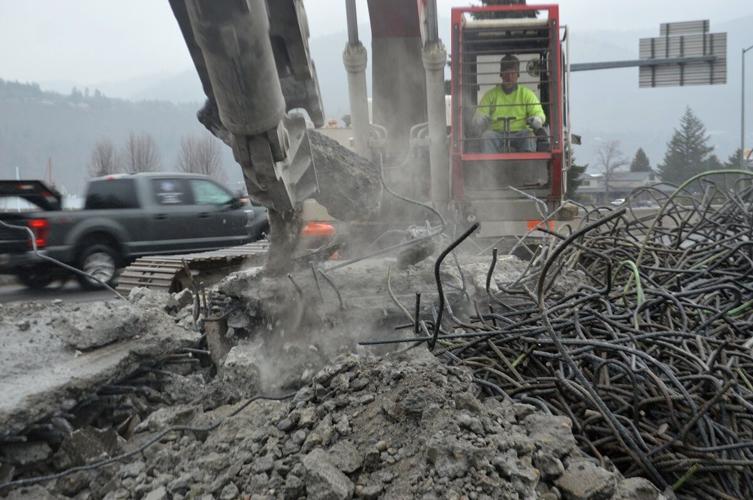
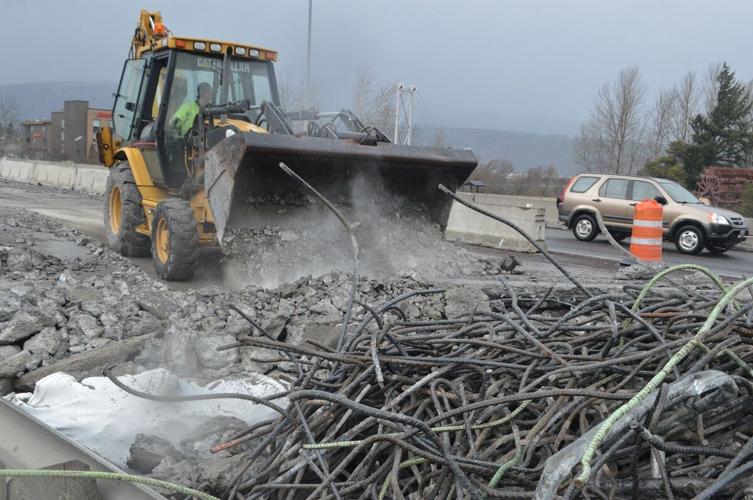
A load of debris is piled up after the “muncher” machine pulverized the concrete and separated the rebar and other metal.
Kirby Neumann-Rea photo
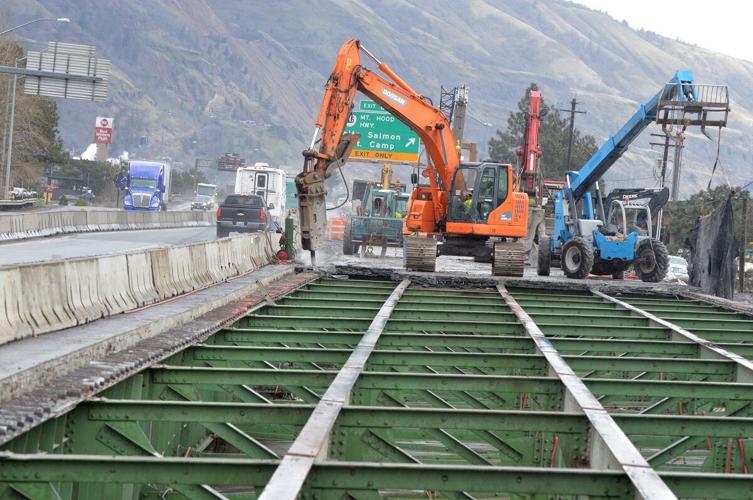
Steel beams are exposed and an auger perforates another concrete section of Interstate 84 near exit 63 in this view looking east in Hood River.
Kirby Neumann-Rea photo
In this case, the crews are taking the bridge down to its steel skeleton, built in 1952, and “all of our structure guys think it looks great,” Lutter said. Kunze and Lutter said the palpable bounce felt on the bridge as work goes on is typical for freeway bridges and evidence of their structural resilience to the weight and motion of regular 70-mph traffic.
Part of the mostly-asphalt freeway, the concrete portion is technically a bridge that dates to when the freeway was first constructed.
Now that the bridge has been whittled down to steel, the next phase is to place a protective coating on the steel, covering the lead paint that has been in place for 70 years, according to Kunze.
Crews will then install what is known as “falsework,” the wooden forms for the new concrete, a lighter-weight composite material that will go down to last the next few decades.
“What they’ll essentially do is build the shape of the new bridge,” said Kunze.
While snow and days of high winds interrupted the flow of work, the project remains on schedule.
“We had a few days with the snow where we were shut down,” Lutter said. “They did a lot of overtime and are caught up.”
Carter and Company supervisor Jim Califf said, “We’ve been putting in some long hours, the guys have been working real hard, but we needed to get caught up.” As slanting rain fell Friday, he joked that, by comparison, “this is great construction weather.”
The is the second bridge deck project between exits 63 and 64 on Interstate 84 in recent months; the west-bound lanes at that location, structurally a separate bridge from the eastbound, was repaired in fall 2020. The western bridge was built in 1962 and added onto about 20 years ago, meaning it required repairs and a new overlay rather than removal.
The first phase of the eastbound replacement was to install a wide catwalk under the bridge to catch material before it falls into the Hood River. Crews worked in 10-foot stages removing first the concrete guardrail and then every piece of concrete coming into contact with steel girders and bolts. All that debris was collected in a hanging tarp and secondary tarps below, brought back up the bridge deck, and systematically pulverized, the metal rebar and pipes placed in separate piles. That incremental process was repeated as the deck pieces themselves were cut up with concrete saws, the rebar severed with saws and acetylne torches.
Gnarled rebar and piles of concrete rubble from the bridge demolition will no longer be a familiar site between exits 63 and 64. The metal is taken to Portland for recycling and the concrete, which is turned nearly to dust on site, is being trucked to Rapid Ready Concrete in Bingen, to become new material that could very well end up back on the Hood River bridge.
Motorists should be aware that the serpentining traffic pattern over the Interstate 84 will remain in place until the project is done, prior to Memorial Day in late May.
Replacement was needed because as recently as a few years ago, pieces of the freeway bridge were literally falling out, and the lanes became a patchwork of repairs ODOT contractors had done in asphalt or concrete and a composite repair material.
The largest hole was one three feet wide that appeared overnight about 10 years ago.



Commented