
By Charlie Vanden Heuvel
Columbia Gorge Beekeepers Association
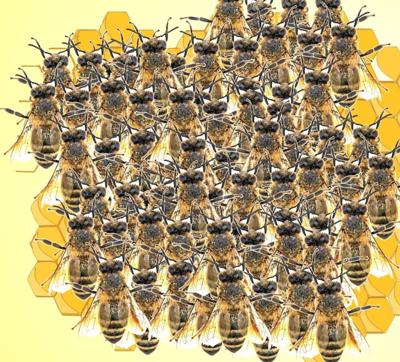
Honey bees thrive through the winter months as a colony while Native Bees only dwindle their population to a hibernating queen. The honey bees downsize their population beginning in July, downward to around fifteen thousand from the peak of fifty thousand.
The peak population is vital to the enormous work the colony must perform in preparation for the impending winter. The bee colony is perpetually focused from the January revival toward the season’s end with winter.
They must sufficient nectar, pollen, propolis and water to bring the brood (babies) into adulthood, sustain the adult in their duties both inside the hive and the more rigorous duty in foraging for stores.
The forager bees comprise the second half of the bee’s life. The last two or three weeks of a six-week life. Their focus is to accumulate sufficient nectar, which is dehumidified from seventy percent water down to around eighteen percent as it becomes honey.
The managed hive, the ones in backyards or commercial operations, should begin the winter with around one hundred pounds. This metric is used as it defines the amount of honey present.
Honey nutrition is comprised of pollen, a protein, for the building of the bee’s body. Nectar, a carbohydrate, essentially becomes the energy vital to the work effort.
Foraging bees are sustained by nectar alone. They only require energy. Nectar is predominately sucrose, monosaccharides, glucose and fructose.
Consider honey as compressed nectar. This maximizes storage compacity.
As temperatures fall below sixty degrees, the colony begins to cluster into a soccer ball shape. The queen takes up a center spot, as she is the most vital member. The queen must be protected. No queen — no colony!
The outer one to two inches of the cluster are worker bees forming a insulation layer to keep the heat within. This layer intertwines its body hairs with the adjacent bee to tighten the layer, preventing cold air to access the inner portion.
The inner occupants of the cluster place their wings at rest. Unlike humans, whose structural movement is dependent on muscles attached to tendons which attach to bone, the honey bees’ flight muscles never come in contact with the wing.
The wings rest in a socket on the thorax of the bee. Inside the thorax are four flight muscles: two vertical and two horizontals. The articulation of these muscles flexes the exoskeleton of the thorax which in turn causes movement of the wings.
During the winter months these muscles begin to move around two-hundred and fifty times a minute, altering to a vibration of around fifty-thousand per minute. This vibration translates into heat.
The enormous effort to sustain the muscle activity demands energy, which of course is offered by the stored honey. Isn’t nature awesome! To sustain the life of the honey bee, it forms a partnership with the surrounding environment. For without the surrounding flora offering nectar and pollen there would not be any bees.
The cluster begins to form in the lowest point in the hive, or if feral their home in a tree. The girls begin a slow rugby huddle scrum advance upward imbibing honey along the way.
What can go wrong? Should the environment not afford copious offerings of nectar, the honey stores become insufficient to thrive through the winter months.
Anyone living in the Columbia Gorge is blessed by the abundance nature offers. For the western half of the Columbia the predominate nectar source comes from Blackberries. The fruit orchards would seem to play a role, yet the abundance of flowers offered by the Blackberries is greater.
Similar to humans, a key survival of the honey bee’s element centers around nutrition. Accumulating nectar and pollen supports the bee’s nutritional needs. Since the honey bee colony cannot forage during winter months it is reliant on the availability and opportunity of the spring and summer months.
The downsizing of agricultural lands limits the vital nutritional requirements of those reliant on the source. For those in the Columbia Gorge, creating a garden, a floral patch of plants, goes a long way to participate in the survival of our nature.
SO, WHAT CAN YOU, THE READER, DO? Planting pollinator foliage around your property, especially ones that bloom in the late summer to fall.
This year the USDA downsized the number of honey bee labs in our country. This at a time when the honey bee needs the vital research tosustain them. This means greater emphasis on local labs, for us the Oregon State University Bee Lab and the Washington State Bee Labs. Research requires money.
Consider dispensing a few dollars toward Project Apis m in support of their funding (https://www.projectapism.org/partners/#give).
The Columbia Gorge Beekeepers Association meets on the third Wednesday of each month,
http://www.gorgebeekeepers.org/, at the Hood River Extension, 2990 Experiment Station at 6:00 PM. All are welcome. Visitors may attend in person or via Zoom. You may reach out to the club for login information - admin@gorgebeekeepers.org.


Commented