
By Nathan Wilson
Columbia Gorge News
THE GORGE — Washington’s Energy Facility Site Evaluation Council (EFSEC) will hold additional hearings to determine whether the Cascade Renewable Transmission Project is consistent with applicable land use laws, the agency decided during an Oct. 21 meeting.
Compliance with the Columbia River Gorge National Scenic Area Act is also on the project’s long list of regulatory requirements, and some groups argue that existing rules outright prohibit it.
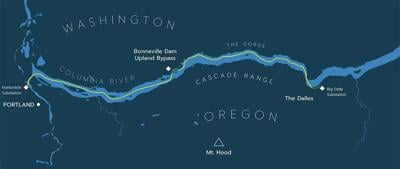
If approved, the first-of-its-kind venture would see a 1,100-megawatt transmission line capable of powering 800,000 homes stretch about 100 miles from The Dalles to Portland, largely underneath the Columbia River. While not yet confirmed, Chris Hocker of leading developer PowerBridge previously told Columbia Gorge News that Portland General Electric would likely be the principal buyer.
Numerous environmental organizations and the four Columbia River treaty tribes have expressed concerns over the project, primarily because of potential impacts on inundated cultural sites and endangered fish species — whether the cable will further warm river temperatures, how sediment dispersed during the burial process affects aquatic health and if electric fields could distort salmon navigation, among others.
“I know we’ve probably met the legal requirements, but under good governance and good representation, I have to ask the question: Did we meet the people’s requirements and expectations?” Asa Leckie, EFSEC council member and Skamania County commissioner, said during last Wednesday’s meeting. “From a local perspective, the perception is that we didn’t.”
EFSEC held informational and land use consistency hearings in each of the three Washington counties that would host a cable segment — Klickitat, Skamania and Clark — last November. However, hearings in Skamania County weren’t noticed in the newspaper of record, the application was still in draft form and several representatives from local jurisdictions, like Leckie, hadn’t yet been appointed to EFSEC.
As a result, there was broad consensus among council members to hold additional hearings; the main disagreements were how many and whether another round of informational hearings was necessary.
EFSEC ultimately decided to hold one land use hearing in each county, but Friends of the Columbia Gorge and Columbia Riverkeeper took several procedural issues with the vote. Both sides have different interpretations of whether legal requirements have been satisfied.
“It is a mystery why some council members have so far been unwilling to fix this situation,” Nathan Baker, senior staff attorney for Friends, said over email. “Proceeding without the required informational public hearings will further violate the law and place the entire decision-making processes in legal jeopardy.”
A spokesperson for EFSEC said that the agency is reviewing the concerns raised by the environmental nonprofit groups. More details on where and when the hearings will take place are expected soon.
Gorge Commission
By running between two states, beneath a federally managed waterway and through 14 municipalities, PowerBridge and its affiliates must acquire dozens of local, state and federal permits, including a site certification from EFSEC.
While what role the National Scenic Area Act would play in the project hasn’t been clear, council members discussed that at length during their monthly meeting in September. Then, EFSEC’s legal counsel formally laid out its position in an Oct. 8 summary of public comments received.
“Approval of the proposed facility for purposes of the National Scenic Area Act, if such approval is legally allowable, will have to be obtained outside of a site certification agreement,” the document reads.
The bi-state compact established the Columbia River Gorge Commission, which administers a management plan and oversees land use decisions outside of urban areas across six counties, from Wishram to Washougal in Washington. EFSEC has the authority to essentially void local and state land use code if a project is deemed important enough, but since the act, management plan and associated ordinances adopted by counties are federal, Gorge Commission review is required.
Part of the cable crosses on land, and into the Gorge Commission’s jurisdiction, to bypass Bonneville Dam in Skamania County. Since Klickitat County has not adopted a scenic area ordinance, the commission directly oversees land use decisions there, too.
Additionally, Friends of the Columbia Gorge and Columbia Riverkeeper have long contended that the project is prohibited in the National Scenic Area because it’s not explicitly listed in the Gorge Commission’s Land Use Ordinance, and that the agency has authority over the in-water portions as well, effectively threatening the entire project.
“The Gorge Commission has not and cannot take a position on whether the proposal is prohibited under the National Scenic Area regulations,” Executive Director Krystyna Wolniakowski said over email. “Doing so would create a conflict with its role as an impartial appellate body.”
Wolniakowski did not specify whether she agrees that the National Scenic Area encompasses the Columbia River, only that her agency has policies on the books for lands and shorelines in the six counties.
Environmental review
EFSEC’s evaluation of whether the Cascade Renewable Transmission Project is consistent with local land use laws also runs parallel to its environmental review process. This past May, EFSEC issued a “determination of significance” under Washington’s State Environmental Policy Act, which requires a detailed analysis of the potential impacts, alternatives and mitigation measures.
The U.S. Army Corps of Engineers is currently working on the draft environmental impact and expects to begin a 45-day public comment period sometime this winter.
Across the river, Oregon’s Department of Energy is moving through a similar siting process, but the project’s application has not yet been deemed complete.


Commented