
Martin Gibson
Columbia Gorge News
THE GORGE —
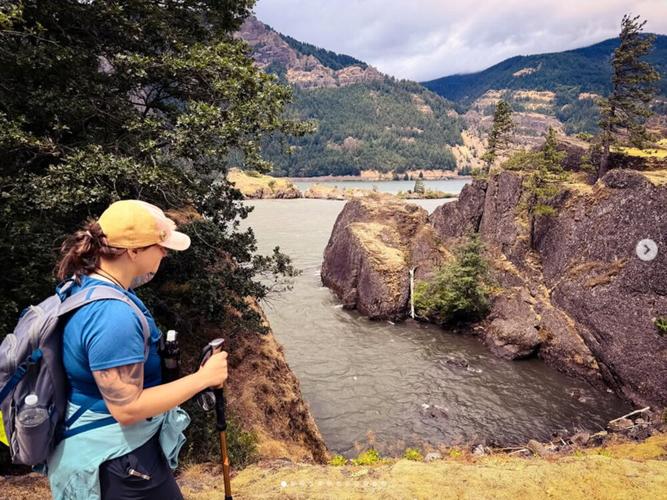
This summer, Djuli Lomboy walked over 200 miles up the Big River, a prayer walk done in protest of the Hanford Nuclear Site and other industrial impacts, and a project she says was given to her by the land. Now she’s organizing others on behalf of the river.
Djuli Lomboy is an enrolled member of the Confederated Tribes of Grand Ronde, a descendant of Klickitat, Molalla, Mosco, Chinookan, Klamath, Filipino, Scandinavian, French Canadian, and German people. “I’m just a small town gal that was given a task by the land and the ancestors to advocate for those that can’t fight for themselves,” she added.
Lomboy grew up in Sandy, Oregon. “They really did assimilate us. And it was only until my late 20s did I learn about the effects of colonization and the genocide against my ancestors, and about the boarding schools,” in which several generations of her own family had their language and culture forbidden to them. “Upon learning these things, I knew that I couldn’t just blindly follow. And I had to continue pursuing more and more education and knowledge of the world around me,” she said.
“You grow up feeling so disconnected from the powers that be and the government,” she commented, unable to change the way things work. “I hope to at least inspire a couple of people to feel empowered, that we don’t have to be passive participants in this world,” she said of her walk.
She started her prayer walk near Astoria, walking as close to the river as she could, toward the Hanford Nuclear Site in Richland, Washington.
“It was a given to me — the objective, the task — after spending time along the Rogue River at some traditional places, Table Rock, and with community engaging in culture. And I had just learned about the Hanford Nuclear Site this last year, and I didn’t realize that there were these giant storage vats full of nuclear waste that is actively seeping into the soil. And I also learned about the AI data centers popping up all over the place, and the plans to put them along the Columbia River along with the nuclear power plants, [that] they want to add to the Columbia River — to simply just add power for the AI data centers — not even to help us common folk, or to diminish our dependence on the dams, which have radically impacted the rivers, the tributaries, and all of the inhabitants.
“And so I knew I had to use my body as best I could, and to speak up for those that are incapable of doing so.”
This is her way of speaking up. It worked.
“I had fear of it being shut down before it even started. I had fear of being persuaded or pressured to stop. But there was an outpouring of support and encouragement and I didn’t imagine it touching so many people in the heart and in the soul,” she said.
“After the first on the first day, I finished my 10 mile hike, and the camp, the area I intended to camp wasn’t very safe. There was a gentleman that just kept kind of lingering around me,” she recalled. “I made the decision to call for help.”
She asked a roommate to driver her to the next campsite, but he said, “All right, it’s time to admit defeat. You know, let’s go home.” Devastated, she returned. But realizing nothing ever goes according to plan, she set out again a few days later from the Longview/Kelso area which has “great importance” as an old burial ground, now industrialized, where the implosion of a 900,000-gallon tank of white liquor at the Nippon Dynawave Packaging facility leaked toxic chemicals into the river this May.
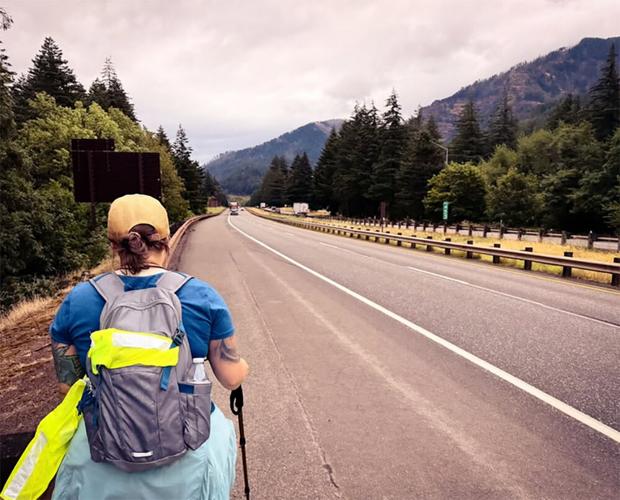
She had to walk I-84 most of the way, watching for reckless drivers. In places she could not get close enough to see the river. A few “incredible times” she walked beside the water. But those experiences were few. “It really highlighted how disconnected we are from the river, and how it is such a luxury to be able to engage and experience it,” she said. Private property, industry, and lack of paths made it “really a challenge.”
“...this was a way of giving my body to the land through the pain and sacrifice of time, and truly all my resources. I mean, I spent every penny I had on this hike,” she said, along with all her paid time off and quite a bit of unpaid time.
“When it came to me, it just was as if like I had always known. It’s it’s it was like an epiphany, and it was something that I didn’t question or doubt a single moment.”
“I mean, there were a few times on the hike where I was like, ‘What am I doing? Why am I doing this?’ Because I’d say about 85% of the hike was along the Interstate, so that was incredibly physically taxing, mentally, emotionally just walking in the under the sun on the asphalt against traffic, and you really see how reckless people are as drivers. The amount of roadkill you see; the amount of dead bees and butterflies, deer, birds, owls, little birds.”
“I’d be in the heat, finding a shady spot, and just like — questioning my decisions, and in pain, and just wanting to just like — ‘Oh, I could call an Uber right now,’ you know. And then I see a ladybug,” she said. Ladybugs are “definitely my animal” and the wild creatures reminded Lomboy of the reasons for her walk.
At one point, a dubious person in The Dalles tried to stop next to Lomboy on the trail. But she said she felt relatively safe from people.
Despite the highway, the heat, and the industrialized riverbanks, she found many “surreal and kind of magical” experiences: Walking at sunrise, “just experiencing the world in its stillness and the beauty that just naturally comes from everybody around you,” she said. A hem-latet, or turkey vulture, hanging on the wind beside her. A giant bald eagle, eating his breakfast, near Cascade Locks. She got to ride in a traditional canoe. She gained “a much deeper appreciation and respect for the river,” she said.
“Some people seldom get to experience that level of intimacy with the land because they’re so forcefully immersed in the colonized system, that they can’t escape to it...” She added, “It’s like, oh, sleeping in the rain is not fun. Having your stuff get soaked isn’t fun. But it’s like, what a privilege it is to be able to be out there in the rain and experiencing that, you know?”
Lomboy reached the Deschutes River by July 5. There a family tragedy sent her back home for a few days, before she completed the last stretch to the Hanford Nuclear site.
“I was appalled,” she said of the Hanford Nuclear Site. The last few miles were lined with “fun facts.” “Fun Fact: The Hanford Nuclear Site was a secret government project that only a few people knew. Fun Fact: there’s nuclear waste leaking, but they’re working to clean it up. I just couldn’t... And that’s not putting any pressure, accountability on the government or the organizations that are contributing to that.”
She stopped briefly at a business named “Bombing Range” before breaking down. “I started bawling, and I just had to go sit under an oak tree and just smudge and sing, and just... I was like, ‘I made it here. I’ve seen, and I don’t need to do any more.’”
She plans some presentations and discussions of her experience, and is gathering tools and resources to “help empower people to be greater advocates on their own, and hopefully together.”
She noted people ask for this to be an annual event, but that seems impossible: She can’t imagine putting others in danger walking 200 miles down I-84, and she doesn’t want to experience that again, either.
Accessing the water “really is almost a luxury, and that’s not even just for us humans... this is the reality of so many around us, and they’re stuck being in this noise and chaos and stress, and with the river so close yet so far and so challenging to engage with,” she said.
Lomboy said the idea of a prayer walk is mostly her own. “Ceremony was really stolen from us, and up until the late ‘70s, it was illegal to even practice ceremony,” she said. “And what I find is, sometimes in a modern-day world we have to find modern practices to be able to connect with our culture and to the spirits and the world around us. And that was me kind of taking it in my own hands.”
Indigenous or not, people often need to re-create their own ceremonies for this, with older ones lost. “We are all victims of colonization,” she said. “I mean, it doesn’t matter what ethnicity you are. We are all victims of it, in one form or another, and we all deserve and need healing to be able to grow as a society. And once we heal ourselves, we can really focus on and heal the land. And I wish that for everybody, truly.”
If others are inspired to follow her example, she offered encouragement and support of that. “I would definitely encourage anyone to pursue connecting with the world around them, and putting pressure on the government I think is always a smart thing,” she said.
“I really hope to inspire people that we don’t have to follow any one path that’s already built. We can create a new path,” she said, adding later, “I hope to spark something in somebody, even if it’s just one person. There’s always a ripple effect, always.”


Commented