Director of School Safety and Security Kyle Rosselle
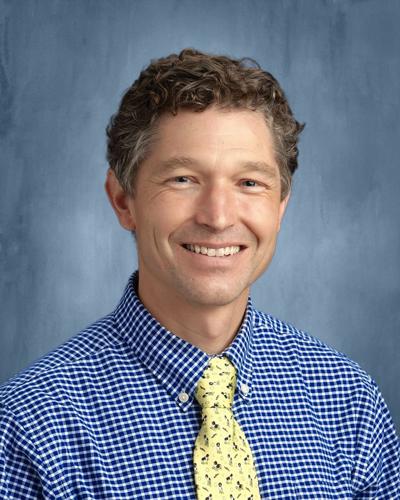
Hood River County School District Chief Financial Officer Doug Holmes
Director of Operations Todd Rainwater
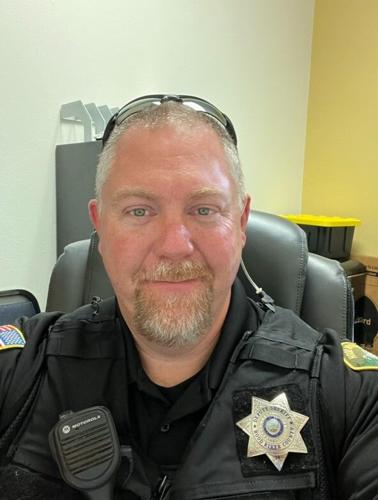
Student Resource Officer Pete Hughes
HOOD RIVER — The Hood River County School District Board of Directors received a Core Values update on operations and safety at its Sept. 13 meeting.
Human Resources Director Gus Hedberg, Director of Safety Kyle Rosselle, Chief Financial Officer Doug Holmes and Director of Operations Todd Rainwater — the district’s safety team — and Student Resource Officer Pete Hughes outlined the Continuous Improvement Plan Data Review for Operations and Safety for the 2023-24 school year, as well as a proposed Action Plan.
The plan includes district staff practicing a reunification drill by next May in addition to regularly scheduled emergency drills, details of which will be sent to families.
Taking data from last spring’s core value survey, Hedberg said two key points came out of student responses: The need to practice emergency drills in a variety of settings (including lunch, echoed by staff) and ensuring all students have someone they trust and can talk to at school.
Staff responses also pointed to a need for some work area upgrades and a suggestion to place emergency kits in classrooms; parents said they want more information on school emergency plans and have concerns about school safety.
The district’s strategic plan includes the goal to “prioritize health and safety as a critical component of school success,” Hedberg said, that “all facilities are maintained in a manner that supports student learning and safety,” and “school safety procedures are effective, practiced and always improving.”
Rosselle said the reunification drill is “a huge undertaking” and will take time to coordinate with its partners, the Hood River County Sheriff’s office, Hood River Police Department, Hood River Fire and EMS personnel and the Oregon State Police.
“We’re going to fall short, which is why we are going to practice these drills, to see where our systems fail and where we can make adjustments,” Rosselle said.
“If we don’t practice this stuff, we won’t be ready when the time comes,” Hughes said.
Hughes discussed the collaborative relationship between local law enforcement, fire and emergency medical service, the hospital and the school district, which he has been a part of since it was established in 2008. “I can tell you, 100%, we were ahead of the game in coming to the table and starting to talk about stuff when it comes to safety,” Hughes told the board.
Board Member Corinda Hankins Elliott (position 3) highlighted that the partnering agencies take an informed trauma approach to emergency management, as studies show that lockdown drills and active shooter drills can cause a significant amount of trauma to students. “The fact that you guys include that as part of your planning and offer services and behavioral health after those [drills] and making sure we can talk to parents about them, I think that’s essential. We really want to make it a learning experience, not another trauma because of what might happen to them now.”
“Since our inception of this … we go into every single classroom and talk to the kids in every single drill that we do,” Hughes said. “It’s not a process where some police officer is stomping through a door and yelling — we come into the class and we say, ‘Hi,’ and ‘Hey, you guys did a great job,’ and talk about the reasons why we’re there doing that stuff.”
He also talked about his role as School Resource Officer, a partnership between the sheriff’s office and the district. He teaches a career-tech class in First Responders and public safety at Hood River Valley High, which has made him a known presence at the school. While he wears a uniform, his focus is on education and prevention.
“For me, that’s been a fantastic way to connect with those kids out there, to get them in,” he said. “… I’m trying to educate kids on ‘See something, say something.’ And it really allows me to connect with those kids, so now when I see them in the hall, they can come tell me something because they trust me because I’ve been in class with them.”
Another action item on this year’s docket is the development of a deferred maintenance plan for all buildings based on the prioritization of needs.
Rainwater gave the board an overview of the district’s current maintenance and custodial staffing levels regarding that action step. Currently, there are eight full-time employees who maintain the district’s 12 facilities and grounds, and 31.5 full time employees who clean those facilities. To put it in perspective, the district has 5,521,665.5 square feet of ground, and 1,543,876 square feet of facilities.
“We’ve done some revamping within the department in the last couple of years, and we have some folks who are specializing now,” Rainwater said; for example, there is now an HVAC technician to keep up units across the district. There is also a grounds team “so we could do more work on the upkeep,” he said.
The team plans to have a deferred maintenance plan by May 2024.





Commented