
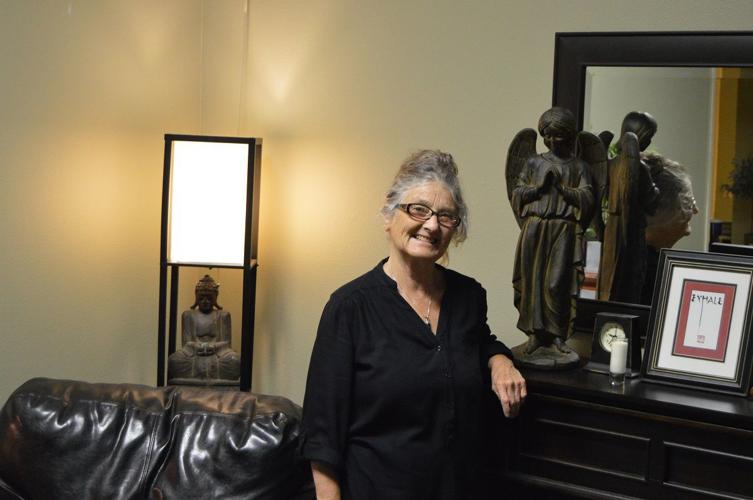
As a child, Diana Blackmon would often hear she saved the best for last, and that’s how she feels about her practice, Reflexology Hood River, located on Sherman Avenue.
“In my life, all the different things I’ve done, this type of work I’m doing now is the most rewarding, most fulfilling, most enjoyable work I’ve ever done,” she said. “I’ve saved the best for the last.”
Before becoming a reflexologist, Blackmon worked as an office supervisor in an out-patient mental health clinic in Eugene. But she’s also worked as a landscape gardener, a clay sculptor, and does writing and editing work in her other business, Lucid Word (lucidword.com).
But her main focus is reflexology and Reiki.
Blackmon started with Reiki — “energy work” — in 2010; she has a Master of Attunement. She saw positive results for her clients, but wanted to do something “more recognizable.”
That led her to reflexology in 2013.
“Reflexology, as obscure as it seems to be, has way more recognition than Reiki,” she said.
She is certified through the American Academy of Reflexology and is working on her national certification through the American Reflexology Certification Board. (Reflexologists are not required to be licensed through the State of Oregon, as massage therapists are.) She also serves as president of the nonprofit Oregon Reflexology Network, whose mission is to help people learn about the practice.
To put it in layman’s terms, reflexology promotes well-being throughout the body, stimulates nerve pathways and breaks up chemicals collected at the nerve endings, and increases circulation so the body can return to its natural state of balance, Blackmon said.
“It’s not so much that reflexology heals, it’s more that it brings about a state within your own body that allows healing,” she said. “All the cells in the body are getting fresh oxygen to repair themselves and get things done. It’s extremely healthy for the body.”
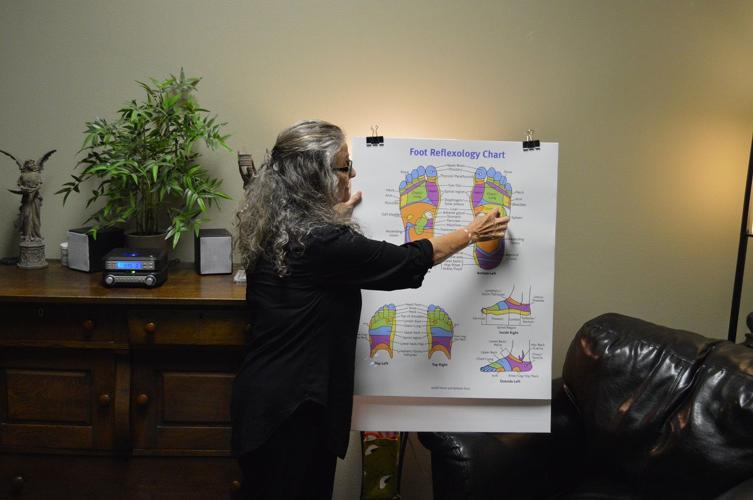
Blackmon uses special charts that connects different parts of the feet and hands to every organ in the body. Although often confused with foot massage, the methodology and intention are different, as Reflexology uses specific thumb and finger techniques to get to the third and fourth muscle layers.
“Underneath the first two (muscle layers), that’s where the nerves start showing up,” she said. Getting down into those layers, “you will often feel what we call little crunchies — it feels almost like grains of sand underneath the skin … It releases those chemicals and that can relieve pain, not only in the area where the chemicals are built up in your toe, but also possibly on the Reflexology chart for the neck or whatever it is (causing pain),” she explained. “That’s the part that makes the most sense to me, that we’re reflexing to remove those chemicals that, according to the maps, relate to all those different parts of your body.”
People see her for a variety of reasons, from pain issues to stress relief. She generally sees those with pain concerns weekly; once patients start feeling better, she suggests bi-monthly or monthly maintenance. For those with lesser issues, a monthly session may be all that’s needed.
As she is not a licensed massage therapist, her sessions are not covered by insurance. She charges $25 for a half-hour and $50 for an hour, with a 20 percent discount to first-time clients.
For those interested in trying reflexology, she can be found during First Friday at The Pines, giving complimentary 10-minute sessions. She also recommends visiting her website, Reflexology Hood River (www.reflexologyhoodriver.com), because it contains Reflexology pressure point charts as well as additional information.
While there isn’t a scientific basis for Reflexology, a Spanish doctor is attempting to create a scientific explanation for the benefits people receive. At this point, all evidence is anecdotal — but there is a lot of it. Blackmon commonly hears clients say — after they wake up — that they’ve never felt so relaxed.
“A lot of times, people will say, ‘I feel a little spacey!’ There’s a mental/spiritual place that you can reach during Reflexology or massage, or any kind of healing body work where the body is just working really well,” she said. “When that session is over, you feel different, so it could take a little while to gain your equilibrium.”
Blackmon never intended to move to — or practice in — Hood River. She had planned on retiring to Florence, Ore., where she had a “great little house down there,” she said.
But in September 2009, it was here she came.
“My son was living here at the time, and he said, ‘Mom, I think you would love Hood River. I think this might be your spot.’ So I came up and visited a couple of times,” she said. Those visits only lasted a couple of days each, so her son invited her to stay for the week.
“At the end of five days, I had bought my first kayak and I knew I wanted to move to Hood River,” she said. “And a month later, I moved.
“Hood River is such a fun place to live — there’s so much going on: Dancing and music and … I even started playing the electric bass guitar! Hood River has just been another whole happy chapter.”


Commented