THE DALLES — David Jensen, Mid-Columbia Fire & Rescue’s (MCFR) new chief, had an ideal career path that leaves him well-positioned for his new role.
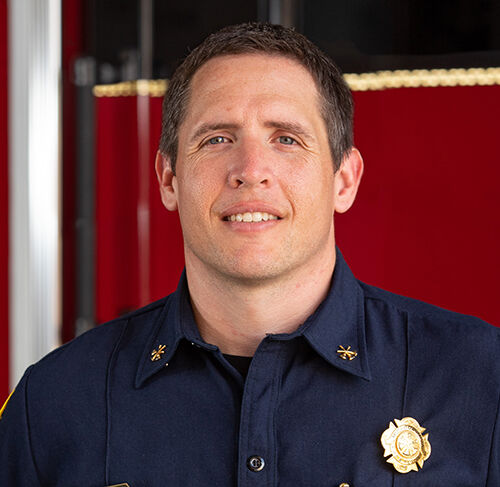
David Jensen, Chief, Mid-Columbia Fire & Rescue
He was introduced to the fire service just after 9/11, while still in high school at Milton-Freewater in eastern Oregon. He volunteered with a welcoming fire crew. “You see a couple of big incidents happen and you’re like, ‘Yeah, I want to try that out.’
“You get to be a part of your community, do something. I was in high school and ready for excitement, drive big fire trucks, spray water on fire," Jensen said.
He was instantly hooked. “I just fell in love with it right away. It’s really like a second family, the fire service. It’s not like co-workers or anything, it’s a complete integration of lifestyles," he said.
Getting a paid position took awhile in the highly competitive post-9/11 environment, but he eventually hired on at Depoe Bay. He steadily advanced through the ranks, reaching captain, and also picked up academic credentials, including associate and bachelor degrees, and he started his master's degree.
But by then he and his wife had kids, and the desire to be closer to grandparents in eastern Oregon saw him take a job opportunity back home in Milton-Freewater.
He worked for the state as regional fire training coordinator for 10 eastern Oregon counties. He worked with 75 departments, including MCFR.
He got to know lots of people in lots of departments. “Those come in super valuable now, in this position.”
He finished his master's degree in public administration and fire and rescue services while working for the state.
He also has an Executive Fire Officer designation, meaning he completed the National Fire Academy Program (similar to the FBI National Academy for police).
Finally, he has a Chief Fire Officer credential from the Center of Public Safety Excellence. That is the fire service’s international accreditation and credentialing body.
But after doing administrative work for awhile, Jensen started to feel “the calling” again. “I needed to be in some kind of response capacity,” so he took a job with MCFR in 2019 as division chief of operations. It’s a great position to have, and doesn’t often come available, he said.
“It was a big surprise to me when I came here and learned how closely integrated everybody was,” he said of local first responder agencies. It wasn’t something he necessarily saw in other areas he’d worked with.
Police and fire agencies in Wasco County have a solid working relationship that has been honed through responses to many wildfires, Jensen said. Wasco County has the most conflagration wildland fires of any area in the state.
Jensen said of Wasco County Sheriff Lane Magill, “Lane’s probably the best in the state in evacuations. They take it very seriously and they are incredibly fast.”
He added, “It’s great coordination, they know what they’re doing, and nobody’s got any sort of ‘This is my job, not your job.’ And that’s not common. Not common, for sure.”
Jensen is a Type A personality, noting, “It’s almost a requirement. It’s what the profession attracts, people who are ready to go.”
But he’s also data-driven, because data tells a story. “I feel it gives you such a good ability to make decisions that are justified. That is why the decisions are being made ... these facts right here and not my Kentucky windage.
“I think the strategy of what creates the best service is the thing I look forward to every day, and how to make it better. And that’s probably why I like data," he said.
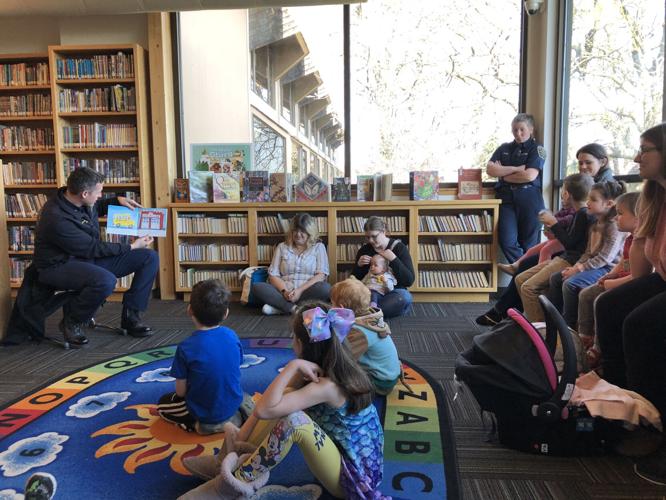
David Jensen, Mid-Columbia Fire & Rescue’s (MCFR) new chief, reads to children at the local library.
Contributed photo
Here’s a shocking data point: Pre-pandemic, MCFR had about 2,900 calls for service a year. Then with the pandemic lockdown early on, people were afraid to go to the hospital. Calls plummeted nationwide. So much so that companies and agencies worried how they’d stay afloat.
Then, call volume came roaring back, and now hovers around 4,000 calls per year. “A 33 percent increase in call volume almost immediately,” Jensen said.
“The increased demand is definitely a huge thing,” he said. And at the same time, a lot of community colleges that were turning out paramedics just stopped. The program requires hands-on training that wasn’t possible with pandemic-forced remote learning.
That led to a huge demand for paramedics. It’s so bad that agencies can have more openings than applicants. So, as a workaround, MCFR started essentially creating its own paramedics by paying for its firefighters/EMTs to go to paramedic school.
Also, an in-house firefighter apprentice program has been a success, with most of its graduates getting hired on at MCFR. They just hired for a class with five apprentices, and they had 39 applications.
“It feels really good, so we could really pick the best of the best out of that kind of quantity and that really sets us up for success. People really do want to come work for us,” he said.
The data shows MCFR is outperforming many metro areas in terms of response time. For medical calls the state standard is that 90% of the time, fire crews are on scene within 15 minutes. “On average we do that in seven minutes. At the 90th percentile, we’re doing it in less than 12 minutes," he said.
Jensen keeps an eye on how MCFR does relative to other agencies, and the Type A in him strives to outdo the competition. “My motivation is to provide the best service to my community," he said.
Some other national standards simply can’t be met. The national standard for response to a house fire is to have 15 firefighters there in just over 8 minutes. “And we don’t have 15 firefighters on duty.”
But they do have 11, which is a big step in the right direction. It used to be just six per shift, and that was if there was nobody off sick or on vacation, he said.
Jensen lauded the preparation he got for his new role from his predecessor, Bob Palmer, who recently retired after 44 years in the fire service. “He really did set me up for knowing all the things he was involved in on a daily basis. That was super helpful in making a smooth transition.”
He added, “I’m excited about where we’re going. I’m excited about the people we have.”
And while he is back in a largely administrative role, he still keeps his hand in the action. “I pull a duty officer shift,” meaning he responds to calls if needed. “In fact,” he said on a recent day, “I’m the duty officer right now.”



Commented
Sorry, there are no recent results for popular commented articles.