BZ CORNER — “I like to make things probable that are seemingly impossible,” said Natalie Anderson, owner and founder of The Missing Corner in BZ Corner, Washington. Right off Highway 141, the building serves as a community center that hosts events, workshops and courses.
On March 16, Anderson hosted a meeting to discuss ways to improve access to fresh, affordable produce in BZ Corner, and the surrounding rural areas.
A resident of the rural town since 2019, Anderson lives with her family and raises her two young sons right on the White Salmon River. While snacks are available at the nearby BZ Mart, as well as food from the taco truck and coffee drive-through, she hopes to create opportunities for people to buy produce directly from those who grow it.
“I see an interest in fixing that link between people who are growing and people who want to eat those things,” Anderson said. “There’s so many trees around here with so much food that just falls to the ground or gardens that produce, that no one eats.”
In addition to nearby orchards, she pointed to local gardeners and farmers who might have an abundance of produce, and not know who might need it or want to buy it.
“There are always too many zucchinis,” Anderson added.
Residents from BZ Corner and the neighboring towns of Husum and Trout Lake discussed ideas for creating a better local food system. Suggestions included community gardens, cold storage infrastructure, food preservation education, produce delivery to the elderly, a farmer’s market and a farmstand.
Anderson said turning those ideas into reality will depend on community participation. “You have to have the visionaries, but you also have to have the people who want to come and do it,” she noted.
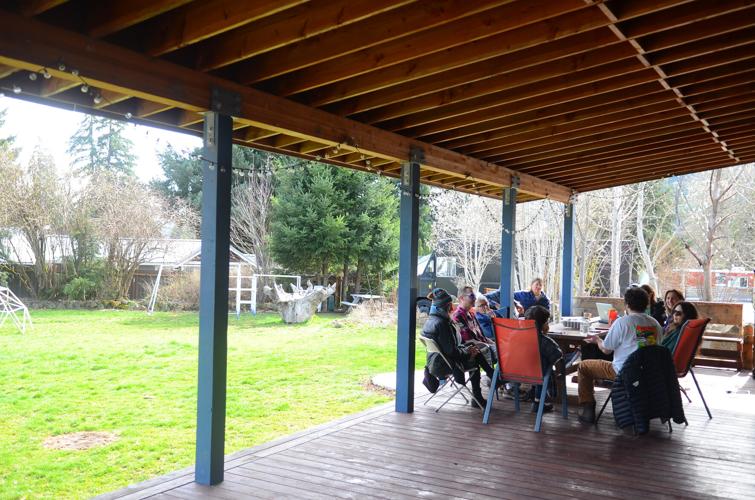
Community members gather on the back porch of The Missing Corner to discuss ways of connecting local growers to consumers.
Emma Renly photo
Carrie Fortier, who lives in BZ Corner, said that while there are nearby grocery stores in White Salmon, Hood River and Trout Lake, they’re still inaccessible to some residents. “You have to have the gas, the car, the transportation, to get into town. And cross the bridge,” she said.
She pointed to a friend who has to intentionally plan which day to get groceries based on when a car is available, and when the different food banks are open.
“It’s not as easy as — oh, I can just pop down into White Salmon today, especially during the winter when trees are falling down,” Fortier said. “Having options that are closer to your neighborhood is huge.”
Currently, The Missing Corner hosts the mobile food bank, known as the Washington Gorge Action Programs (WAGAP) Food Truck, on the third Thursday of every month. Fortier feels the resource is best served for residents who are unable to travel to Bingen’s Food Bank. However, it still has its drawbacks.
“You can only get so much at a food bank; they don’t have a lot of fresh, good vegetables or fruits,” Fortier said, especially in the winter. “Having something nutritional year-round here would be so great.”
Anderson said she plans to try a “One Community Table,” an informal farmer’s market during the same time frame as the mobile food bank, along with events like open mics and seasonal produce features to bridge that connection. Starting mid-to late May, local resident Dottie Moulton will also sell low-cost plant starts at The Missing Corner.
Beyond finding buyers, farmers face additional logistical challenges in the area.
Teigha Mondragon, a private chef based in Trout Lake specializing in farm-to-table meals, said she’s noticed, especially through her business, the diminishing number of local farmers. This is partly due to the zoning regulations in Klickitat County.
“I’ve watched several farmers be driven out of the area because of a lot of this agricultural red tape that we have,” Mondragon said, speaking about the smaller farms operating on 2 to 5 acres. “It has to be these huge lots, and taxes have gone through the roof.”
The Klickitat County Unincorporated City Zoning Code requires the minimum lot sizes for agriculture zoning designation to be twenty acres, or more in specific areas. While landowners can still grow crops on the land regardless of size, there are no agricultural tax benefits.
Mondragon hopes to continue conversations about the importance of supporting local farmers. “I think that small situations like this, where we can start poking holes, is what eventually going to help us with less dependency on current systems,” she said.





Commented