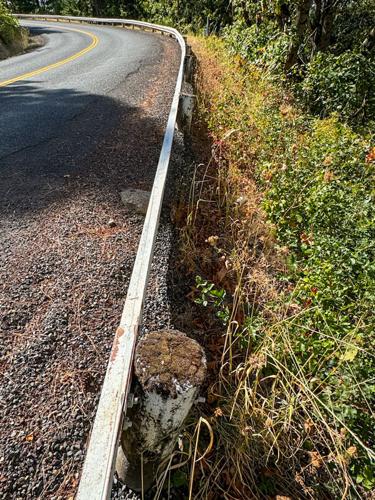
Providing adequate maintenance and safety to maintain the roadway system including paving, striping, sign replacement, mowing and ditching is one transportation funding priority of Hood River County administrators.
HOOD RIVER — New solutions to Oregon’s road and transportation funding are one of the significant challenges lawmakers and local governments will face in the next legislative session. These solutions could have a direct impact on Hood River County, its cities, and other districts that depend on state transportation funding.
To focus on this, an Oregon Joint Committee (JCT) on Transportation Safety and Sustainability has been traveling across the state to host meetings and gather information on transportation and local challenges at 12 locations around the state. The committee stopped in The Dalles on Sept. 13, including a guided trip of transportation facilities in the area and a roundtable discussion about local transportation needs.
“Hood River County officials showed up in large numbers to discuss transportation needs in our county. Many of us emphasized the importance of not overlooking road and transportation maintenance due to the county’s limited funding sources, in addition to once-in-a-lifetime bridge projects, and the impact of tourism without revenues to offset it,” said Hood River County Administrator Allison Williams.
Allison Williams, Hood River County administrator
The input received in The Dalles and around the State holds opportunities to shape a transportation package for Oregon’s 2025 legislative session.
Hood River County’s Road Maintenance Program primarily includes chip sealing county roads, as well as crack sealing and rut patching prep work, snow and ice removal, mowing, ditching, and culvert cleaning, and some maintenance of gravel roads. Sign replacement and striping are carried out on an as-needed basis.
Due to a combination of factors such as inflation, reduced fuel consumption, and a limited local tax base, Hood River County has had to defer needed safety improvements and routine maintenance work, resulting in a lower standard of quality and safety for the existing road system. Roadway construction cost inflation has more than doubled costs, while revenue has grown by less than half since the last statewide transportation package was passed in 2017. Unfortunately, the additional funding in House Bill 2017, at the time, was estimated to cover less than half of the projected need to improve and maintain the county road system statewide to a safe and adequate condition.
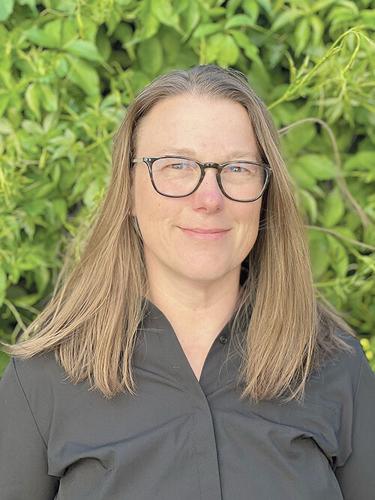
Cori Wiessner, Hood River County Public Works
Cori Wiessner, Hood River County’s director of public works, said “My primary focus is to ensure that Hood River County has adequate funding to fully cover the maintenance of our roadway system. Establishing an Asset Management Program to track the performance of roadway items would greatly aid in planning for and executing replacement of failing infrastructure, something that our current budget does not allow for.”
The long-standing 50-30-20 State Highway Fund distribution formula supports Oregon’s public road system. This means that 50% goes to the state, 30% goes to counties, and 20% to cities. Hood River County partners closely with the Oregon Department of Transportation (ODOT) to support a safe and reliable multimodal transportation system that connects our communities, brings tourists to the area, and supports the economy.
However, Oregon counties, along with ODOT and other transportation agencies across the state, are facing structural funding challenges such as increasing costs for improvements and shrinking gas taxes that impact core services, such as maintaining roads and bridges. Additionally, federal partners have significantly reduced funding for Oregon’s rural roads over the last 30 years. Dwindling timber harvest receipts historically supporting county road budgets have left a gap that has never been fully remedied.
Providing adequate maintenance and safety to maintain the roadway system including paving, striping, sign replacement, mowing and ditching is one transportation funding priority of Hood River County administrators.
Photo courtesy Hood River County
Statewide, counties are responsible for the largest share (41%) of Oregon’s public road system, with over 32,000 miles of roads and 4,000 bridges. Hood River County owns and maintains 190 miles of road and 27 bridges.
The legislature will consider revenue-raising tools that grow the State Highway Fund and diversify our transportation funding system. Potential solutions include increased gas tax, making sure electric vehicles are paying their fair share, and indexing fees and taxes to inflation. While we know that household budgets, like the county’s budget, are tight, Oregonians must come together to support a transportation funding package in 2025 that will meet our local communities’ needs and keep all system users safe.
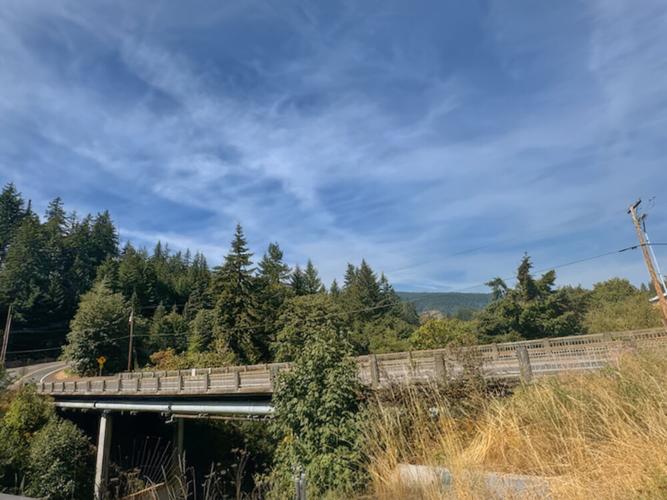
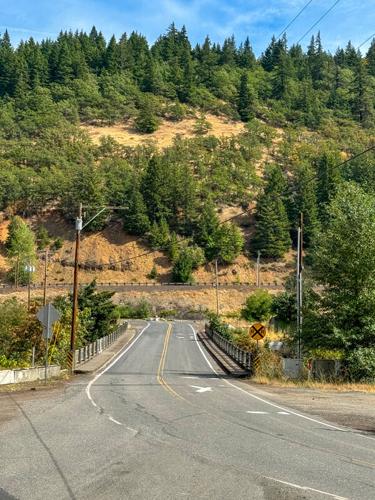
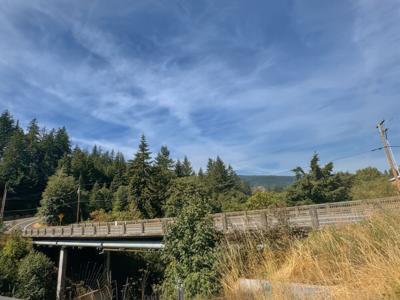
Replacing the Lost Lake bridge on the Hood River near the community of Dee is one transportation funding priority of Hood River County administrators.
Photo courtesy Hood River County
The Joint Committee on Transportation will hold a virtual hearing “open house” as part of its regular Salem committee meeting on Sept. 25 from 2:3-6 p.m. The agenda and online testimony opportunities are available at olis.oregonlegislature.gov/liz/2023I1/Committees/JCT/Overview. Time permitting, remote public comment may be taken. A link to register for public comment is on the meeting agenda page and must be done before 5 p.m. on Sept. 24.
To submit written public comment, email JCT.exhibits@oregonlegislature.gov, or send by mail to Joint Committee on Transportation, 900 Court St. NE, Room 453, Salem, Oregon. Written comment may be submitted up to 48 hours after the meeting start time.




Commented