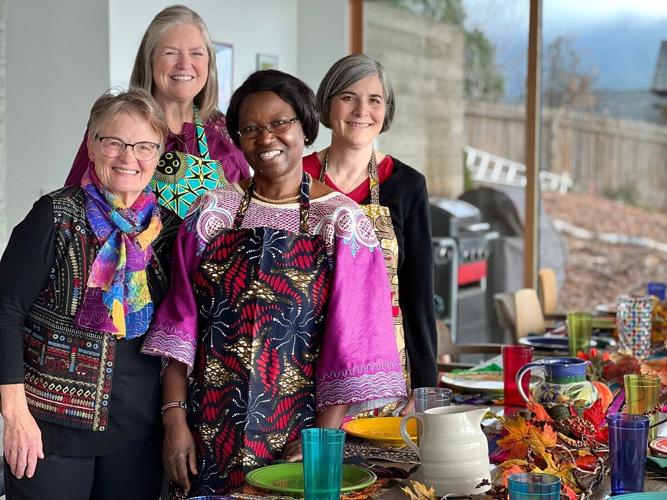
Pictured from left, Pam Morneault, Tammy Kaufman, Grace Kuto, and Loni Sanders prepare a “Be a Gift” luncheon in White Salmon to bring more awareness to the Najijali Project.
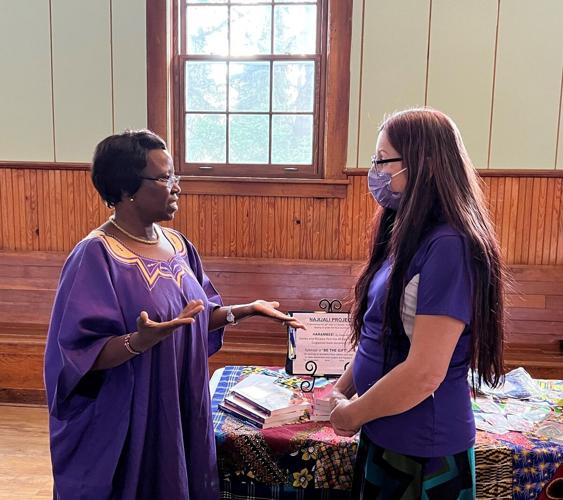
Grace Kuto (left) talks with Tammara Tippel, resident of the White Salmon-Bingen Rotary Club, about her experiences being a Kenyan woman in the United States and how it has led her to join the Tigard Noon Rotary Club and inspired her work on projects in partnership with the Harambee Centre where Kuto serves as the volunteer executive director. Tippel and club members are working with Kuto and the Tigard Noon club to develop the Najijali Project, intended to empower teenage girls affected by pregnancy to become financially independent, creating a more prosperous community in Chwele, Kenya.
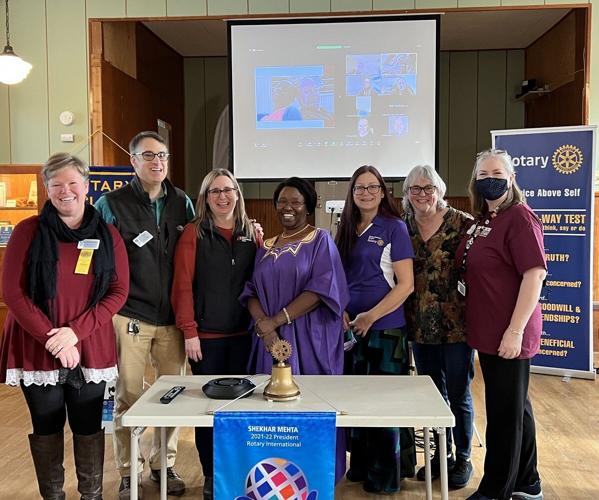
The members of the White Salmon-Bingen Rotary Club shared a special thank you and honored Grace Kuto (center) with a Rotary “Superhero” designation at a club meeting on Jan. 18 for her work to improve the lives of others in impoverished rural East Africa. Left to right are Wendy Patton, Felton Jenkins, Karalee Holtmann, Grace Kuto, Tammara Tippel, Lora Williams Helmer, and Tammy Kaufman.
Pictured from left, Pam Morneault, Tammy Kaufman, Grace Kuto, and Loni Sanders prepare a “Be a Gift” luncheon in White Salmon to bring more awareness to the Najijali Project.
Contributed photo
Najijali Project set to empower girls in Kenya to break the cycle of poverty
WHITE SALMON — We are all shaped by the conditions we are born into and the events in our lives. For some, like Grace Kuto of the Tigard Noon Rotary Club, these conditions spark a desire to help others that lasts a lifetime.
Kuto shared her story recently at Rotary Club meetings in Hood River and in White Salmon, where she was honored as a “Superhero” for her efforts to improve lives.
Born and raised in Chwele, Kenya, she was orphaned early and brought up by her siblings and community. She learned that excelling in her studies could be a way to improve her lot in life, and she earned a spot at the Alliance Girls High School, the best high school in Kenya.
Her elder sister’s husband worked for the Kenyan government and was offered a diplomatic position with the Commonwealth Secretariat and later with the United Nations. He and his wife asked Kuto and his niece if they wanted to come to their new post in England. She jumped at the once-in-a-lifetime opportunity to travel and go for further education abroad. She had just completed high school.
Later, Kuto applied to college in the United States and was accepted at Portland State University on a partial scholarship. She met a young man, Paul, who happened to be from Kenya, just a couple of villages away from where she grew up in Chwele. The two shared many values and have been married now for 45 years. Kuto laughs, “I went around the world to meet my future husband, who happened to be the boy next door!”
After college, she worked with IBM for five years then with Oregon Health Sciences University for almost 30 years, until she retired. She and her husband always appreciated the benefits of living and working in the United States. They returned often to Kenya to support the people of the impoverished communities where they grew up. Through the years, they received tremendous support from the Tigard Community Friends Church, which inspired Kuto to become a co-founder of the Harambee Centre in 2001.
She now serves as the organization’s executive director, fostering education, healthcare, community engagement, and service projects that improve lives in rural Eastern Africa.
Grace Kuto (left) talks with Tammara Tippel, resident of the White Salmon-Bingen Rotary Club, about her experiences being a Kenyan woman in the United States and how it has led her to join the Tigard Noon Rotary Club and inspired her work on projects in partnership with the Harambee Centre where Kuto serves as the volunteer executive director. Tippel and club members are working with Kuto and the Tigard Noon club to develop the Najijali Project, intended to empower teenage girls affected by pregnancy to become financially independent, creating a more prosperous community in Chwele, Kenya.
Contributed photo
Personal challenge
It’s personal for Kuto, who shared how fortunate she was to be in the United States when she and Paul tried to start a family.
She experienced pre-eclampsia, a condition she says is commonly fatal among African and other Black women worldwide. They lost one baby, and her two others were born prematurely, one born at 30 weeks and weighing 2 pounds, and the next born at 27 weeks at just 1.5 pounds.
Kuto believes that if she had been in Kenya, neither she nor her children would be alive today due to the minimal healthcare systems. Because she had access to a modern, well-equipped hospital and excellent medical staff in the U.S., her daughters Muyoka and Lutomia survived. They thrived and now are healthy adults and giving back to the world.
Her experiences made her even more determined to bring services and opportunities back to Africa to help the impoverished community members have a better life. The Harambee Centre focused on educating people in the Pacific Northwest about Africa and provided cultural exchange opportunities. In Swahili, “harambee” (pronounced HAR-AHM-BAY) means “let’s pull together.”
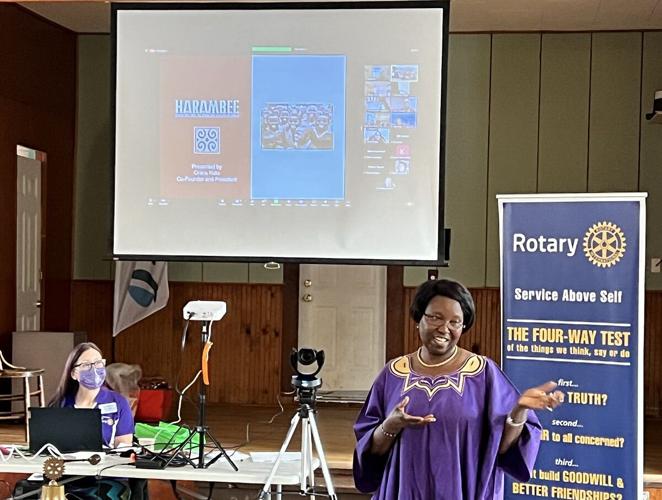
Grace Kuto presents her personal story at a club meeting on Jan. 18.
Contributed photo
Pulling together
Harambee Centre focuses on healthcare, education, and creating small businesses for women. It currently serves in Kenya and Uganda and celebrates past projects in Tanzania and Ghana that have become self-sufficient. Among significant projects are building a health clinic, providing an ambulance, building school dormitories, and establishing vocational training programs (harambeecentre.org).
Kuto joined the Tigard Rotary Club after seeing how well the Harambee Centre mission lined up with Rotary International’s mission to create lasting positive change across the globe. She has been making new and lasting connections ever since.
Inspiring change
“Grace has been a wonderful mentor,” said Tammy Kaufman of the White Salmon-Bingen Rotary Club. “We first met during a grant training class just after she joined Rotary five years ago.” The two women struck up a friendship. “Her passion was inspiring. It made me feel we could make a significant difference in a child’s life,” Kaufman said.
In 2021, the Portland Metro Rotary Club and the Harambee Centre worked on a new project using Rotary District and Global Grants to install a water catchment system for St. Andrews Secondary School in Matale, Uganda, in partnership with the Tigard Noon and White Salmon-Bingen Rotary Clubs. That project is now near completion, and the group hopes the water pump will be installed in time for the rainy season.
“It has been a great project for our small club to learn from,” Kaufman said. “As we worked through the water system project, a new need in neighboring Kenya was brought to our attention.”
The members of the White Salmon-Bingen Rotary Club shared a special thank you and honored Grace Kuto (center) with a Rotary “Superhero” designation at a club meeting on Jan. 18 for her work to improve the lives of others in impoverished rural East Africa. Left to right are Wendy Patton, Felton Jenkins, Karalee Holtmann, Grace Kuto, Tammara Tippel, Lora Williams Helmer, and Tammy Kaufman.
Contributed photo
Desperate times
In Chwele, Kenya, community healthcare workers saw evidence that the mandatory COVID-19 lockdowns severely impacted poor, rural communities. They witnessed a 40% rise in teen pregnancies in a region that already has the second-highest rates in the country. Two of 10 girls between the ages of 14-19 are pregnant or already have a child.
“It is a devastating side effect of the pandemic,” said Kuto. “In some cases, children were idle and used sex as a way to combat boredom. In other cases, girls were desperate to feed their families and used their bodies to barter for food and supplies.
“Other girls were trapped at home in isolation with predatory family members or neighbors, leaving them unable to flee or report abuse.
“The cultural implications are significant, as the burden of responsibility lies with the girl and not the boy or man involved,” Kuto said. “Of teenage girls who survive childbirth in Kenya, 98% drop out of school. Girls are often shunned from their families and left to fend for themselves and their children without access to education or money.”
‘I care for myself’
This led to a new effort called the Najijali Project. In Swahili, “najijali” means “I care for myself.” It is focused on empowering girls affected by pregnancy to learn a skill to become financially independent to break the cycle of poverty for themselves and their children.
During a community assessment conducted throughout 2021, the Rotary group learned more about the area, demographics, and available resources. “Support systems that many Americans take for granted, like food banks and housing programs, do not exist in rural East Africa,” Kaufman said.
The White Salmon-Bingen Rotary Club has taken the lead on the Najijali Project. It is working with the Harambee Centre and the Bungoma Magharibi Rotary Club in Kenya, and Grace Resources for Community Action (GRECA), a local non-governmental organization, to create a sustainable program. The Tigard Noon and Portland Metro Rotary Clubs are teaming up as primary partners.
“The Harambee Centre’s experience with international projects gave our club the confidence to branch out beyond local projects,” Kaufman said.
The team is developing a vocational training program. Additional support will include microfinance opportunities, business and finance training, reproductive health education, home management, food stability, childcare training, and mental health support for the girls.
“It is a comprehensive approach. Our partnerships and community support will be essential to the project’s success,” she added.
Funding change
Kuto and Kaufman have been branching out to share the concept for the Najijali Project and have begun to raise awareness and funds to support the project. They hope to magnify donations by tapping into matching funds available through Rotary at the district and international levels. Together, the team has raised more than $50,000, about one-third of the project’s estimated cost.
“If all goes well, we want to launch a new program before the end of 2022 and then take a volunteer team to Kenya in 2023 to support the program,” Kuto said. The group holds a monthly project update meeting on the fourth Friday of the month at 9 a.m. online via Zoom.



Commented