
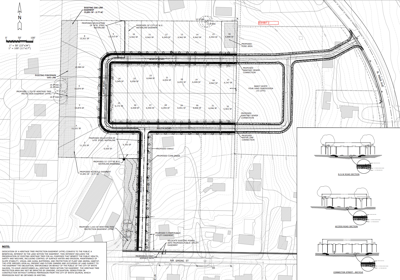

WHITE SALMON — A new housing complex is coming to the base of Strawberry Mountain. White Salmon’s City Council approved the Cherry Hill Estates subdivision, a 31-unit neighborhood near the intersection of Spring Street and Main Avenue, during its Jan. 15 meeting.
As previously reported by Columbia Gorge News, the planning commission recommended city council deny the application put forth by Curtis Homes LLC and the Legacy Development Group INC, primarily over concerns about fire risks, kids safely commuting to school and the ability of Spring Street to handle construction traffic.
“We’ve really worked hard at listening to what the planning commission said, what folks have said from community comments and really adjusted our plans and addressed specific needs,” said Cameron Curtis, who owns the two companies.
Originally slated for 36 single-family homes, Curtis and his team plan to add to a second road into the subdivision off Main Avenue, improving firefighter access, along with a fire hydrant on site. They will also build a sidewalk on the north side of Spring Street and, once they begin, halt all construction operations between 7:30-8:15 a.m. when school traffic peaks.
As another condition of approval, Curtis Homes and Legacy Development must document the condition of Spring Street prior to breaking ground and remediate any damage they caused after finishing the subdivision. With water and gas line replacements coming, Spring Street will also see significant reconstruction in that area.
Supported by Public Works Director Andrew Dirks, council approved the application in a 4-0 vote as Councilor Ben Giant was absent.
The Greenhouse Gas Emissions Reduction Plan was a major topic last Wednesday evening as well. Authored by White Salmon’s CityLab Board, the plan includes data on the natural gas and electricity consumption of residents, an inventory of emissions from city-owned facilities and priority recommendations. The plan and recommendations serve as a first step towards meeting the goals of White Salmon’s Climate Crisis Resolution: Reducing greenhouse emissions by at least 45% by 2030 and 100% by 2050.
Council debated removing several parts of the plan, particularly the strategic focus areas, a section that undergirds the priority recommendations and offers several other climate solutions related to facilities and buildings, transportation, energy independence and resilience, water and governance.
“They’re written in a binding way,” said City Attorney Shawn MacPherson of the strategic focus areas. “The council, as the electeds, are the ones that have to ensure that the vision is appropriate and that it’s doable.”
Some solutions posed in the section include piloting a renewable energy and battery backup system and committing to net-zero design standards for all new city-owned buildings.
“We didn’t want to get into a laundry list of action items that likely will not be getting staff capacity or time to move forward,” said Mayor Marla Keethler. “If we were a city functioning at our highest level of efficiency and competency of processes that we have worked through and found all the kinks, then we are ready to do some of these things in a short-term outlook, but that’s not where our city is at.”
Councilors Patty Fink, Jim Ransier and David Lindley countered MacPherson and Keethler. Fink compared the emissions reduction plan to White Salmon’s Transportation System Plan, which similarly includes objectives the city probably won’t complete in full.
“It’s sort of a vision document, a document where we can say these are the things we’re planning to work on,” said Fink. “These are the things we want the community to know that are important to us — that the community values.”
“I’m okay with leaving that in if it’s not prescriptive and legally binding,” said Lindley. “I think there’s an element there that is refreshing and should challenge us to decide what we want to pull forth, and should challenge future councils to pick up pieces as well.”
Eventually, council requested that MacPherson and staff incorporate the strategic focus areas, with softer language, into the emissions reduction plan for review at the next city council meeting, which will take place Feb. 5.
In shorter matters, council opened a public hearing for the Tree Protection Ordinance, which implements arboriculture practices and Firewise guidance while allowing more flexibility for tree removal, and the related stormwater runoff control standards. The public hearing will continue on Feb. 5.
Council also named Damarys Alvarez as White Salmon’s 2025 nominee for the Association of Washington Cities Center for Quality Communities Scholarship and adopted their legislative priorities for the next year. Recognizing students with outstanding civic engagement, Alvarez will compete for a $3,000 reward given to three students across the state.
The legislative priorities vary from funding street repair projects to revising Washington’s 1% property tax cap. To view the full list, visit the supporting documents on the Jan. 15 city council meeting webpage.
At the top of the meeting, Keethler announced she’s still waiting to hear from the U.S. Postal Service about the possibility of a no-fee postal box option for all city residents while aiming for a carrier service in the long-term. Separately, Washington’s Department of Transportation awarded $1 million to the Bluff Connector Trail, either for planning, design or construction, while the city continues to assess whether the project is feasible.
Lastly, council held a special meeting Jan. 10 to approve the job description for a new finance director. White Salmon’s current Clerk Treasurer, Stephanie Porter, is stepping down from her position Jan. 31 and Troy Rosenburg, Deputy Clerk Treasurer, will fill her vacancy, but the city is creating a new position that will solely handle the financial operations of White Salmon.
•••
Our journalism needs your support. Become a subscriber today at columbiagorgenews.com; click subscribe.


Commented