


Warning: This story contains descriptions of sexual violence. If you’re a victim of domestic abuse, contact the National Domestic Abuse Hotline at 1-800-799-7233.
WHITE SALMON — City council’s meeting on March 18 began with two important presentations: one on the legacy of labor rights and feminist icon Dolores Huerta, and the other on where free postal delivery for city residents currently stands.
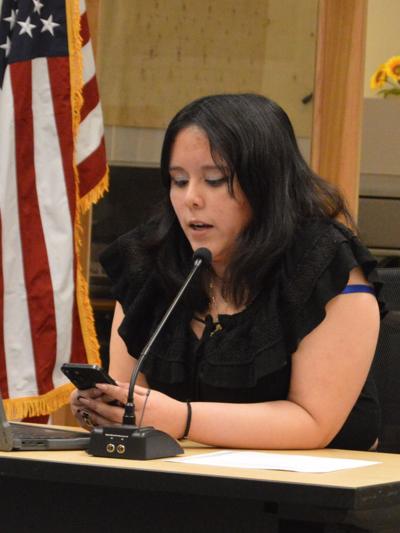
In honor of Women’s History Month, Mayra Juarez, a Columbia High School student whose parents are farmworkers, told Huerta’s story. After briefly working as a teacher, she led voter registration drives and joined a boycott on California grapes, encouraged Latinas to run for political office, helped pave the way for farmworker unionization and co-founded United Farm Workers with Cesar Chavez.
The same day, however, Huerta revealed that Chavez raped her twice in the 1960s during their advocacy work, and both assaults resulted in pregnancies she subsequently hid. Huerta shared the details following an investigation by the New York Times, which found that Chavez had also sexually abused two other daughters of longtime organizers, beginning when they were 12 and 13, for years, including another instance of rape.
“I carried this secret for as long as I did because building the movement and securing farmworker rights was my life’s work,” Huerta wrote. “I have never identified myself as a victim, but I now understand that I am a survivor — of violence, of sexual abuse, of domineering men who saw me, and other women, as property, or things to control.”
Juarez emphasized how Huerta remains a symbol of hope and determination for farmworkers, the vast majority of whom identify as Hispanic or Latino and continue to face harsh working conditions.
“Huerta’s legacy matters because the issues she fought for are still relevant today. Every single day, we sit down for breakfast, lunch or dinner, and the food on our tables was planted, picked or harvested by a farmworker,” Juarez said. “Her life shows that ordinary people can create extraordinary change, and her message continues to inspire communities today.”
“Sí, se peuede,” she concluded, a phrase coined by Huerta that means, “Yes, it can be done.”
Mayor Marla Keethler then updated council on the city’s most recent efforts to secure free home delivery from the United States Postal Service (USPS). As White Salmon residents know very well, they must pay for a P.O. box, while rural carrier routes serve those outside city limits. It’s an issue predating Keethler and one that costs $300,000 collectively in fees, she estimated.
Beginning in 2020, the city pursued a Contract Delivery Service route with USPS, but those efforts stalled in 2023, and securing no-fee P.O. boxes has been the priority since. While the local postmaster has been a reliable partner, Keethler said, movement at the district level has been difficult, which she voiced to Sen. Patty Murray’s staff earlier this month.
“We have neighbors in the same city that are receiving different levels of federal service, some that have to pay for it, others that do not. And mail delivery in this country is a basic right,” Keethler said.
Beyond the financial burden, she highlighted that many veterans rely on prescriptions delivered via mail, and Washington, of course, is a vote-by-mail state. Keethler encouraged residents to contact Murray, Sen. Maria Cantwell and USPS’s federal office, emphasizing that she’s pushing for solution before her term ends.
As for business items, council unanimously amended the municipal code so that a hearing examiner, which typically presides over appeals related to land use or development, can make quasi-judicial decisions on code compliance (things like public nuisances, junk vehicles, etc.). It wasn’t an expansion of enforcement authority, staff noted, but rather clarified the hearing process referenced in several sections of the code.
Council also discussed the Citywide Garage Sale slated for April 10-12, encouraging folks to have their properties cleaned up by the following Tuesday, and updated the land use fee schedule. In order to make way for the new Hood River-White Salmon Bridge and associated roundabout, approximately 190 trees will be removed from the waterfront area, but there was no fee-in-lieu of tree replacements on record for special and significant trees, as defined by code.
With no timeline given but wanting to ensure the loss is recouped, at least in part, Council tentatively agreed on $400 per tree, knowing that White Salmon’s Tree Board will provide an updated figure at some point in the future.
Lastly, Keethler reminded residents that, despite the name, flushable wipes aren’t and never have been flushable.


Commented
Sorry, there are no recent results for popular commented articles.