
HOOD RIVER — There’s no such thing as free money, and that holds for federal grants too — even those awarded half a century ago.
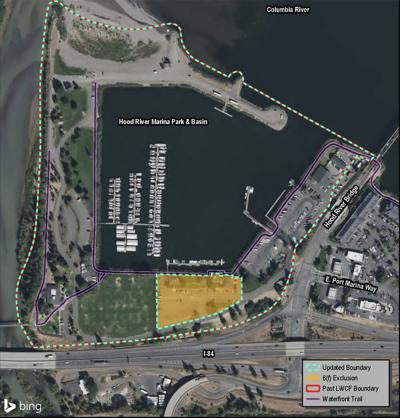
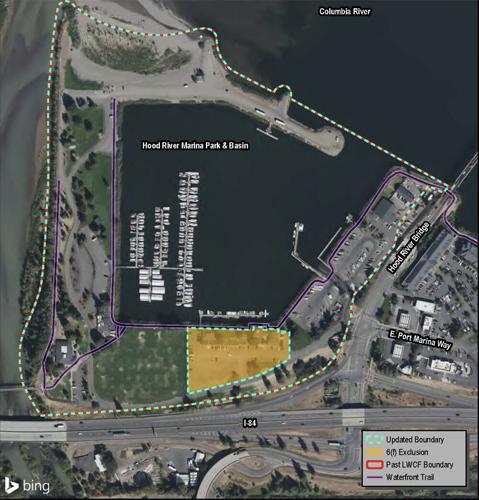
When a new structure replaces the Hood River-White Salmon Bridge, now scheduled for 2031, the new bridge’s Oregon approach will land on the east side of the Hood River Marina, roughly where the port’s current administrative offices now stand. The new bridge will only require a small fraction of that area, about 2.3 acres, some for interim construction staging.
Although the U.S. Army Corps of Engineers raised the land base from river dredgings in the 1960s, the port conducted subsequent improvements in the 1970s, including a boat ramp, docks and marina utilities. The federal Land & Water Conservation Fund (LWCF) paid for those park improvements. There were four LWCF grants totalling $32,145.
Here’s the catch: LWCF funding means the land cannot be used for non-recreational purposes without dollar-for-dollar “mitigation” by acquiring and developing other, new recreational lands. And, one more catch … the dollar-for-dollar value needs to reflect the current value of the property originally developed, rather than the original grant amount.
Just what that means has yet to be confirmed. An initial appraisal pegged the cost at $3.4 million — more than a hundred-fold increase over the 1970s federal investment — but this assumed intensive, “highest and best use” development far beyond anything envisioned for the site. An independent appraisal is pending.
“Adding multiple million dollars more to mitigate a $30,000 grant does not feel like a good use of taxpayer dollars,” said Commissioner Mike Fox during a March 9 meeting of the Hood River-White Salmon Bridge Authority. Whatever the final amount, both the bridge authority and port will be on the hook: the port since it received the grant funds back in the 1970s, and the bi-state bridge authority (which is a separate, quasi-governmental entity) because the authority will be purchasing the land in question.
Commissioners reviewed the issue last summer and discussed new developments when they met last Monday. One challenge in particular, above and beyond the significant cost discrepancy, is finding a mitigation location acceptable to Oregon Parks & Recreation District (OPRD). Several parcels are under consideration, some at considerable distance from the bridge.
Ultimately, mitigation approval will reside with the National Parks Service, but OPRD has initial jurisdiction because Port of Hood River is an Oregon entity.
On the other hand, the bi-state bridge authority is … well, bi-state … and thus commissioners would like to have mitigation options in both Oregon and Washington. For instance, could new green spaces, parking, pedestrian and bicycle access at both ends of the new bridge, or elsewhere in Port Marina Park, qualify for mitigation? And, could the new bridge’s dedicated pedestrian and bike lane qualify?
It’s still an open question, subject to how state and federal agencies apply the federal statute in question, enacted in 1965.
Bridge authority commissioners would like to focus bridge replacement dollars on bridge-related projects, including any mitigated recreational development.
“I understand LWCF requires mitigation of recreational assets,” Fox noted. “Our project will develop park-like areas on both landings, plus cyclist and pedestrian paths that span the entire 4,400-foot bridge, two recreational overlooks on the bridge, and will restore the existing bridge’s Oregon approach to a park-like setting.”
Washington commissioner Jacob Anderson agreed, and would like to see mitigation dollars invested on his side of the river.
For the time being, mitigation awaits resolution, likely to be decided by the National Park Service.
In other business at the March 9 bridge authority meeting:
• The Port of Hood River will have a two-day bridge closure April 3 and 10, from 12:30 to 6 a.m. each day, to replace expansion joints and upgrade bridge signage.
• A $200 million infrastructure grant awarded in 2024 is still on track, as the U.S. Secretary of Transportation reviews contract language.
• Final bridge design is on track, with 60% anticipated by mid-summer. Updated design elements are posted to the bridge website, www.hoodriverbridge.com
• Bridge staff and commissioners are considering a visit to Washington, D.C., this spring to update Congressional staff. Anticipated but unconfirmed funding will be a priority, especially a $532 million Bridge Investment Program grant application. About half the estimated $1.12 billion cost is already secured.
• Riverbed cores are still being sampled from barges moored along the Washington shore and the main channel. These will confirm future pier placement.
• Remote monitoring stations are in place, gathering baseline data on bridge piers to ensure construction of the new bridge immediately downstream doesn’t have any adverse effects. These data, along with weather and water levels, will be available on the bridge website’s dashboard. Commissioners discussed the need for public engagement.


Commented