
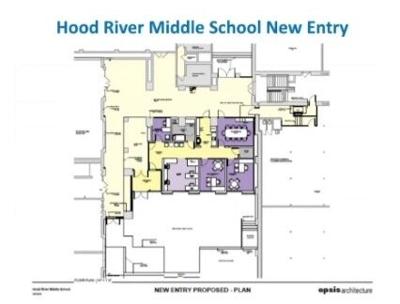
Hood River County School District board members heard a capital projects report during the April 13 virtual meeting — and later voted to approve construction of the Hood River Middle School new entry project, one of the last of the capital projects stemming from a bond measure passed by voters in 2016.
Joining the district’s Chief Financial Officer Doug Holmes were Dale Kuykendall, Wenaha Group senior project manager, and Steve Nelson, Opsis Architecture associate principal/architect.
Superintendent Rich Polkinghorn explained that the entryway project was slated to begin during the 2019-2020 school year, but, “because of a series of setbacks, not the least of which was the pandemic stealing our focus for several months, the project never got started.” Last school year, he and administrative staff reprioritized the project, with design work completed during the 2020-2021 school year. Because HRMS is a National Historic Site, the design had to be approved by both city planners and the State Historical Preservation Office; at the beginning of this school year, the district learned both agencies had approved the plan.
“During this nearly two-year delay, as we know, the price of goods has increased, the supply chain has been disrupted and labor availability has decreased. So the project has seen a cost escalation of about 36% … The plan to fund this project has always been to utilize two main funds — the capital fund, which is our bond fund, and the construction excise tax. With that cost escalation, these two funds are not sufficient to cover the total cost of the project.”
He said that to bridge the difference, he and Holmes have worked closely together to prioritize some general funding resources. “So through these three braided funds, we have a viable pathway to bring this project to completion, and one that does not reduce or inhibit our academic model first,” Polkinghorn said.
In his action items explanation, Holmes wrote that the board approved contracting with Griffin Construction, LLC, as the district’s construction manager and general contractor in July 2017, and since then, Griffin has been involved in the planning, scheduling, budgeting and bidding of the Hood River Middle School New Entry project. Subcontractor bids were received on March 16 of this year, and Griffin has been working with the design team and administration to establish an acceptable Guaranteed Maximum Price (GMP).
The administration was recommending approval of the GMP of $2,997,703 for the project. “Funding for this Guaranteed Maximum Price will be primarily from construction excise tax along with general obligation bond proceeds and other available funding sources,” Holmes wrote.
The board approved the GMP, 5-1; voting yes were Barb Hosford, Brandi Sheppard, Vice Chair Julia Garcia-Ramirez, Corinda Hankins Elliot and Board Chair Chrissy Reitz, and voting no was Jen Kelly. Board Member Tom Scully was absent.
Kelly said she did not believe this was the time to go forward with the project, given current economic factors such as increased building costs and supply chain issues. She also pointed to improvements already made at HRMS to keep students and staff safe.
“I don’t want anyone to think that I don’t think student safety is critical. I absolutely do,” Kelly said. “I believe in the project and believe that it needs to be done. But I also believe in our sense of community and the individuals who make up or community … I just think it’s the wrong time to be taking on a multi-million-dollar project. I know that’s going to disappoint a lot of people, but I’m afraid of it, frankly, for all those reasons.”
Sheppard responded by acknowledging the risk, but added, “This is something that we promised to the community, the safety for our students, and I think that’s something we need to move forward on … We don’t know that next year’s going to be better, and there’s always things that come up and that we need to work on and fix. I feel like this is something we need to move forward on and make happen.”
Hankins Elliot noted this was the last major project that had been promised in the 2016 bond measure, and most of the funding would come from that fund. She also said that in the six years the district has been working with its contractors, they have “delivered what they said they would deliver … I don’t love that we’re having to bring in money (from other funds) too, but I’m willing to do it at this time, specially, because I have trust in our partners …
“We’re already seeing the fact that we let it go further, waited on it, and now it’s causing trouble,” she added. “And I don’t want to see us two years from now saying, ‘Oh, we still need to do this, but we have another (project) so we have to put our money towards that.”
Voters — 75%, Polkinghorn said — approved a $57.2 million construction bond in May 2016; the district was able to increase that funding to $79.6 million, thanks to premiums from bond sales, grants, and interest, among other sources.
The funds were to be used to upgrade technology, as well as safety and security at each site, and as such, projects have been completed at Hood River Valley High, Hood River Middle, Wy’east Middle, Cascade Locks, Pine Grove, May Street, Mid Valley, Parkdale, Westside, transportation and maintenance, and the district office and alternative education building.
The board’s next meeting, scheduled for May 11, will be held in person beginning at 6:30 p.m. at the Nathaniel Coe Administration Center, 1011 Eugene St. The meeting will also be livestreamed via Zoom.


Commented