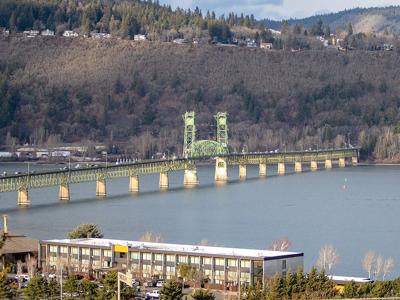
The Biological Opinion from the National Marine Fisheries Service says the project’s plans to construct a new bridge and demolish the existing bridge will not “adversely” affect endangered wildlife and threatened lands along the Columbia River.Noah Noteboom photo/file
The Biological Opinion from the National Marine Fisheries Service says the project’s plans to construct a new bridge and demolish the existing bridge will not “adversely” affect endangered wildlife and threatened lands along the Columbia River.Noah Noteboom photo/file
THE GORGE — The Hood River-White Salmon Bridge Replacement Project received the long-awaited Biological Opinion that is intended to protect endangered wildlife and land in and along the Columbia River during construction of the new bridge and deconstruction of the existing bridge. The study was required in accordance with the Endangered Species Act (ESA) of 1973 and ensures that actions by each Federal agency will not adversely affect the continued existence of the animals and ecosystems.
The project team received the notice on June 3 from the National Oceanic and Atmospheric Association’s (NOAA) National Marine Fisheries Service (NMFS).
Project Director Mike Shannon said approval of the Biological Opinion is a “big step towards finalizing the Record of Decision,” and that “[The biological opinion] concluded that the project is not likely to jeopardize any continued existence of endangered species,” Shannon said. “The ESA listed species, the [construction] will not destroy or adversely modify any designated critical habitat for these species. And it underscores the commitment to the environmental stewardship and regulatory adherence.”
The NMFS designated critical habitats for 11 species of salmon and steelhead that would most likely be affected by the proposed action of building a bridge. Among these designated habitats are watersheds that have been affected by human activities and climate change. The biological opinion identifies “intensive agriculture, channel modifications and diking, disturbance of riparian vegetation, draining and converting wetlands, livestock grazing, dredging, road construction and maintenance, logging, mining, and urbanization” as causes of the weakened ecosystems. In turn, this has affected fish spawning and forced many organizations to act.
The project began in 2019 with conversations between the NMFS and ODOT regarding the endangered and threatened species in the area. Discussions centered around an overview of the project, species included on the list and potential impacts and preliminary effects. In August of 2019 the NMFS and Federal Highways Administration (FHWA) provided comments on the first draft of the biological assessment. A final draft was approved in April 2023 to “reflect the results of additional coordination between the Port, ODOT, FHWA, and NMFS regarding anticipated construction means and methods.”
Shannon added that they worked closely with the four tribes in the Mid-Columbia region.
Included in the biological opinion were minimization measures “designed to avoid and minimize adverse effects to species and habitat.” Project teams must develop a Water Quality Protection and Monitoring Plan and create measures for spill prevention, pollution control, site and sediment control in addition to fish capture and release management practices that follow the most recent NMFS guidelines. The report estimates that sediment will be displaced up to 300 feet down river and will cause temporary and intermittent, negative effects to water quality for up to seven years during construction and demolition. The report also states that the Port of Hood River is willing to incorporate avian deterrents — sloped surfaces and sharp points on foundation — to protect young salmon.
With the green light from the NMFS, Shannon explained the project is shifting focus to beginning design which he expects the project to finish 15% by the end of the calendar year. Funding is still needed for roughly 40% of the project.
“Oregon has given us $20 million; we’re still hoping to get another $105 million from Oregon,” Shannon said. “And then Washington has been a great partner. They’ve given us $75 million, and we’re hoping to see an additional $50 million from them this year through the legislative sessions.”
Shannon was joined by other project representatives who traveled to Salem, Ore. to meet with Oregon lawmakers to aid their request for funding in the next legislative session.



Commented