
By Nathan Wilson
Columbia Gorge News
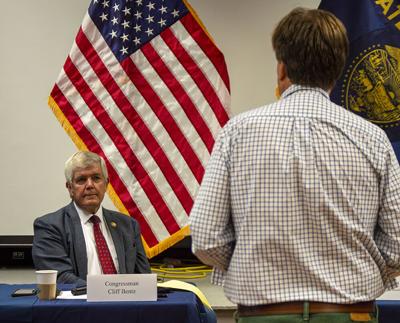
THE DALLES — Rep. Cliff Bentz, who’s seeking a fourth term serving Oregon’s sprawling 2nd Congressional District in the U.S. House, held a town hall on Sept. 11 to discuss a variety of wildfire-related matters at Columbia River Hotel.
Alongside input from a panel of officials with the United States Forest Service, Bureau of Land Management and Farm Service Agency, Bentz provided an update on the Grasshopper Fire, talked national staffing numbers for wildland firefighters, shared available recovery resources and heard from residents about what they thought the federal government could be doing to better reduce wildfire risk.
Bentz also noted that the Republican-led House Committee on Natural Resources, which he serves on, is investigating 19 environmental organizations across the country, including statewide nonprofit Oregon Wild.
“The Committee is particularly concerned with Oregon Wild’s coordinated capitalization on misleading and emotive messaging to build powerful and profitable litigation machines funded by taxpayer dollars through the exploitation of statutory fee-shifting provisions,” reads a letter to the nonprofit dated Sept. 4.
The letter explains that the Endangered Species Act, and other statues covered by the Equal Access to Justice Act, allow organizations like Oregon Wild to recoup attorney’s fees, even with partial victories and settlements. Essentially, it alleges that the groups pursue litigation to make money and fundraise on the back of successful rulings.
The Equal Access to Justice Act was enacted, in part, to “diminish the deterrent effect of seeking review of, or defending against, government action,” particularly for parties unable to afford expensive legal fees, the legislation states.
While the committee has not presented evidence that any organization has broken the law, Bentz cited Oregon Wild’s lawsuit of a planned fuels reduction project, which has now largely been burned by the Grasshopper Fire, during the meeting.
The Wasco County Forest Collaborative and Forest Service have been planning the Grasshopper Restoration Project to variably thin about 5,280 acres of trees along the southern Badger Creek Wilderness boundary, just above Pine Hollow, since 2019. In line with the collaborative’s diverse stakeholders, the goals were to reduce wildfire risk, restore forest diversity, enhance wildfire habitat, maintain safe access roads and provide sustainable timber products.
In June 2023, Oregon Wild sought an injunction to prevent the project from proceeding until various procedural and ecological concerns, particularly the commercial logging of tree stands 80 years or older that provide critical habitat to the Northern Spotted Owl, were addressed. They settled in January 2025, obtaining $55,000 in attorney fees, after the Forest Service agreed to remove two tracts and reduce treatment intensity on several more, among other provisions.
Then, a week after the Grasshopper Fire ignited, the American Forest Resource Council (AFRC) issued a press release criticizing Oregon Wild for delaying the project, prompting Oregon Wild to respond.
While nearly all of the project’s non-commercial work was complete by the end of 2025, the commercial portion did not proceed. AFRC estimated that around 25 million board feet of timber were lost as a result, and while the Forest Service did have 18 months between the settlement and ignition to move forward, the agency halted preparation of those units in 2024 because of the legal challenge.
Notably, the Forest Service also lost 5,860 employees, a 16% staffing decrease, in the first half of 2025 alone, according to a report from the U.S. Department of Agriculture’s Inspector General, and faced two prolonged government shutdowns since the settlement.
In its letter to Oregon Wild, the committee requested that a slew of documents be turned over by Sept. 18, and that staff testify in Washington, D.C., on Oct. 18.
Tax filings show that contributions and grants made up about 92% of Oregon Wild’s total revenue in 2024, but since Crag Law Center lead the Grasshopper-related litigation, those fees wouldn’t appear on the nonprofit’s books anyway.
As of last Monday, the nonprofit was still formulating its response and declined to comment any further. In tandem with WildEarth Guardians, Oregon Wild also issued an intent to sue four other fuels and insect mitigation projects that are nearby in early July, just prior to the Grasshopper Fire.
•••
Our journalism needs your support. Subscribe and read more at columbiagorgenews.com.


Commented