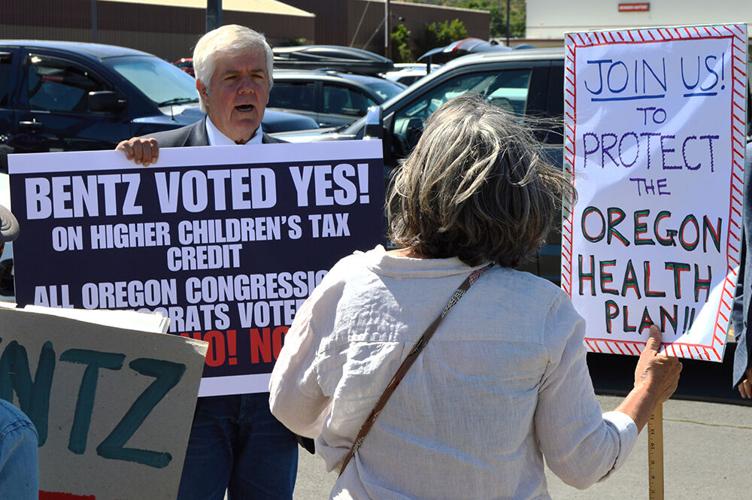
Rep. Cliff Bentz speaks with protesters calling for a Wasco County town hall after meeting with The Dalles Rotary Club at Spooky’s Pizza Aug. 20. Bentz spoke on the passage of the Big Beautiful Bill before taking audience questions. More photos are available online at columbiagorgenews.com.
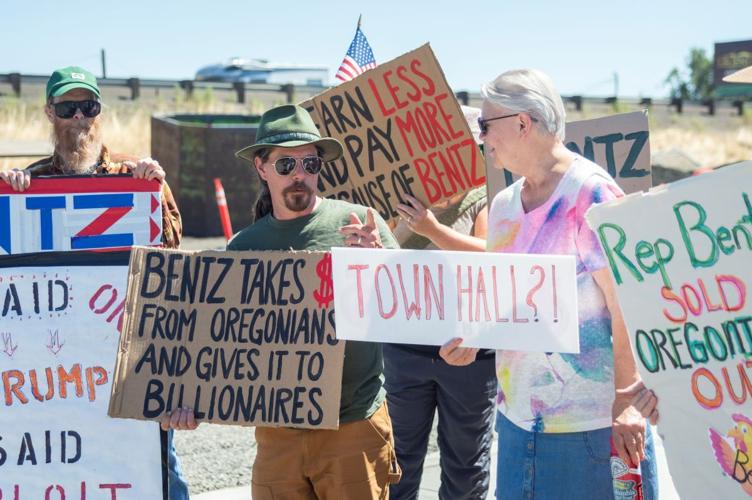
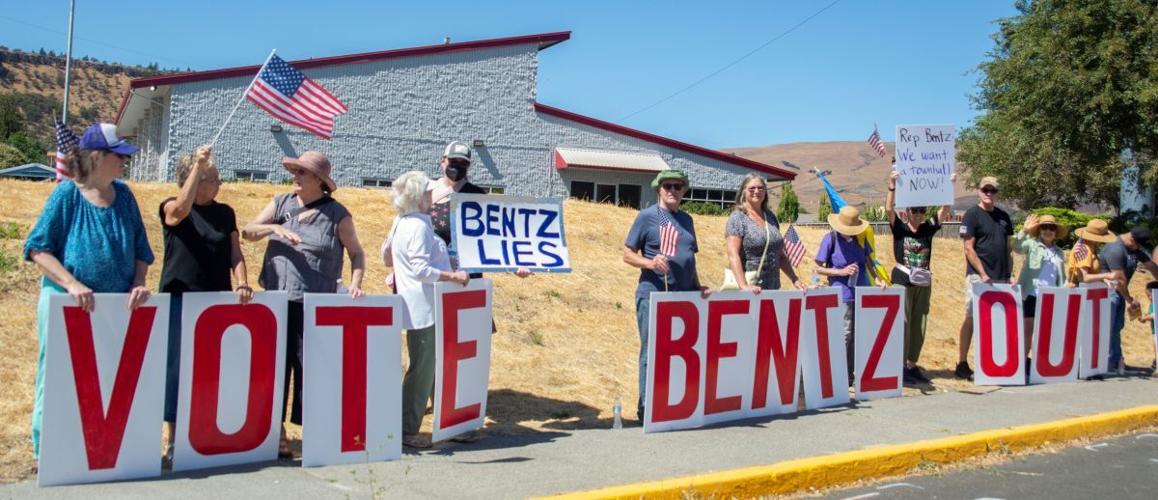
Protesters call on Rep. Cliff Bentz to schedule an in-person town hall as he left the Rotary Club of The Dalles' Aug. 20 meeting, where he was a guest speaker.
Rep. Cliff Bentz was guest speaker at the Rotary Club of The Dalles meeting Aug. 20, regularly held at Spooky’s Pizza. Bentz took audience Q&As after talking about the Big Beautiful Bill, signed into law on July 1. He was met by two groups of protesters outside the building.
Protesters call on Rep. Cliff Bentz to schedule an in-person town hall as he left the Rotary Club of The Dalles' Aug. 20 meeting, where he was a guest speaker.
Rep. Cliff Bentz speaks with protesters calling for a Wasco County town hall after meeting with The Dalles Rotary Club at Spooky’s Pizza Aug. 20. Bentz spoke on the passage of the Big Beautiful Bill before taking audience questions. More photos are available online at columbiagorgenews.com.
Trisha Walker photo
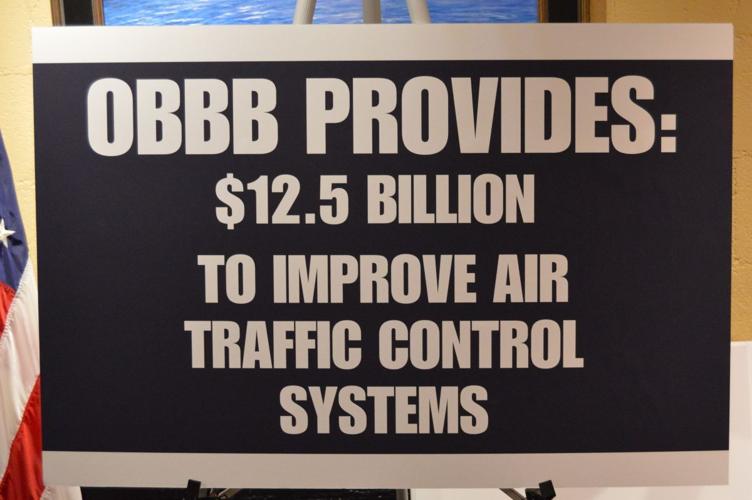
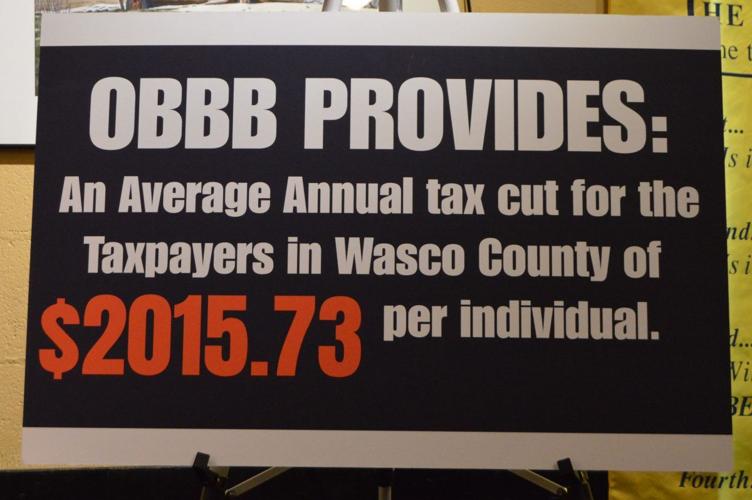
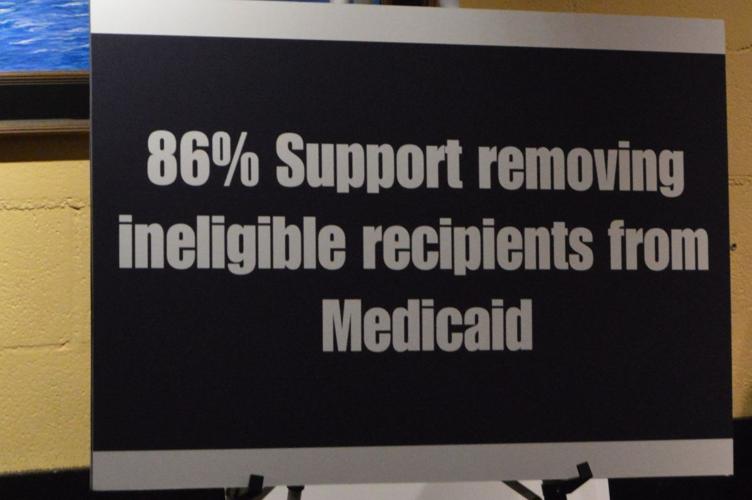
Rep. Cliff Bentz featured three posterboards touting the passage of the Big Beautiful Bill on July 1.
Trisha Walker photo
Rep. Cliff Bentz featured three posterboards touting the passage of the Big Beautiful Bill on July 1.
Trisha Walker photo
Rep. Cliff Bentz featured three posterboards touting the passage of the Big Beautiful Bill on July 1.
THE DALLES — Oregon’s 2nd Congressional District Rep. Cliff Bentz attended the Rotary Club of The Dalles meeting at Spooky’s Pizza on Aug. 20, where he focused on aspects of the recently passed Big Beautiful Bill (BBB) that “will help this community economically over the next 10, if not longer, years.”
He also toured The Dalles Watershed, the would-be beneficiary of his The Dalles Watershed Development Act after the Rotary meeting Aug. 20, and the Deschutes Rim Health Clinic in Maupin on Aug. 21 (see sidebars at left). Wasco County was one of 10 that he planned to visit in the next two weeks.
The 2nd congressional district is the largest of the state’s six and comprises all or part of 20 counties, including Wasco, Sherman, Gilliam and Deschutes.
Bentz expressed surprise over the heightened focus on Medicaid provisions in the bill, instead of the other elements he said will help the economy.
“There’s going to be reduced taxes on overtime, there’s going to be reduced taxes on tips,” he said. “There’s going to be reduced taxes on your interest that you would pay on a new car built in America, and so forth. But one of the most important things in the bill is a continuation of the 20% deduction for adjusted gross income for small businesses.”
Protesters call on Rep. Cliff Bentz to schedule an in-person town hall as he left the Rotary Club of The Dalles' Aug. 20 meeting, where he was a guest speaker.
Flora Martin Gibson photo
The BBB includes “a significant amount” of money dedicated to finishing the border wall and military drone research.
“It’s a funny thing, isn’t it — the border was everything last year, and suddenly the border is not an issue,” he said. “Why? Because the border is secure.”
There’s also a piece requiring the U.S. Forest Service to increase harvest by 20% “over and above the previous year’s harvest,” which he called good news to reduce fire risk and increase jobs.
The changes to Medicaid, he said, are designed to address people who are unlawfully enrolled in the program due to citizenship or income. The greatest impact is a requirement — 20 hours a week, 80 hours a month — to work, volunteer or attend school.
“I want to emphasize, we want to keep this program, but we have to do a better job of offering it,” he said.
According to Bentz, Oregon has lost hundreds of millions of dollars because its administration of the Supplemental Nutritional Assistance Program (SNAP), or food stamps, namely by handing out too much money, and has been fined by the federal government for exceeding the national error rates two years in a row.
Rep. Cliff Bentz was guest speaker at the Rotary Club of The Dalles meeting Aug. 20, regularly held at Spooky’s Pizza. Bentz took audience Q&As after talking about the Big Beautiful Bill, signed into law on July 1. He was met by two groups of protesters outside the building.
Flora Martin Gibson photo
While he supports SNAP and Medicaid, “I don’t support doing either one of these things sloppily or imprecisely or illegally,” he said.
Bentz took audience questions that ranged from the plight of farmers to burdensome food assistance requirements. (He said that for state matters, constituents should “go yell at” Oregon State Sen. Daniel Bonham to provide fixes.)
For one, he was asked about a $20 million grant, rescinded by the Trump administration, that was the last piece of funding to bring the now-dead Columbia Gorge Early Learning and Climate Resiliency Hub to The Dalles. The center was slated to provide childcare to more than 200 local kids, offer career opportunities and serve as an emergency response shelter powered by renewable energy, as reported by Columbia Gorge News in April.
“About that same time, we also learned through some great reporting that more than $20 million in taxpayer dollars have been spent on Donald Trump’s golfing vacations during just his first two terms in office … I too am in favor of getting rid of waste, fraud and abuse, and I happen to think that $20 million in taxpayer dollars would have served your constituents better as an early childhood learning center,” the commenter said.
“I don’t know exactly why people confuse me with the president. I’m not Donald Trump,” Bentz said. “And the point is, when I heard that happened, I talked to my staff about it, and we’re trying to figure out what the justification was.”
Protesters call on Rep. Cliff Bentz to schedule an in-person town hall as he left the Rotary Club of The Dalles' Aug. 20 meeting, where he was a guest speaker.
Flora Martin Gibson photo
A Vietnam veteran expressed concern regarding the BBB’s cuts to veterans benefits, facilities and hospitals. He told the story of his brother-in-law, who was shot down in a helicopter three times and now faces a number of medical challenges, and finished by saying that many enlisted military members receive SNAP benefits.
“A mom with three kids whose husband may be halfway around the world can’t work 20 hours a week, but she’s going to get her SNAP benefits cut because she’s physically capable of work,” he said. “There’s a lot of things in the Big Beautiful Bill — they’re small, individual things, but they’re hurting people, and it needs to be taken care of.”
“It is not our goal to impose additional burdens on people, but it is our goal to try to make these programs work appropriately,” Bentz said. “And it’s also our goal to ensure that we don’t have people using them who are not contributing to the very costly programs by at least having a job. That’s what we’re trying to do.”
Another commenter asked if Bentz was in favor of mail in voting. In response, Bentz explained that when Dennis Richardson was Oregon Secretary of State, Richardson found only three problems related to voting by mail, though “would say that it’s not working, and they would say it’s not working for various reasons.”
Regardless, he said the most important thing about voting is that people believe in the result. “So when it comes to vote by mail, my first questions would be not necessarily what the president suggested he wants,” Bentz said. “It would be, instead, what do my constituents want? If my constituents say they no longer trust vote by mail, we better do something different because we can’t have a system where people don’t trust us.”
By a show of hands, two said they would prefer to go back to polling sites, with the rest wanting to keep voting by mail.
He acknowledged the room’s support before continuing, “I would say I’ll be asking those questions, because if people don’t believe, that’s a problem. If people still believe, well, then it’s kind of hard to see why we would change. But I’ll tell you this, when you have a president like Donald Trump, you ask questions very carefully and you look at your foundational approach to how you represent people. My point of reference is you. I represent you, so I’ll be going around and asking all of you the exact question.”
Another participant encouraged Bentz and Congress to refrain from “bending a knee” to Trump. “We’re supposed to have co-equal branches of government, and I want to see that carried through,” he said.
Bentz said that getting anything through is a challenge. “Since there’s 221 of us and we have four votes to spare, you try to make sure that whatever you’re going to do is understood before you get there,” he said. “And that includes all the bills that you’ve seen come through — the amount of time we spend, I cannot tell you how much time we spend on a bill, particularly a bill like [the BBB], working from the ground up. And then on the recissions, or on other things that the president has suggested. Each one of those things gets that kind of attention.”
He said that people believe Congress is kowtowing because of the president’s technique for negotiating. Using the Freedom Caucus as an example with the BBB, he said that groups who disagree with the president are called to the White House for discussions, with the president “making arrangements with them to get their vote.”
“Now, does that mean we’re all giving in to Trump? No, but it does mean that if you choose to disagree, then someone’s going to call you in and some sort of arrangement is going to ultimately be made,” he said. “Now, that’s just the way it is, and I would like to say it was otherwise, but you’ve got to move this thing forward, and it requires that kind of effort.”
One of the biggest reactions from the crowd came when one participant said that legislation removing funding for public broadcasting, including Oregon Public Broadcasting (OPB), would have a negative impact on Eastern Oregon.
“Public broadcasting would have a lot easier time getting federal support if it weren’t so biased,” Bentz responded, triggering boos from the crowd. “It is absolutely, totally biased … I went to my staff when I heard that this was going to be coming down the road — I think it was Marjorie Taylor Green’s concept — because I have been a supporter of public radio for years, and public TV for years … I had my staff go through and check each one of the programs that OPB has done over the past five years and put them into columns and see which ones were on the liberal side and which were on the conservative. And it was ridiculous.
“… That wasn’t my reason for suggesting that we not fund OPB. My reason was quite simple — there’s a heck of a lot more important things we’ve got to be spending money on, and we’re going $2 trillion a year in the hole. So, the proper argument is not bias, the proper argument is we’re going broke.”
At this point, Bentz was met with a chant of “tax the rich,” which he said would not be enough to make up the deficit. “I looked at it. If we added up all the money the rich from a billion on up, it’s $4 trillion. That’s what’s our budget for one year in America — $6 trillion,” he said. “So if we took all their money, we could pay for one year of our budget. Then we’d be rid of those pesky billionaires. We wouldn’t have to worry about them any longer. Then who do we tax? What I’m trying to suggest to you guys is this, those who say tax to solve it are imprecise, incorrect and haven’t thought about it enough.”
He said under the Biden administration, the super-rich were paying 60% in taxes. “But guess what — those rich people, they have the ability to leave the country, so they’re not necessarily going to hang around if we decide to go higher than what they’re already paying,” he said. “So we got to do this thoughtfully. I’m not saying they shouldn’t pay more, couldn’t pay more, might pay more. I’m saying, let’s do whatever we’re going to do carefully with appropriate balance.”
Bentz was met by a group of protesters outside the restaurant; noticing their signs, he went to his vehicle and grabbed one of his own that read, “Bentz voted yes! On higher children’s tax credit. All Oregon Congressional Democrats voted: No! No! No!” He briefly talked to the group, who called on him to hold a town hall, before leaving.




Commented