THE DALLES — In March, while excavating a retaining wall downtown, construction workers stumbled upon a previously unidentified archaeological feature tied to Native American history. Though its exact nature remains undisclosed, resolving the discovery and getting construction to resume will require more cash.
At its July 27 meeting, The Dalles City Council approved a fifth amendment to its long-term endeavor — the First Street Streetscape project — and an extra $146,955 to its service agreement with Archaeological Investigations Northwest (AINW), bumping the total cost to nearly $6 million. The project includes a variety of roadway and pedestrian upgrades to First Street and several abutting intersections.
Councilors’ decision came after deliberation with AINW representatives Jo Reese and Nicholas Smits, ultimately finding the added recovery work is required under state law for construction to proceed.
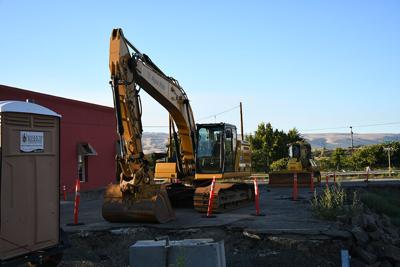
According to Community Development Director Joshua Chandler, construction ceased immediately after the discovery occurred in a corridor between Washington and Court streets, under and around where a new retaining wall is being built. Contractors then placed steel plates on top of the archaeological site, described as two 1x1 meter excavation units, and built “some walls around the area,” Chandler said.
Staff and engineers tried to raise the retaining wall to avoid disturbing the feature, but could only adjust “by inches” before compromising structural integrity. Oregon’s State Historic Preservation Office (SHPO) requires the city to perform data recovery, resulting in added costs (digging, processing, cataloging, specialist analysis, museum curation, and reporting). Archaeology now represents 14% of the First Street Streetscape’s total cost.
The site includes historic artifacts (things like bottles and similar material) and at least some evidence of Indigenous people’s presence in the area. AINW President and Senior Archaeologist Reese said the firm is deliberate in its lack of specificity to protect the area from illicit digging. Oregon law protects the location information of archaeological sites from public disclosure.
Even if some artifact descriptions could be shared legally, they recommended not doing so yet because the area is temporarily vulnerable during construction. Once the retaining wall and backfill are in place, the site will be better physically protected, and more information can likely be shared safely.
Though frustrated with the circumstances, emphasizing that the service agreement with AINW has more than doubled from original estimates, councilors ultimately yielded to the SHPO laws that bind them and passed the amendment 5-0.
They stressed wanting only the minimum work required to recover the data, not an open-ended dig, pressing staff to coordinate schedules better, restart construction as soon as possible, and explore working on other parts of the project in parallel to limit further delays.
“This is necessary work legally, and maybe it’s necessary work to some degree ethically, but it’s also necessary for us to fill the holes in and have our street back,” Councilor Dan Richardson said to Reese and Smits. “I just want to really impress on you that there’s necessary work, but we need you to guide yourselves within those parameters, that we’re not a lottery ticket.”
AINW has already achieved an updated archaeological permit from SHPO on an expedited basis, and will coordinate with the contractor (Ajax Northwest) for its return to work after SHPO’s recovery requirements are met.
•••
Our journalism needs your support. Subscribe and read more at columbiagorgenews.com.



Commented