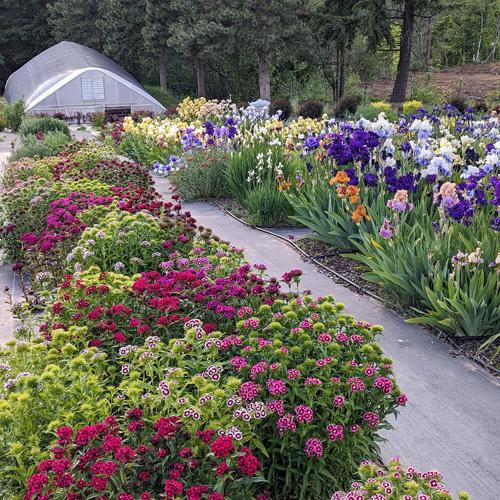
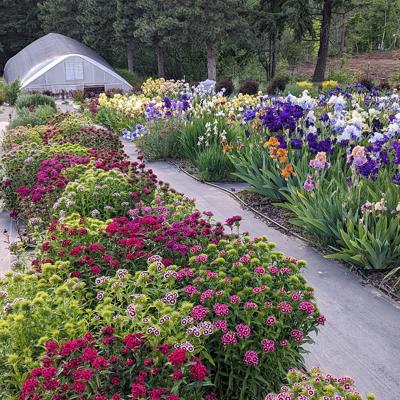
Apple Core Farm & Cut Flowers, located south of Odell, boasts colorful blooms inside and out. You can pick your own bouquet, put together your wedding flowers, or just enjoy the view. For a list of all farm offerings, see sidebar, below.
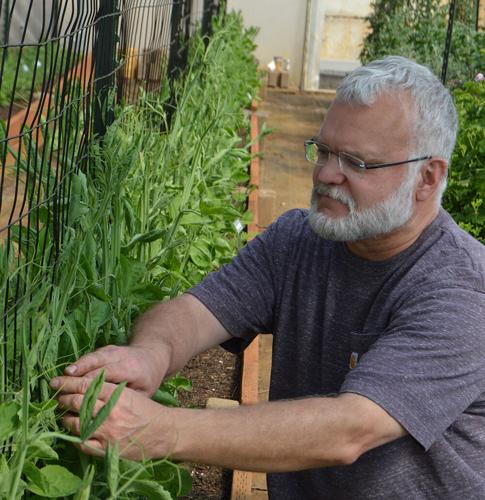
Matalucci tends to his sweet peas, located in one of his greenhouses. From early May until (usually) late June, guests can enjoy tea and pastries and, later, pick a bouquet of sweet peas to take home. Reservations are required.
Apple Core Farm & Cut Flowers, located south of Odell, boasts colorful blooms inside and out. You can pick your own bouquet, put together your wedding flowers, or just enjoy the view. For a list of all farm offerings, see sidebar, below.
HOOD RIVER — When life gives you overgrown Christmas trees, plant flowers. And apples.
Okay, that’s not quite how the saying goes, but it is what Paul Matalucci did. He owns and operates Apple Core Farm & Cut Flowers, a destination farm located at the end of Endow Drive, just south of Odell on Highway 35 (applecorefarm.com).
The farm is a peaceful retreat, where you can enjoy blooming sweet peas in one of the greenhouses (served with tea and pastries in May and June), learn the art of flower arranging in the barn, or walk around and admire the blooms — which are helpfully labeled for easy identification (see sidebar for details on all farm offerings).
“There’s sort of a craving for the farm experience — and I know this from having lived in the city,” Matalucci said. “So what I offer is the experience of just being here. And because the farm is spacious and attractive, I invite people to linger. They really soak it up. I think people have a strong need for spaces to feel joy and seek solace, and I’m happy to offer that.”
Matalucci tends to his sweet peas, located in one of his greenhouses. From early May until (usually) late June, guests can enjoy tea and pastries and, later, pick a bouquet of sweet peas to take home. Reservations are required.
Trisha Walker photo
When Matalucci and his husband, Tom Osborne, bought the 8-acre, former Christmas tree farm in 2018, its several hundred trees measured about 45 feet tall and were too close together to be useful. The trees were chopped and chipped in place one year; the following, a rotovator chewed up the stumps, roots, and top layer of mulch, leaving behind what Matalucci described as a “gorgeous” 10 inches of loamy soil.
“Mistakenly, it made me think our soil here was just really easy,” he said. “Turns out that below that is a hard pan clay.”
Once the trees were removed, the couple had a blank canvas and began thinking about what they would grow, wanting to preserve the land’s zoning as exclusive farm use (EFU).
“My husband has always loved apples, so we knew that we’d like to grow apples at some point, specifically thinking about heirloom apples,” Matalucci said. “We wanted to pick cultivars that people had never tasted before, give them an unusual flavor experience.”
The couple ultimately selected 13 cultivars from Temperate Orchard Conservancy, located in Molalla — eating apples with a firm flesh and sweet/tart taste.
“Three or four years ago, we were given scion wood from the Temperate Orchard Conservancy; we grafted that onto rootstock, and we started our first crop,” he said.
Osborne still has his day job — fraud and security — but when he retires in a year, he will focus on the orchard full time.
“Right now, we’re learning how to be farmers. We planted 60 apple trees in the back field, and that’s just our first attempt,” he said. “As we get better at it, we’ll plant more.”
But orchards take time to grow and produce fruit, so, in practical terms, planting flowers was the fastest way to generate income. The farm has row after row of tulips, peonies, David Austin roses, snapdragons, sunflowers, dahlias, zinnias, cosmos, and tall bearded iris (Matalucci’s favorite), as well as two greenhouses, where he produces flower starts in addition to chrysanthemums, eucalyptus and sweet peas — to name but a few, both inside and out.
“With cut flowers you can go from seed to income in a single season,” he said. “And I always wanted to grow flowers. I tell people I feel like I’ve been a flower farmer my whole life, but I took a 26-year detour into corporate America, and now I’m back on the right path for me.”
Matalucci specialized in internal employee communications, working with companies employing tens of thousands of people across different continents: He created strategies for leadership to communicate with employees, which in turn allowed those employees to voice questions or concerns back to leadership.
“It was all about the flow of information in a large corporation,” he said. “I was good at it, but I didn’t quite love it the same way that I love flower farming.”
Born in London, he lived in England until he was 10, when his Air Force father was transferred to Albuquerque. But the experience stuck with him.
“The British — their life is all about the garden and is such a big part of their identity,” he said. “Everybody has a garden or vegetables or flowers, that’s just the cultural norm.”
After 20 years in Albuquerque — where he learned to grow in a climate much different from London’s — he moved to Wisconsin for college, then to San Francisco, where he spent the next 28 years.
“When I moved to San Francisco, there was a long period where I couldn’t afford to have a garden,” Matalucci said. “I just lived in apartments that didn’t have land. So it wasn’t until Tom and I met that we could move to a place that had basically a 10-foot by 10-foot backyard, and that’s what I used to garden.”
In 2015, he became a Master Gardener through the University of California’s Extension program. And in 2020, when Matalucci and his husband decided to leave city life behind them and move to the Gorge permanently, he took the Master Gardening course through Oregon State Extension, in which he still participates.
Gardening is different from farming, but he’s found the community, including orchardists and his fellow Master Gardeners, to be generous with their knowledge.
“Most of the people we met in farming have opened up their hearts and their homes to us to say, ‘Here’s how you do it,’ and that’s been a wonderful gift,” Matalucci said.



Commented