
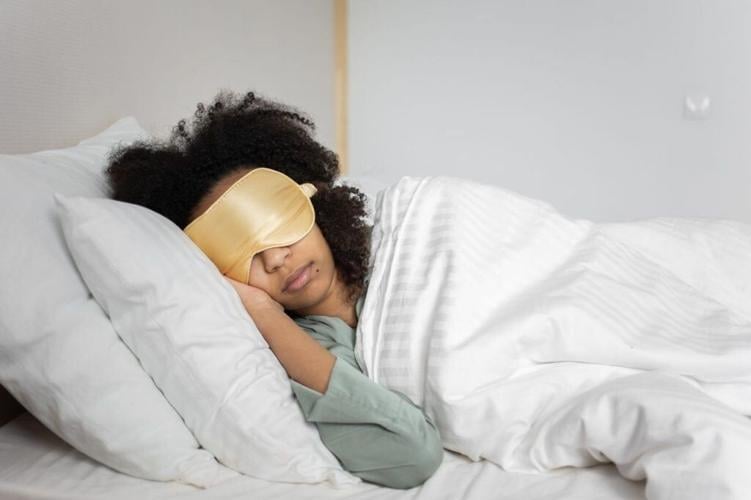

Photo by aslhndogan via Pexels
By Lauren Wilkin
Experts in sleep and neuroscience have issued a warning ahead of this year's clock change, comparing the health effects to jet lag.

Photo by BATRIN BOLOVTSOVA via Pexels

Photo by aslhndogan via Pexels
By Lauren Wilkin
Experts in sleep and neuroscience have issued a warning ahead of this year's clock change, comparing the health effects to jet lag.
The clocks are set to fall back on October 25 at 2 a.m., a day earlier than last year's October 26 clock change.
The UK will transition back to standard time from British Summer Time. And while that does mean we get an extra hour in bed, experts say it can wreak havoc on our health.
Dr. Eric Zhou, an associate professor at Harvard Medical School, says the change can disrupt our body clock.
"Changing the clocks twice a year throws off our circadian rhythm, which helps our bodies time everything from when we should sleep to hormone production," says Dr. Zhou, who is also a sleep medicine clinician-researcher.
"This can lead to sleep deprivation, increased stress, and more fatigue," he adds.
The expert, who is faculty in the division of sleep medicine at Harvard Medical School, also notes that data shows increased health risks that coincide with the clock changes.
He says: "There is intriguing data pointing to the increased risk for bad health outcomes, like strokes, heart attacks, and suicide rates."
Photo by BATRIN BOLOVTSOVA via Pexels
And he points to the American Academy of Sleep Medicine, which says: "Seasonal time changes should be abolished in favor of a fixed, national, year-round standard time."
Laura Bojarskaite, a neuroscientist and postdoctoral researcher of sleep at the University of Oslo, agrees.
She says that despite the autumn transition being easier than the spring - because we gain an hour of sleep rather than lose it - many people still experience a temporary "circadian disruption."
"The clock change essentially creates a mild form of social jet lag," explains Laura, whose sleep research has been published in Nature Communications.
"Our work schedules suddenly shift while our biological clocks remain on the old time."
"Most sleep scientists agree that eliminating the twice-yearly clock changes would be beneficial because our brains and bodies prefer stable timing cues," she explains.
"The healthiest clock is the one that changes the least."
The experts say that the best way to minimize these effects are to try and keep your routine as normal as possible.
That means avoiding lying in later than usual - as an extra hour in bed can quickly spiral to an extra few, and the negative effects will feel considerably more significant.
Originally published on talker.news, part of the BLOX Digital Content Exchange.
Information from the News and our advertisers (Want to add your business to this to this feed?)
Success! An email has been sent to with a link to confirm list signup.
Error! There was an error processing your request.
Sign up to receive notifications when a new Columbia Gorge News e-Edition is published.
Would you like to receive our news updates? Signup today!
Receive weekly updates on obituaries and death notices.
Oregon Capital Press presented by Columbia Gorge News
Receive updates on upcoming promotions and special sections.
Receive weekly updates on local sports news.


Sorry, an error occurred.
Already Subscribed!
Cancel anytime
Thank you .
Your account has been registered, and you are now logged in.
Check your email for details.
Submitting this form below will send a message to your email with a link to change your password.
An email message containing instructions on how to reset your password has been sent to the email address listed on your account.
No promotional rates found.
Secure & Encrypted
Thank you.
Your gift purchase was successful! Your purchase was successful, and you are now logged in.
| Rate: | |
| Begins: | |
| Transaction ID: |
A receipt was sent to your email.
Commented