
The Wild About Nature series will continue every Friday during the month of April at Mount Adams Grange in White Salmon. There is no charge to attend.
The first Wild About Nature presentation of the series was held in April 5 in the White Salmon Community Library and began with a reception for series organizer and artist Joy Markgraf. We were surrounded by her exquisite paintings of wildlife done on wild cherry bark.
Ignite the Future: Harnessing Beneficial Fire in the Cascades
Living in a Fire Landscape - Lucas King, member of the Mount Adams Prescribed Burn Association, provided information on the historic use of fire and tips and information on using prescribed burns to protect your house and property from intense wildfire.
FIRE IN THE GORGE Our Mid-Columbia area is experiencing larger and more intense wildfires including the massive Eagle Creek Fire, The Tunnel 5 Fire, and The Big Horn Fire. Why? Summers are hotter and drier than they used to be, true, but that is not the only reason. We have been suppressing fires for about 100 years. Now when they ignite, they have a lot more fuel to burn. The result is intense fires that scour the land.
King says historically some forests in our area burned with low to moderate severity every 1 to 35 years with less damage than today’s severe fires. Many trees survived these lower intensity fires. Ponderosa pines are built to withstand fire, with bark 3 to 5 inches think. They self-prune their lower branches which keeps fire from climbing the tree.
Is fire always the enemy? It can be a tool. Native Americans used controlled burning to preserve huckleberry fields, to aid game management, and kill pests like mosquitos and ticks. Now King and the Mount Adams Prescribed Burn Association are advocating for the use of prescribed burns, which are the “planned, skilled application of fire at the right time and in the right place to meet specific objectives.” Just thinning trees to reduce the fire load is not as effective as thinning plus controlled burning along the ground, as evidenced in the Sycan Marsh preserve fire in south central Oregon. Here is a link to the Sycan Marsh Preserve case study, https://www.nature.org/en-us/about-us/where-we-work/united-states/oregon/stories-in-oregon/climate-change-wildfire-recovery/
The Suksdorf Native Plant Society was one of the sponsors of the Wild About Nature series, and many members were in attendance. There were some questions about how well wildflowers and other ecosystem components would survive burns. King says Balsam Root and many others species are fire adapted and flourish after prescribed fires. An enthusiastic advocate of controlled burns, King was still open to working with wildflower experts about how to mitigate possible ill effects on more tender woodland species. There was discussion about eliminating the understory in wetter western forests. “What is ladder fuel to you are treasures to me: Ocean Spray, service berry, vine maple, dogwood,” suggested one audience member. King later clarified that in most cases prescribed burns are patchy, leaving swaths of understory vegetation intact. They are done on only a small unit of a larger woodland site, leaving refugia for sensitive species. All agreed a prescribed burn would be far less damaging than a high intensity wild fire.
King points out that fire efforts are more effective if a neighborhood or a larger community work together. He invites you to join the email list, come out and watch a burn, assist at a burn to practice, and/or host a burn on your property. You can contact Lucas King at lucas@mtadamsstewards.org. Our conservation districts can also help with fire plans and advice on fire wise landscaping.
Lichens and the Environment by Katherine Glew, PhD
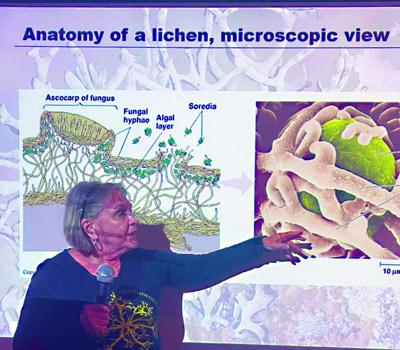
Fascinating composite beings, lichens are formed by the symbiotic relationship between an alga and a fungus, and appear as one organism. (Freddy Fungus took a lichen (liking) to Alice Alga is a fun way to remember this combo.) Algae convert the sun’s energy to food by photosynthesis and share that food with fungi. In return, fungi provide protective structures to house the algae. The fungi are by far the larger part of the pair in size. Likewise the fungal partners are more numerous, 1,500 in Washington state, whereas there only 45 different photobionts (mainly algae) partners. The fungal hyphae look like arms which embrace the green algal cell.
Animal, vegetable, or mineral? Now we have more kingdoms to choose from than the plant or animal choice available back in the day. Some lichens represent three kingdoms: are Fungal, Protista, and Bacteria,Lichens come in three forms: Foliose (leafy), Fruticose, (hairy, shrubby) and Crustose, (crusty, like those on rocks or fences).
Lichen have survived even in the harshness of Space. They can temporarily shut down their life processes. Then they reactivate after being spritzed with water, even after 18 months on the outside of a space capsule.
Fungi and the Great Depression- part of what caused the Great Depression in the 1930’s was The Dust Bowl. The soil had been plowed and trampled by range animals. Then it blew away in huge storms of dust. In arid areas extensive carpets of lichens, bryophytes and cyanobacteria are called BIOLOGICAL SOIL CRUSTS and one of their major functions is erosion control. Leave them in place and no more dust bowl.
Is it heathy that my trees have so much lichen on them? Yes! Lichens are accurate and no-cost indicators of air pollution. An abundance of lichens usually indicates clean air.
Are lichens useful for anything besides pollution gauges? Yes! When fermented with ammonia they make beautiful natural dyes, as seen in the Native American Chilkat Blanket. Scottish kilts are also from lichen and plant dyes, nitrogen fixation by lichens adds valuable fertilizer to the ecosystem, and they aid in mineral recycling when falling out of trees to add to the soil below or by breaking down rocks.
The Wild About Nature Series brings amazing experts to our small town. Katherine Glew is a lichenologist with a PhD in botany. She has studied lichens for over 40 years in forest, alpine and island ecosystems and is the Associate Curator of Lichens at the University of Washington Herbarium.


Commented