Welcome to February, our shortest month. Those with winter doldrums will be happy to know that during February, we gain almost an hour and a half of day length during the month. At the end of February, sunrise will come at about 6:45 a.m., sunset at about 5:51p.m.
Feb. 2 is Groundhog Day, when Punxsutawney Phil (yes, I had to look up the spelling) checks to see if his shadow is visible. The event comes from German and Celtic festivals associated with early February, which is half way between the winter solstice and spring equinox. It is called a “cross-quarter” day. Other cross-quarter days are May Day, half way between the first of spring and summer, Lammas, in early August, and Halloween, half way between the autumnal equinox and winter solstice.
February will also be a “black moon” month for us. That simply means there will be no new moon in February. We’ll have a new moon on Jan. 31, and one again on March 2. This happens infrequently, about once every 19 years.
The bright planets are just about gone from the evening sky in February. Jupiter is low in the southwest after sunset, but getting hard to see as it gets lower in the sky and has to compete with the light from the setting Sun. Neptune and Uranus are in the evening sky, but difficult to see. Uranus is technically visible to the naked eye, but not brighter than nearby stars. Neptune is too dim to see with the naked eye.
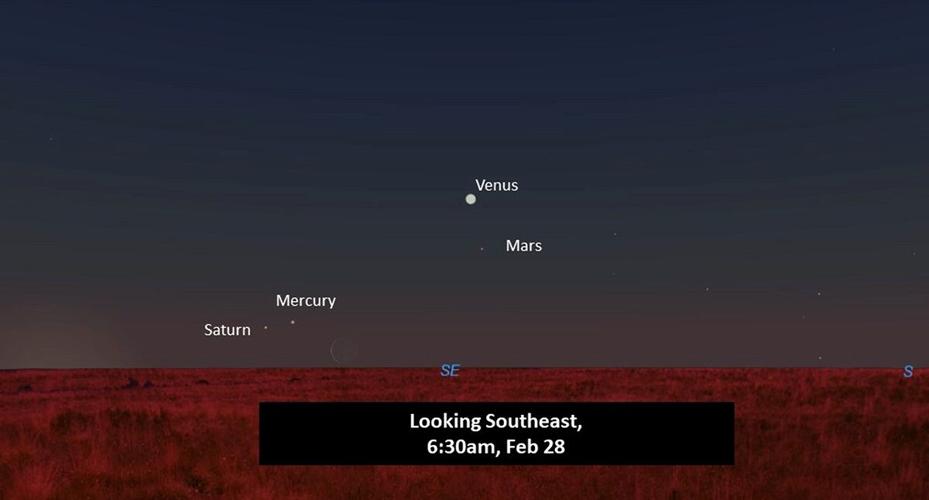
Early morning is the time to see planets in February. Venus will be quite bright, in the southeast before sunrise. Look for Mercury to the left of Venus, lower in the sky but brighter than nearby stars. Mars is below Venus as well, to the right of Venus early in the month, and below Venus later in the month. At the end of February, Saturn will join the party, very low in the sky, to the left of Venus and Mercury. On the 28th, a very faint waning crescent Moon will be just to the right of Saturn and Mercury. Look at about 6:30 a.m. You’ll need a good view of the southeastern horizon, and binoculars, to pick out the Moon. And, of course, clear skies!
Winter constellations continue to dominate the evening sky in February, with brilliant Orion leading the way. Taurus the Bull, and Gemini the twins, are above and to the left (Gemini) and right (Taurus) of Orion. Look straight up for Auriga, and its bright star Capella, which glides high overhead.
But spring constellations are beginning to show up in the east. Leo the lion will be above the eastern horizon by 8 p.m. early in the month, and high in the southeastern sky at the end of the month. Ursa Major and its Big Dipper will be in the northeastern sky, with the dipper’s “handle” pointing down. If you look straight up in February, you’ll see the bright star Capella, in the constellation Auriga.
When the clouds part, bundle up and enjoy February’s night skies!




Commented