

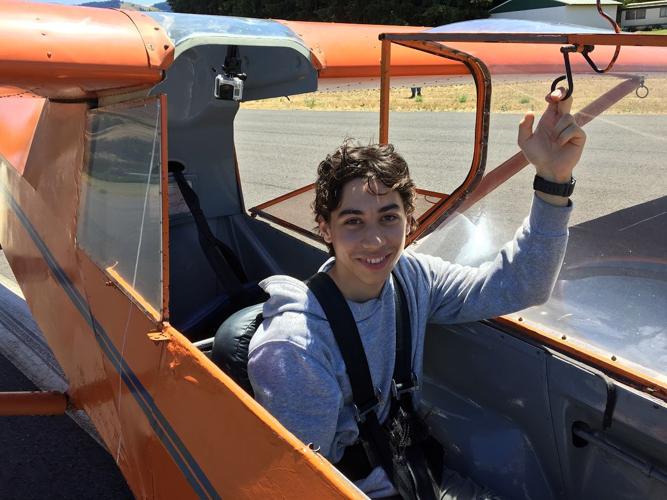
There’s a new nonprofit in town encouraging community youth to reach for the sky.
Quite literally.
Hood River Soaring, incorporated as a nonprofit in February, started out “with nothing except five people who got together with the mission to make this happen,” said Paul Woolery, one of the founding members. “We’ve managed to put together seed money and donations, and we’ve purchased a training glider and started giving lessons (in June).”
Hood River Soaring’s mission is “promote the art and science of soaring by making the sport more accessible to all, including special outreach to youth,” according to its website, hoodriversoaring.org.
Based on the jump in membership to 24 since opening it up to the public a couple of months ago, they’ve hit upon an aviation need. But they’d like to see even more participation, particularly by youth — right now, there are only two teen members.
To that end, Hood River Soaring’s youth program provides assistance to help kids get started in two ways: A work-study program, providing financial assistance for the cost of glider flying lessons in exchange for service on the ground crew and general club operations, and scholarships to pay for soaring instruction and glider pilot certification, the details of which are still being developed.
Woolery is motivated to grow the program in part because he started so late himself.
“I soloed at the age of 60, started training at 59, and I’ve been really enthusiastic about the sport,” he explained. “But I’m well aware of the fact that starting late in life holds you back. It’s such an amazing experience, especially for young people, to build confidence and really rapidly mature.”
Board Member Cory Roeseler agrees.
“I waited until I was 45 and I’m 46 now, learning to soar,” he said. “Hood River had all these great outdoor activities, but I think the aviation opportunities aren’t as well known among the young crowd, how accessible it is.”
Of the two youth members — Nathan Fuentes and Francisco Naylor, both 15 — Fuentes has already received his pilot’s certification and gone solo.
Fuentes began flying a couple of years ago, focusing on single engine planes, but “got to the point where I was limited by my age and couldn’t solo,” he said — just like with driving, pilot’s licenses can be obtained at age 16 — so he began to pursue gliding. He’d hoped to solo by age 14, but the gliding club he’d joined prior to Hood River Soaring closed before he was able; his first solo ride was just this year.
Now, he’s working towards his pilot license, studying and building his solo hours in the glider.
“I’ve always been interested in aviation, and then gliding was fairly recent, just the past couple of years,” Fuentes said. “Eventually, I’m hoping to do something in aviation. I don’t know (what) yet, maybe helicopters, maybe corporate.”
“Nathan is the poster child; he’s every aviator’s dream of what a young man should be doing with his time,” said Roeseler.
“Nathan is an extraordinary young man,” said Woolery. “I don’t know when I’ve met someone as focused and mature at his age as he is. I really admire him.
“The sense of what you’re capable of increases exponentially when you fly,” he added. “The sense of confidence it can build in a young person, it’s hard to overstate how valuable that can be. It also grows you up fast — you are faced with very important decisions, you really have to make good, responsible, mature decisions and it really compels people to learn.”
But just because a kid shows interest in soaring doesn’t mean they’ll automatically go up.
“We start making those judgements about youngsters on the ground,” Woolery said. “We access their capabilities and whether they’re ready to take this on in the ground crew operations, which allows us to really evaluate that level of maturity and that attentiveness needed to fly responsibly.”
Up in the air, “you feel like you have a really good field of view,” Fuentes said, because of the large glass canopy. “And what’s really cool about gliders is they’re really quiet. They don’t have any engine, so the only sound is the wind.”
The cost of flying a glider is less than a plane with an engine, said Roeseler, plus the aviation community in Hood River is a supportive one.
“You don’t have to be a gazillionaire. Having money is helpful, but having an open willingness to go to the airport and make new friends and express your desire to learn to fly, that’s half the battle,” he said.
“It’s not stuffy — the aviation community is personable and approachable … it’s not the cheapest activity, but it does help that people are open with their experiences and willing to share with rides and stuff.”
For more about Hood River Soaring or to make a donation to the youth program or organization, Woolery recommends visiting the nonprofit’s website. Members also give glider rides, a source of revenue for their continuing work — details are listed on the website.
“While people are enjoying the experience of soaring above the valley, they can also enjoy knowing that the money they paid for the ride is going to a good cause,” Woolery said.


Commented