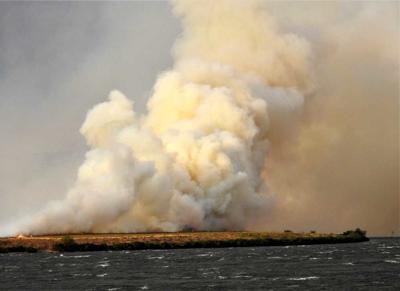
A lightning-sparked wildfire sweeps across Miller Island, east of The Dalles, on Tuesday, July 23, as the 2019 fire season begins.
Gary Elkinton photo/contributed
Fire knows no boundaries, engulfing private, state and federal lands with no regard for ownership or agency boundaries, and when fires run wild, coordination and cooperation between local, state and multiple federal fire agencies is critical in minimizing loss.
For many years, the Bureau of Land Management and the U.S. Forest Service have had cooperative agreements with local fire departments in the region, ensuring an “all hands on deck” response to the fast-moving, wind-driven wildfires we have every year east of the High Cascades.
That “all hands on deck” response is now at risk, as federal agency rules put local and state cooperative agreements in jeopardy even as we enter the fire season.
On July 22, U.S. Representative Greg Walden (R-OR) and Senators Ron Wyden (D-OR) and Jeff Merkley (D-OR) expressed concern that a number of local fire departments in the region may no longer be able to serve as partners to the federal government in fighting wildfires.
In a letter to Department of Agriculture Secretary Sonny Perdue and Department of Interior Secretary David Bernhardt, the congressmen noted that although the agencies have decided to allow existing cooperative agreements to remain in place for the 2019 fire season, that short-term fix has gaps that will prevent a number of “highly qualified fire professionals from serving on incident management teams.”
“We have not heard any compelling reason why your agencies cannot renew these longstanding agreements through this fire season. While we understand there are workarounds that would require very seasoned professionals, with years of experience, to work at very low wages, these solutions would not provide funds for fire departments to ‘backfill’ positions and therefore will not meet the needs of our local departments,” Walden, Wyden, and Merkley wrote.
“We would appreciate your best efforts to address concerns of state and local fire departments, which are ready to help and interested in a fair and equitable long-term solution. These professionals, with long-term agreements that are in flux for this fire season, should have the opportunity to contribute and help battle the inevitable fires.”
It’s unclear what Perdue and Bernhardt are trying to accomplish by curtailing such agreements, but as Oregon trio wrote in their letter, “fire season is here, and fire danger is increasing.”
That such a situation exists at the end of July is astonishing; last summer’s wildfires in south Wasco and Sherman counties illustrated the value of such agreements, even as they revealed concerning gaps in fire response, jurisdictional “no man lands” where the fires were able to move and grow. Reducing federal support and cooperation at the local level is clearly the wrong path to be taking.
Hopefully, the combined voices of our bi-partisan representatives Walden, Wyden and Merkley will serve as the goad Perdue and Bernhardt need to get their heads out of the ashes and properly manage their departments—preferably before somebody parks in the grass and sets off this year’s inferno.



Commented