
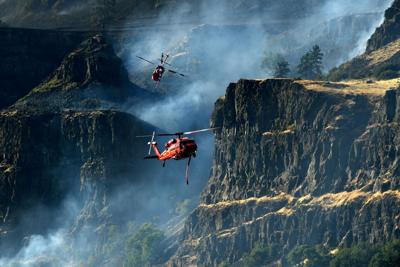
LYLE — Klickitat County Commissioners held a special post-fire meeting Aug. 6 at the Lyle Lions Club Community Center in Lyle.
The meeting was divided into two parts. All three commissioners were present for the first event, which began at 2 p.m., a listening session where they heard compliments and complaints.
It also gave officials a chance to correct some misconceptions. Some voiced a real concern that fire crews from the Department of Natural Resources (DNR) would not help defend structures, even when seriously threatened.
Peter Lovejoy, a local 24-year veteran firefighter had a detailed response:
“I'm not affiliated with DNR,” he said, “but their staff isn't trained to put out a structure fire. Their engines have small pumps and small posts. They flow a tiny fraction of water in gallons per minute compared to a structure engine. They don't have the right turnouts, they don't have breathing apparatus, they have none of the right gear. They just aren't equipped to deal with structure fires. So I understand their policy. They will try and save your structure. They'll be back burns around it. They'll prep the site to do everything they can to keep your structure from catching on fire. But once it is, they can't do anything about it. It's not that they won't, they just aren't in a position.”
Other key concerns expressed at the meeting involved:
Need for better communication. There was a critical need for a single, credible, and accessible source of information during the emergency. Information was often slow to arrive, conflicting, or unavailable to those without smartphones or internet access.
Confusion over chain of command. Residents were unclear about which agency or official was in charge of decisions, particularly regarding evacuation levels. This created confusion and undermined trust.
Inconsistent evacuation protocols. The process for evacuations was perceived as inconsistent and poorly communicated. Residents received conflicting information about their evacuation levels and were frustrated by long, unexplained periods of being barred from their properties. This led some to state they would not evacuate in the future.
Inter-agency cooperation. There was a perception that different agencies and elected leaders were not working together effectively, which hampered the emergency response.
Resource and support needs. Residents raised urgent needs for assistance with debris removal from burned properties, help removing hazardous trees, and financial resources for rebuilding. Unfortunately, they were told, Washington does not have a program similar to the one offered by the Oregon Department of Environmental Quality (DEQ), in which the agency supervised and paid for cleanup of hazardous materials in the Rowena Fire.
Volunteer and agency conduct. While there was immense gratitude for firefighters and many volunteers, some residents reported negative interactions with posse members at roadblocks, citing a need for better training in public interaction during a crisis.
Homeowner's insurance crisis. A significant and growing number of residents reported being dropped by their homeowner's insurance companies, creating a major barrier to recovery and future security in the county.
Concerns about future risks. Issues such as the danger of fireworks, trains carrying explosive fuel during the fire, and the need to bury power lines were raised as preventable risks that needed to be addressed. The loudest and most fervent applause and cheering at the event came when someone suggested that fireworks be permanently banned in the county except for New Year’s Eve, when the risk is significantly lower.
The special listening session meeting was followed at 4 p.m. by an event just for people who had losses related to the fires. Volunteers from various agencies signed people up for services and provided them with supplies and advice.


Commented