If you’re like so many of us in America, you may find yourself mowing your lawn regularly at this time of year. You may well love your lawn, and I may not convince you otherwise. But what if it could be so much more? What if it could become a space that feeds your family and pollinators? What if it could actually help regenerate the soil and help the planet?
What is regenerative planting, you might be wondering? As the article “Regenerative Agriculture: What It Means and How to Apply It To Our Home Gardens” explains, this sort of planting seeks to remediate ways of gardening that are more resource-intensive, like lawns, and “improve our soil, preserve our water, and enhance biodiversity.” It is often used in the context of industrial monocultural agricultural systems, but we can apply this approach to our own front (or back) yards and do our small part to address some of the practices that contribute to climate change.
While having a front lawn does not inherently mean that we are hurting the environment, we can make different choices about how we use that space that might better serve the planet in terms of soil, water, and habitat. Maintaining a well-manicured and green lawn requires regular watering, and in a place like the Gorge, where water is an increasingly scarce resource, that means using water at a time when we should be thinking about how to conserve it. Also, lush green lawns are often made possible by fossil fuels in one way or another (running a gas-powered mower, using fertilizers, etc).
But where to start? Replacing lawn with diverse plantings and garden beds might seem like it will be a labor-intensive proposition, but it doesn’t need to be. You could, of course, get a turf cutter and remove the grass. That takes time, and it would mean renting a machine. You may want to do that, but if not, you could consider two other options that are less time-consuming but require a little patience.
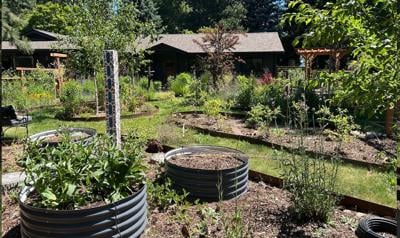
First, you could use the tarping method and cover any grass you wanted to get rid of with heavy plastic, which will use the power of the sun to kill off any grass or weeds below the plastic’s surface. This method takes several months or so to be effective. Another method you can use is sheet mulching, which involves covering grass you want to eliminate with cardboard, wetting it, then covering that with a thick layer of mulch (and compost before the mulch, if you wish). Sheet mulching can be very effective, especially with grasses that do not have dense rhizomes. This is the method I used in my own front yard, just one year ago. The above is of my yard now, which integrates pollinator-friendly and edible plants (fruits, vegetables, and herbs). And boy, do we have a lot of life underground now!
How might replacing your lawn put into practice the three elements of regenerative agriculture (improving soil, replacing water, increasing biodiversity)? Especially with the sheet mulching method, you are actually adding carbon back into the soil and improving soil structure and supporting a range of creatures under the surface. As the cardboard breaks down and mingles with the mulch and compost, it combines with the soil that was already there to become an ideal habitat for worms, beetles, and a variety of underground life that not only continue to nourish the soil, but also the root systems of any plants you ultimately plant there. This enriched soil will be better positioned to support plants, insects, and invertebrates. And, this more nourished soil with improved structure will retain water better than a depleted one.
This newly-enriched landscape space you’ve created can also support biodiverse habitat above ground. After about six months of breaking down (or once your lawn is removed using the other methods), your space will be ready for planting. And it is at this point that you can really think hard about how best to maximize your planting for biodiversity and water usage in mind.
As you get ready to plant, consider not only shade, sun, etc, but also how you might use pollinator- and wildlife-friendly plantings to support a range of birds, insects, and more, all of whom serve an important role in sustaining a healthy ecosystem. To maximize this sustainability and support, you might focus on native plants, which are uniquely adapted to the conditions and species right here in the Gorge. Consider growing food in and amongst your flowers. There’s no reason why you necessarily have to grow flowers and vegetables in separate areas. Not only will they look great together, but the flowers (especially natives) will help attract pollinators for your fruit and vegetables and beneficial insects to help them grow well.
Regenerative planting prioritizes working with nature rather than trying to change it, and it’s worth giving a try. If you’re interested in knowing more about how to make your front lawn a regenerative space, or about regenerative agriculture in general, have a look at the articles at the end of this piece. You might also join the Central Gorge Master Gardener Association on September 12 from 9am-1pm for our Front Yard Garden Tour, which features gardens that approach some of these issues in creative ways that might work in your own yards. For more information, see this link or go to the QR code below.
Central Gorge Master Gardener volunteers provide free beginning gardening classes and continuing education to home gardeners. For research based information about specific gardening or pest questions, submit your concern online at extension.oregonstate.edu/mg/hoodriver or by phone at 541-386-3343. Home gardeners can also drop off plant or pest samples Monday - Thursday between 9 AM and 4 PM at the OSU Hood River County Extension Service, 2990 Experiment Station Drive, Hood River, OR.
The Central Gorge Master Gardener program is a division of the OSU Hood River County Extension Service. OSU Extension Service prohibits discrimination in all its programs, services, activities, and materials.



Commented