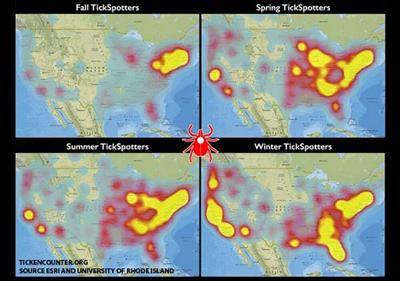
This graphic from “What To Know About Tick Season,” by Richard Horowitz, highlights high tick areas in each of the four seasons across the United States.
Graphic courtesy Environmental Systems Research Institute and University of Rhode Island
This graphic from “What To Know About Tick Season,” by Richard Horowitz, highlights high tick areas in each of the four seasons across the United States.
Graphic courtesy Environmental Systems Research Institute and University of Rhode Island
As spring temperatures rise, so does the risk of tick bites — and with them, the growing threat of Lyme disease and other tick-borne illnesses. Every year, countless individuals suffer health issues from infections that could have been prevented with a little awareness and preparation.
The Centers for Disease Control and Prevention (CDC) predicts high tick activity this season in the Northeast, Midwest, and Pacific Northwest. However, no area is entirely safe — tick-borne illnesses have now appeared in every state, and the numbers are alarming:
• The CDC now estimates more than 476,000 new Lyme disease cases each year, and Medicare data suggests actual rates could be seven times higher.
• Ticks are spreading beyond their traditional habitats. Lyme is no longer just a Northeast problem — it’s been reported in all 50 states.
• Up to 50% of ticks in some areas carry harmful pathogens.
• Lyme isn’t the only concern. There are more than 20 different tick-borne diseases, including Babesia, Bartonella, Anaplasmosis, Ehrlichia, and the potentially deadly Powassan virus. Some of these can be transmitted in as little as 15 minutes after a bite.
You can significantly reduce your risk by taking these precautions:
• Wear light-colored clothing when outdoors — ticks are easier to spot.
• Use tick repellents: 20% picaridin spray is a favorite among experts, and IR3535 is another option.
• Treat clothing with permethrin, or buy pre-treated outdoor wear. Never spray permethrin while wearing the clothes.
• Shower after outdoor activities: Ticks take time to attach, so washing up quickly can help. Toss clothes in a hot dryer for 10–15 minutes to kill any hidden ticks.
• Do thorough tick checks, especially in hidden spots like the scalp, underarms, behind knees, and waistband areas.
Most tick-borne diseases are preventable with the right precautions. As tick season kicks into high gear, take steps now to protect yourself and your loved ones. A little prevention goes a long way.
If you find a tick
• Remove it promptly with fine-tipped tweezers, pulling straight up from the skin. More information on tick removal and testing can be found at tickease.com/
• Clean the area with alcohol or soap and water.
• Save the tick in a sealed container — you can send it out for testing. It’s much easier and significantly cheaper to test the tick than it is to test a person. An infected person may take weeks or months to test positive. Tests catch only about 50% of the cases. Tick testing only takes 24-48 hours (testing sites are listed below).
• Watch for symptoms like rash, fever, fatigue, or joint pain in the days or weeks after a bite.
If the tick was attached for several hours or seemed engorged, there may be a risk of infection — even if you removed it carefully. While some sources say Lyme takes more than 24 hours to transmit, it may happen faster if the tick had previously fed on another host.
Consider seeking preventive treatment if:
• The tick was engorged or hard to remove.
• You were in a high-risk area.
• You develop flu-like symptoms, rashes, neurological changes, or joint pain.
A short course of doxycycline (7–10 days) may help prevent infection if taken early. It’s generally safe for adults, children, and pregnant women in short-term doses, and contrary to old concerns, doxycycline does not stain teeth like older antibiotics. If symptoms develop, ask your doctor about testing for co-infections like Bartonella, Babesia, Ehrlichia, and Anaplasma, which often require different treatments.
Editor’s Note: Always consult your doctor for treatment and testing.
•••
Mary Jane Heppe has been a national advocate and educator on Lyme disease since 2006. She has consulted with patients across the U.S., spoken in Washington, D.C., and, alongside her late husband Steve, worked closely with Oregon legislators in 2013–2014 to support a bill that would have given physicians more flexibility in diagnosing and treating Lyme disease. Although the bill did not pass, Heppe continues to passionately support both local patients and those nationwide.



Commented