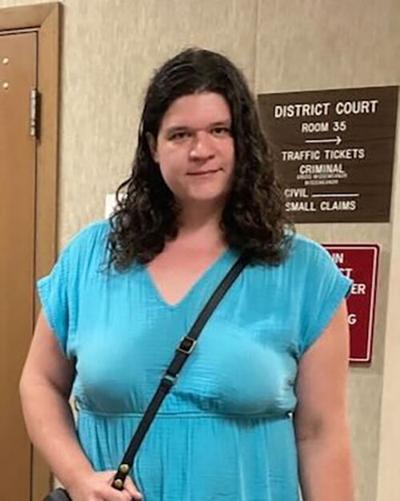
STEVENSON — Stevenson city council member Lucy Lauser is one step closer to facing a jury trial on indecent exposure charges, after a district court judge denied her motion to dismiss the case.
Lauser, a transgender woman, was arrested July 4 as she stood on the Skamania Courthouse lawn, wearing no top but with her nipples covered by black tape. She held a sign that said “The President says I’m a man” on one side, and “My body is not obscene, stop sexualizing trans people” on the other.
Lauser has always maintained that her actions were a political protest.
On Nov. 17 in Skamania County District Court, her attorney, Brian Pruett, argued for dismissal under a practice known as a Knapstand motion, which makes the claim that the evidence cannot support a guilty finding. On Dec. 2, Judge Ronald H. Reynier ruled against her.
“The evidence could justify an inference of liability by jurors to support a finding of guilty,” he wrote.
Knapstad motions go back to a 1986 Washington Supreme Court ruling in favor of a defendant named Douglas Knapstad. That case found that criminal defendants can request dismissal prior to a trial, if both sides agree on the facts, yet prosecutors’ evidence is insufficient for a jury to come to a guilty verdict.
Lauser’s attorney argued exactly that. He wrote that the case hinged on “whether Ms. Lauser’s conduct was ‘obscene’ or conduct that would be considered protected speech” under the U.S. Constitution. His motion to dismiss argued that her conduct was not offensive but was a serious political statement, and, based on the facts that both sides agreed on, she was not even nude.
“She did not display her genitalia or…anything that depicted sexual conduct,” the Knapstad motion said. “Her protest was not intended to appeal to the sexual interests of any person, in fact…that was opposite [her] intention. And the conduct had political values as she was protesting the President’s stated view of transgendered persons.”
It also said that Lauser’s protest was held at an appropriate place and time — July 4 outside the county courthouse.
But when ruling on a Knapstad motion, judges are required to weigh evidence that would be presented to a jury in a way that is most favorable to the prosecution. In this case, Skamania County deputy prosecuting attorney Elise Howard had argued that Lauser’s protest wasn’t clear enough to be constitutionally protected.
A nonverbal expression of protest, Howard said, “is often protected, but there are exceptions when public decency laws are violated or if the message is unable to be understood by those in view.”
In her motion against dismissal, she had asked the court to find that there is “at least a possibility that a reasonable juror” might decide Lauser’s actions were not understood as a protest, or were sexual in a way that violated community standards.
Judge Reynier agreed that was a possibility. Given “all evidence and inferences in a light most favorable to the prosecution,” he wrote, jurors could find Lauser guilty of indecent exposure.
Lauser says she is not surprised. “I never expect to be treated fairly and my expectations are usually met,” she told Uplift Local.
A trial date is expected to be scheduled at a hearing later this month. However, Lauser told Uplift Local she is considering an appeal of Reynier’s ruling, which could potentially affect a trial timeline.
•••
Emily Harris is a co-founder and Uplift Local’s Community Journalism Director, overseeing the local newsroom network and the Documenters program.



Commented